THE CLASSIC COLLECTION✦An outlaw’s diary: the CommuneCLASSIC FREE BOOKS
An outlaw’s diary: the Commune
Cécile Tormay
THE CLASSIC COLLECTION · 1909
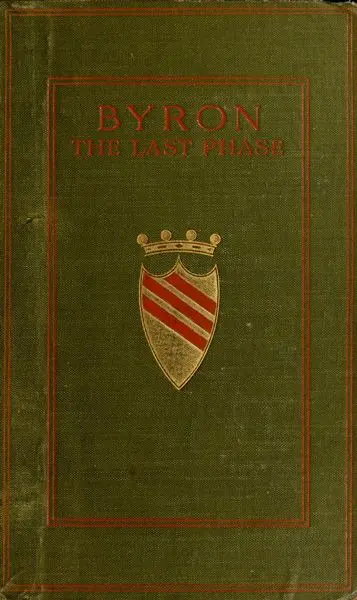
"Byron: The Last Phase" by Richard Edgcumbe is a historical account written in the early 20th century. The work delves into the latter years of the life of Lord Byron, revealing how his experiences and personal transformations, especially during his time in Italy and Greece, diverged from the notorious public persona he had acquired earlier in his life. The narrative particularly focuses on unexplored elements of Byron's character and relationships, particularly involving his friends and lovers. The opening of this biography sets the scene in Pisa around 1821, where Byron has recently arrived with an entourage that includes not just servants but also various pets. Edgcumbe introduces the reader to a contrasting view of Byron—he is described as being visibly changed from the man he once was, showing a disposition more sociable and compassionate. The text meticulously details Byron's physical appearance through the eyes of those who met him, while also hinting at the tumultuous nature of his personal life, including references to his estranged relationships and the lingering impact of his separation from his wife. The introduction builds intrigue around Byron's psychological state and contributions to the Greek War of Independence, setting the stage for a detailed exploration of his character during this pivotal period.
Introduction adapted from the source catalogue; source summaries may be automatically generated.
Free to read · English · 129,526 words · No account needed
MAKE TIME FOR A GOOD BOOK
On by default. Untick to stop anonymous reading totals. Each page counts after 10 seconds in view. How this works.
Anonymous counting is on unless you have switched it off.
Odysseus, Greek insurgent leader:
his opposition to Mavrocordato, 153;
and Trelawny, 179, 180
Osborne, Lord Sidney, and Sir Thomas Maitland, 115;
goes to Missolonghi, 198;
eulogy of Byron's conduct in Greece, 201
Parry, Major:
his arrival at Missolonghi, 91, 92;
his peculiarities, 92 et seq.;
practical joke on, 95;
on Byron's intentions in Greece, 97, 98;
on the relationship between Mavrocordato and Byron, 116;
on Byron's mode of reproof, 117;
account of Byron's illness, 121;
anecdote of Jerry Bentham's Cruise, 126;
Turkish brig-of-war ashore, 139;
artillery at Missolonghi, 144;
on Byron's mode of life, 145;
on Byron's power in Greece, 151, 152;
Byron's last illness and death, 164 et seq., 196;
his opinion of Byron, 175
Phillips, Thomas, his portrait of Byron, 9
Pigot, Elizabeth, Byron's letters to, 222, 223
Pisa: Shelley's description of, 3;
Byron's life at, 20
Po, Stanzas to the, what they reveal, 298 et seq., 370
Pope, Alexander, Homer, 51
Prothero, Rowland E.:
Letters and Journals of Lord Byron, 70 n., 125, 256 n., 260 n., 383
Quarterly Review, the, 50, 100
Recollections of a Long Life. See Broughton, Lord
Roberts, Captain, describes the wreck of The Bolivar, 33
Robertson, Rev. Frederick, Lady Byron's spiritual adviser, 324
Robinson, Crabb, 77
Romilly, Sir Samuel, consulted by Lady Byron, 338
Salona, Congress at, 152, 153
Sanders, Mr. George, painter, his portrait of Byron, 9
Sardanapalus, a tragedy, 101
Sass, Lieutenant, death of, 141
Schilitzy, a Greek, accompanies Byron to Greece, 47
Scott, Captain, commands the Hercules, in which Byron travels to
Greece, 47
Scott, Dr., surgeon, and Byron, 54, 58
Scott, Sir Walter:
Byron's opinion of, 35, 51, 55, 79;
his denial of the authorship of the Waverley Novels, 53
Segati, Marianna, Byron's liaison with, 371
Shakespeare, William, Byron's opinion of, 101
Shelley, Percy Bysshe:
describes Pisa, 3;
and Byron, 11 et seq.;
fracas at Pisa, 20, 21;
and Allegra, 22;
leaves Pisa for Lerici, 26;
and Leigh Hunt, 26 et seq.;
his death, 30;
Byron's opinion of, 30, 35;
his legacy to Byron, 32
Shelley, Life and Letters of Mary Wollstonecraft, by Mrs. Julian
Marshall, 178
Stanhope, Col. the Hon. Leicester:
arrives in Cephalonia to co-operate with Byron, 68;
on Byron's character, 78, 174;
begs Byron to come to Missolonghi, 81;
on Byron's conduct in Greece, 91, 107;
interviews and misunderstandings with Byron, 108 et seq.;
his conduct in Greece, 119, 153;
accompanies Byron's body to England, 199, 202;
Greece in 1823 and 1824, and Sketch of Byron, 201;
character sketch of Byron, 205 et seq.
Stanhope, Earl, historian, opinion of Mrs. Leigh, 318
Stephen, Sir Leslie, and Mrs. Leigh's letters, 357
Stowe. See Beecher Stowe
Stravolemo, Dr., physician, and Dr. Bruno, 79
Suliotes:
Byron takes 500 into his pay, 91;
false alarm, 123;
serious fracas, 140;
their dismissal, 142
Swift, William, bootmaker at Southwell, his evidence of Byron's
lameness, 8
Taaffe, Mr., fracas at Pisa, 20, 21
Thomas, Dr., invited to attend Byron in his last illness, 168, 193 et
seq.
Thorwaldsen, his marble bust of Byron, 10
Thyrza poems, what they reveal, 221, 232, 235
Tita, Giovanni Battista Falcieri, Byron's faithful servant, 97, 166, 169
et seq.
Toole, Mr., receives Byron at Santa Eufemia, 60
Your reading position is saved on this browser. Take it to another device with a library code. Reading pages adapt to text, rather than matching a printed edition.
BEHIND THE BOOK
This eBook is for the use of anyone anywhere in the United States and most other parts of the world at no cost and with almost no restrictions whatsoever. You may copy it, give it away or re-use it under the terms of the Project Gutenberg License included with this eBook or online at www.gutenberg.org. If you are not located in the United States, you will have to check the laws of the country where you are located before using this eBook. Read the source licence.
The original source file, including credits and licence, is retained by this library. Request an original-format copy at no charge. Please include the book title and Project Gutenberg identifier #41809.
KEEP YOUR CURIOSITY GOING
Cécile Tormay

Moritz Busch
John L. Ransom
Frances Wright
Cécile Tormay

Mabel Potter Daggett