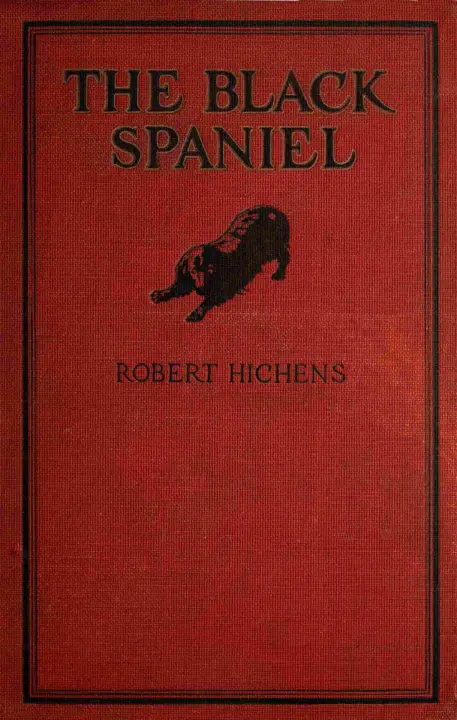
The black spaniel, and other stories
Robert Hichens
THE CLASSIC COLLECTION · 1897
"Bye-Ways" by Robert Hichens is a novel written in the late 19th century. The story revolves around the complex relationship between Desmond Renfrew and his new wife, Claire, an acclaimed actress grappling with fame’s demands and her yearning for freedom. As they embark on a honeymoon in Morocco, the tale explores themes of desire, identity, and the haunting presence of the mysterious figures that surround them. The opening portion of the book introduces Desmond Renfrew as he lies awake in their camp in Morocco, disturbed by the sounds of the night and reflecting on his marriage to Claire. Claire's beauty and the aura of her celebrity preoccupy him, as does his obsessive desire to protect her. Renfrew’s unease grows when he notices their soldiers have vanished, and when he discovers Claire is not in her tent. His search leads him to find Claire enthralled by a performance, revealing her connection to a snake charmer, a character that mirrors some of her own theatrical qualities. This first encounter sets the stage for an exploration of Claire's identity and the forces that shape her, hinting at deeper, intertwining connections between art, life, and the exotic landscapes surrounding them.
Introduction adapted from the source catalogue; source summaries may be automatically generated.
Free to read · English · 77,117 words · No account needed
MAKE TIME FOR A GOOD BOOK
On by default. Untick to stop anonymous reading totals. Each page counts after 10 seconds in view. How this works.
Anonymous counting is on unless you have switched it off.
"She has known many things, good and evil," he thought, as his mind noted the intellect that spoke in the changes of time, the regret and the gaiety that the touch demonstrated so surely and easily, as the mood of the composition changed. The music ceased.
"Betty," a woman's voice said, in English, but with a slight French accent, "I want to see the stars. This awning hides them. Come for a little walk."
"Yes; I want to see the stars too, and the awning does hide them," a girl's voice answered. "Do let us take a little walk."
Bellairs smiled, as he said to himself, "The first voice is the voice of the musician, and the second voice seems to be its echo." He was still standing on the bank when the two women stepped upon the gangway to the shore and climbed to the narrow path.
As they passed him by they glanced at him rather curiously. One was a woman of about thirty, dark, with a pale, strong-featured face. The other was a fair, aristocratic-looking girl, not more than seventeen.
"She is the echo," Bellairs thought. "Rather a sweet one." Then, at a distance, he followed them, and presently found them sitting together in the garden of the Hotel. He sat down not far off. A man, whom he knew slightly, spoke to them, and afterwards crossed to him.
"That lady plays very cleverly," Bellairs said.
"Mademoiselle Leroux, you mean--yes. You know her?"
"Not at all. I only heard her from the river bank."
"She is travelling with Lord Braydon. She is a great friend of Lady
Betty Lambe, his daughter."
"That pretty girl?"
"Yes. Shall I introduce you?"
"I should be delighted."
A moment later Bellairs was sitting with the two ladies and talking of Egypt. It seemed to him that they were the first nurses to dandle his new baby-nature, this nature which Egypt had given to him, and which only to-night he had definitely accepted. Perhaps this fact quickly cemented their acquaintance. At any rate, a distinct friendship began to walk in their conversation, and Bellairs found himself listening to Mdlle. Leroux, and looking at Lady Betty, with a great deal of interest and of admiration. Presently the former said:--
"I knew you would be introduced to us to-night."
Bellairs was surprised.
"When?" he asked.
"When we passed you just now on the bank of the Nile."
"I knew we should too," said Lady Betty.
"You must be very intuitive," said Bellairs.
"Women generally are," remarked Mdlle. Leroux.
"Yes. Do your intuitions tell you whether our acquaintance will be long
and agreeable?"
"Perhaps--but I never prophesy."
"Why?"
"Because I am always right."
Your reading position is saved on this browser. Take it to another device with a library code. Reading pages adapt to text, rather than matching a printed edition.
Robert Hichens
Robert Hichens
Robert Hichens
Robert Hichens
BEHIND THE BOOK
This eBook is for the use of anyone anywhere in the United States and most other parts of the world at no cost and with almost no restrictions whatsoever. You may copy it, give it away or re-use it under the terms of the Project Gutenberg License included with this eBook or online at www.gutenberg.org. If you are not located in the United States, you will have to check the laws of the country where you are located before using this eBook. Read the source licence.
The original source file, including credits and licence, is retained by this library. Request an original-format copy at no charge. Please include the book title and Project Gutenberg identifier #33040.
KEEP YOUR CURIOSITY GOING
Coulson Kernahan

Maurice Baring
Frances Wright
Cécile Tormay

Frederic Jesup Stimson

W. H. P. (William Henry Pope) Jarvis