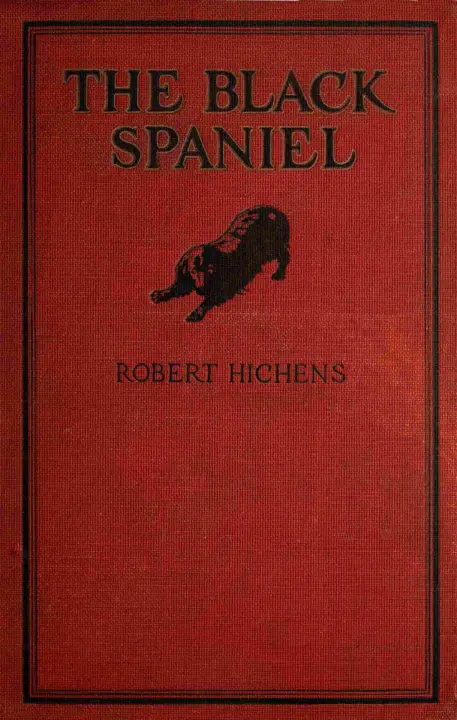
The black spaniel, and other stories
Robert Hichens
THE CLASSIC COLLECTION · 1897
"Bye-Ways" by Robert Hichens is a novel written in the late 19th century. The story revolves around the complex relationship between Desmond Renfrew and his new wife, Claire, an acclaimed actress grappling with fame’s demands and her yearning for freedom. As they embark on a honeymoon in Morocco, the tale explores themes of desire, identity, and the haunting presence of the mysterious figures that surround them. The opening portion of the book introduces Desmond Renfrew as he lies awake in their camp in Morocco, disturbed by the sounds of the night and reflecting on his marriage to Claire. Claire's beauty and the aura of her celebrity preoccupy him, as does his obsessive desire to protect her. Renfrew’s unease grows when he notices their soldiers have vanished, and when he discovers Claire is not in her tent. His search leads him to find Claire enthralled by a performance, revealing her connection to a snake charmer, a character that mirrors some of her own theatrical qualities. This first encounter sets the stage for an exploration of Claire's identity and the forces that shape her, hinting at deeper, intertwining connections between art, life, and the exotic landscapes surrounding them.
Introduction adapted from the source catalogue; source summaries may be automatically generated.
Free to read · English · 77,117 words · No account needed
MAKE TIME FOR A GOOD BOOK
On by default. Untick to stop anonymous reading totals. Each page counts after 10 seconds in view. How this works.
Anonymous counting is on unless you have switched it off.
The door of the long, dreary room, with its mahogany chairs, its littered table, its motley crew of pale, silent people, opened noiselessly. A dreary, lean footman appeared in the aperture, bowing towards a corner where, in a recess near a forlorn, lofty window, sat a tall, athletic-looking man of about forty-five years of age, with a strong yet refined face, clean shaven, and short, crisp, dark hair. The tall man rose immediately, laying down an old number of Punch, and made his way out, watched rather wolfishly by the other occupants of the room. The door closed upon him, and there was a slight rustle and a hiss of whispering.
Two well-dressed women leaned to one another, the feathers in their hats almost mingling as they murmured: "Not much the matter with him, I should fancy."
"He looks as strong as a horse; but modern men are always imagining themselves ill. He has lived too much, probably."
They laughed in a suppressed ripple.
At the end of the room near the door, under the big picture of a grave man in a frock-coat, holding a double eye-glass tentatively in his right hand as if to emphasise an argument--a young girl bent towards her father, who said to her in a low voice:
"That man who has just left the room is Brune, the great sculptor."
"Is he ill?" the girl asked.
"It seems so, since he is here."
Then a silence fell again, broken only by the rustle of turned pages and the occasional uneasy shifting of feet.
Meanwhile, in a small room across the hall, by a window through which the autumn sun streamed with a tepid brightness, Reginald Brune lay on a narrow sofa. His coat and waistcoat were thrown open; his chest was bared. Gerard Fane, the great discoverer of hidden diseases, raised himself from a bent posture, and spoke some words in a clear, even voice.
Brune lifted himself half up on his elbow, and began mechanically to button the collar of his shirt. His long fingers did not tremble, though his face was very pale.
He fastened the collar, arranged his loose tie, and then sat up slowly.
A boy, clanking two shining milk-cans, passed along the pavement, whistling a music-hall song. The shrill melody died down the street, and Brune listened to it until there was a silence. Then he looked up at the man opposite to him, and said, as one dully protesting, without feeling, without excitement:--
"But, doctor, I was only married three weeks ago."
Your reading position is saved on this browser. Take it to another device with a library code. Reading pages adapt to text, rather than matching a printed edition.
Robert Hichens
Robert Hichens
Robert Hichens
Robert Hichens
BEHIND THE BOOK
This eBook is for the use of anyone anywhere in the United States and most other parts of the world at no cost and with almost no restrictions whatsoever. You may copy it, give it away or re-use it under the terms of the Project Gutenberg License included with this eBook or online at www.gutenberg.org. If you are not located in the United States, you will have to check the laws of the country where you are located before using this eBook. Read the source licence.
The original source file, including credits and licence, is retained by this library. Request an original-format copy at no charge. Please include the book title and Project Gutenberg identifier #33040.
KEEP YOUR CURIOSITY GOING
Coulson Kernahan

Maurice Baring
Frances Wright
Cécile Tormay

Frederic Jesup Stimson

W. H. P. (William Henry Pope) Jarvis