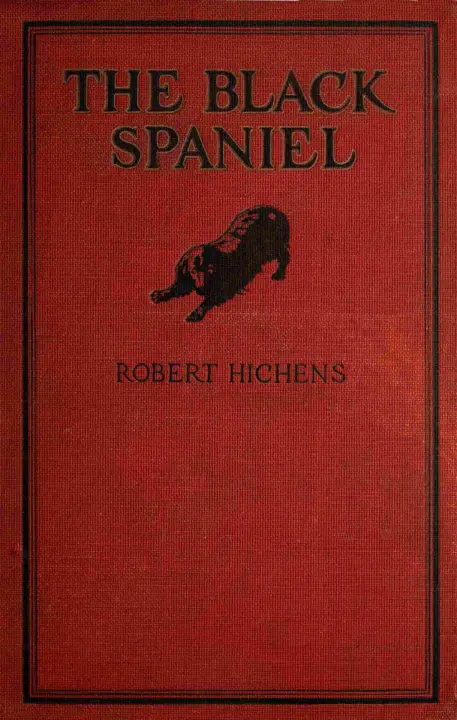
The black spaniel, and other stories
Robert Hichens
THE CLASSIC COLLECTION · 1897
"Bye-Ways" by Robert Hichens is a novel written in the late 19th century. The story revolves around the complex relationship between Desmond Renfrew and his new wife, Claire, an acclaimed actress grappling with fame’s demands and her yearning for freedom. As they embark on a honeymoon in Morocco, the tale explores themes of desire, identity, and the haunting presence of the mysterious figures that surround them. The opening portion of the book introduces Desmond Renfrew as he lies awake in their camp in Morocco, disturbed by the sounds of the night and reflecting on his marriage to Claire. Claire's beauty and the aura of her celebrity preoccupy him, as does his obsessive desire to protect her. Renfrew’s unease grows when he notices their soldiers have vanished, and when he discovers Claire is not in her tent. His search leads him to find Claire enthralled by a performance, revealing her connection to a snake charmer, a character that mirrors some of her own theatrical qualities. This first encounter sets the stage for an exploration of Claire's identity and the forces that shape her, hinting at deeper, intertwining connections between art, life, and the exotic landscapes surrounding them.
Introduction adapted from the source catalogue; source summaries may be automatically generated.
Free to read · English · 77,117 words · No account needed
MAKE TIME FOR A GOOD BOOK
On by default. Untick to stop anonymous reading totals. Each page counts after 10 seconds in view. How this works.
Anonymous counting is on unless you have switched it off.
Beyond the trees there was a small clearing that almost corresponded to our English notion of a village green. On the near side of it was the clump of trees in whose shadow Renfrew now stood. On the far side of it was the Moorish village, a minute collection of low huts like hovels, featureless and filthy. The moon streamed over the clearing and lit up faintly a cluster of seated figures that formed a good-sized circle. The figures looked broad and almost shapeless, for they were all smothered in long, voluminous robes, and over all the heads great hoods were drawn which hid the faces of the wearers. They were absolutely motionless, and differed little from the more distant clumps of dwarf palms that grew everywhere among the huts. Only they possessed the curiously sullen aspect of things alive but entirely motionless. It was not this living Stonehenge of Morocco, however, which caused Renfrew to catch his breath and rooted him in the shadow. In the centre of the circle, lit up by the moon, there stood something that might have been a phantom, it was so thin, so tall, so white-faced, so strange in its movements. It was a woman, and long black hair flowed down to its waist,--night standing back from that moon, vague and spectral, the face. In this human night and moon, great sombre eyes gleamed with a sort of fatigued beauty. This spectre stretched out its long arms in weird gesticulations and sometimes swayed its body as if it moved to music. And from its lips came a soft and liquid stream of golden words that mingled with the acid barking of the dogs, some of which crept furtively about on the outskirts of the serene hooded circle of the listeners. This murmuring spectre was Claire. She was girt about with silently staring Moors. And she was in the act of delivering one of her most famous recitations, which she had last given at a monster morning performance before Royalties in London, on a sultry day of the season. As this fact broke upon Renfrew's mind, he seemed for a moment to be back in the hot dressing-room in which Claire had said: "I will marry you." He seemed to hear her passionate exclamation: "I should like to act to-night to a circle of savages!" The hill men of this part of Morocco may not be savages, but they are fierce and wild and ruthless. And now they hung upon the lips that had spoken to London, Paris, Vienna, New York--but never before to such an audience as this. The recitation was a description of the performance of a snake-charmer, his harangue to his reptiles and to the crowd watching him, and his departure into the solitude of the great desert, there to obtain, in communion with its spirit, the power to work greater miracles, and to charm not alone the serpents that dwell among the rocks and in the forests, but also men, women, little children,--the power to thrust a human world into a kennel of plaited straw, to take it out in sections at pleasure, and to make it dance, pose, and posture, like a viper tamed into a species of ballet-dancer. In this recitation the peculiar and almost serpentine fascination of Claire had full liberty. She represented the snake-charmer as a being who through long and intimate association with snakes had become like them, lithe, fantastic, and unexpected, soft and deadly, by turns sleepy and violent, a coil of glistening velvet and a length of cast-iron, tipped with a poisoned fang and the music of a hiss. His fanaticism, his greed for money, the passionate prayer to Sidi Mahomet that flowed from his lips while his terrible eyes searched an imaginary crowd in search of the richest man or the most excited woman in it, his bursts of dancing humour, his deadly stillness, his playful familiarity with his dangerous captives, his mesmeric anger when they were sullen and recalcitrant, his relapse into the savage churchwarden with the collecting box when his "show" was at an end,--every side, every subtlety of such a creature Claire could give with the certainty of genius. As you watched her, you beheld the snakes, you beheld their master. Even at the end you almost saw the vast and trackless desert open its haggard arms to receive its child, who passed from the crowd to the silence in which alone he could learn to fascinate the crowd. At the great morning performance in London, a prince who knew the East had said to Claire, "Miss Duvigne, you must have lived with snake-charmers. You must have studied them for months."
Your reading position is saved on this browser. Take it to another device with a library code. Reading pages adapt to text, rather than matching a printed edition.
Robert Hichens
Robert Hichens
Robert Hichens
Robert Hichens
BEHIND THE BOOK
This eBook is for the use of anyone anywhere in the United States and most other parts of the world at no cost and with almost no restrictions whatsoever. You may copy it, give it away or re-use it under the terms of the Project Gutenberg License included with this eBook or online at www.gutenberg.org. If you are not located in the United States, you will have to check the laws of the country where you are located before using this eBook. Read the source licence.
The original source file, including credits and licence, is retained by this library. Request an original-format copy at no charge. Please include the book title and Project Gutenberg identifier #33040.
KEEP YOUR CURIOSITY GOING
Coulson Kernahan

Maurice Baring
Frances Wright
Cécile Tormay

Frederic Jesup Stimson

W. H. P. (William Henry Pope) Jarvis