THE CLASSIC COLLECTION✦Half a dozen boysCLASSIC FREE BOOKS
Half a dozen boys
Anna Chapin Ray
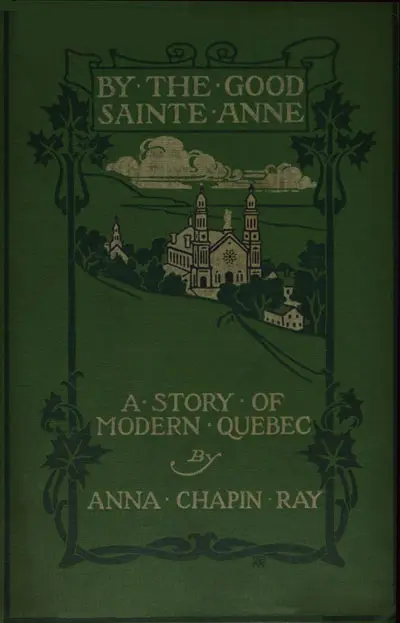
THE CLASSIC COLLECTION · 1904
"By the Good Sainte Anne: A Story of Modern Quebec" by Anna Chapin Ray is a novel written in the early 20th century. The story is set against the backdrop of Quebec and follows Nancy Howard, a young American girl who is struggling with feeling exiled from her social life back home as her father studies history in the picturesque but remote region of Beaupré. The narrative explores Nancy's interactions with a cast of characters that reveals both her longing for excitement and the cultural dynamics of the area. The opening of the novel introduces Nancy Howard, who is feeling exasperated by her father's academic pursuits that keep her isolated in the countryside while her friends are enjoying social events back home. As she engages with a local woman, Madame Gagnier, she learns of a pilgrimage to the church of Sainte Anne-de-Beaupré, sparking her curiosity about the miracles associated with it. The chapter captures Nancy’s spirited desire for adventure and connection, as she resolves to participate in the pilgrimage. Simultaneously, we encounter a young Englishman, Mr. Cecil Barth, who finds himself in Quebec but is grappling with his own feelings of isolation, setting the stage for future interactions between them. Through a blend of humor and introspection, the narrative hints at the themes of cultural clash, faith, and personal growth that will unfold in their journey within the unique setting of modern Quebec.
Introduction adapted from the source catalogue; source summaries may be automatically generated.
Free to read · English · 52,520 words · No account needed
MAKE TIME FOR A GOOD BOOK
On by default. Untick to stop anonymous reading totals. Each page counts after 10 seconds in view. How this works.
Anonymous counting is on unless you have switched it off.
Nancy glanced up, as St. Jacques appeared in the doorway with Brock at his side. At the farther end of the room, Barth also glanced up. The action was wholly involuntary, however, and Barth sought to disguise with a yawn his ill-timed manifestation of interest.
“You look as if you had something of importance to announce,” Nancy replied, as she rose and crossed the room to the door.
“So we have. What are you going to do, this evening?”
“That isn’t an announcement; it is a question,” she suggested.
St. Jacques laughed. Nancy always enjoyed the sudden lighting of his face. At rest, it was almost heavy in its dark, intent earnestness; at a chance word, it could turn mirthful as the face of a child, gentle with the sympathetic gentleness of a strong man. Just now, the rollicking child was uppermost.
“How can I tell the difference? I am not English,” he answered.
Nancy cocked the white of one eye towards the far corner of the room.
“Neither am I,” she said demurely.
Brock’s answer was enigmatic; but Nancy held the key.
“It is always possible to be grateful to Allah,” he said, low, but not so low as to keep the color from rising in Barth’s cheeks.
St. Jacques turned suddenly.
“Good evening, Mr. Barth. Is your ankle better?” he queried.
But Barth was as yet unable to make any distinctions in measuring out
his displeasure.
“Thank you, Mr. St. Jacques,” he answered icily. “It is almost quite
well.”
“O—oh. I am very glad,” St. Jacques responded, in such vague uncertainty as to how great a degree of gain might be represented by the almost quite that he entirely missed the note of hostility in Barth’s voice.
Again the white of Nancy’s eye moved towards the corner of the room, as
Brock said,—
“But you haven’t answered St. Jacques’s question, Miss Howard.”
“I beg your pardon. I am not going to do anything, unless sitting in this room counts for something.”
“But it doesn’t.” Barth took an unexpected plunge into the conversation.
“Then what makes you do it?” Brock inquired.
His intention had been altogether hostile, for he had been irritated by the discourtesy shown to his friend. Nevertheless, his irritation gave place to good-tempered pity, as the young Englishman answered quietly,—
“Because there’s not so very much left that I can do. One doesn’t get much variety in a radius of half a mile a day.”
This time, Nancy turned around.
“Doesn’t that ligament grow strong yet?” she asked, in a wave of sympathy which swept her off her guard.
Your reading position is saved on this browser. Take it to another device with a library code. Reading pages adapt to text, rather than matching a printed edition.
Anna Chapin Ray
Anna Chapin Ray

Anna Chapin Ray

Anna Chapin Ray
BEHIND THE BOOK
This eBook is for the use of anyone anywhere in the United States and most other parts of the world at no cost and with almost no restrictions whatsoever. You may copy it, give it away or re-use it under the terms of the Project Gutenberg License included with this eBook or online at www.gutenberg.org. If you are not located in the United States, you will have to check the laws of the country where you are located before using this eBook. Read the source licence.
The original source file, including credits and licence, is retained by this library. Request an original-format copy at no charge. Please include the book title and Project Gutenberg identifier #60175.
KEEP YOUR CURIOSITY GOING
Coulson Kernahan

Maurice Baring
Frances Wright
Cécile Tormay

Frederic Jesup Stimson

W. H. P. (William Henry Pope) Jarvis