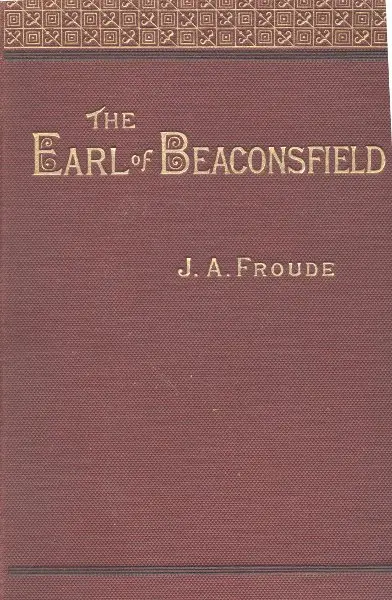
The Earl of Beaconsfield
James Anthony Froude
THE CLASSIC COLLECTION · 1880
"Bunyan" by James Anthony Froude is a historical account written in the late 19th century. The book delves into the early life of John Bunyan, the author of "The Pilgrim's Progress," and the profound spiritual struggles he faced that shaped his thoughts and writings. Froude explores Bunyan's humble beginnings, his tumultuous path to faith, and the moral conflicts that defined his character, offering readers insight into how such experiences influenced his later works. The opening of the book introduces readers to John Bunyan as a boy of low birth born in 1628, in a period of significant political upheaval in England. Froude describes Bunyan's upbringing in a poor household, detailing his early mischievous behavior and struggles with sin and moral conviction, often exacerbated by nightmares and an intense consciousness of evil. Despite growing up ignorant of formal schooling, Bunyan's life was heavily influenced by the deeply ingrained religious beliefs surrounding him, causing him to grapple with inner turmoil. This conflict between his sinful nature and his yearning for redemption sets the stage for his eventual calling to ministry, shedding light on the extraordinary faith journey that would culminate in the creation of his enduring literary masterpiece.
Introduction adapted from the source catalogue; source summaries may be automatically generated.
Free to read · English · 56,229 words · No account needed
MAKE TIME FOR A GOOD BOOK
On by default. Untick to stop anonymous reading totals. Each page counts after 10 seconds in view. How this works.
Anonymous counting is on unless you have switched it off.
He was now seventeen, and we can form a tolerably accurate picture of him--a tall, active lad, working as his father's apprentice, at his pots and kettles, ignorant of books, and with no notion of the world beyond what he could learn in his daily drudgery, and the talk of the alehouse and the village green; inventing lies to amuse his companions, and swearing that they were true; playing bowls and tipcat, ready for any reckless action, and always a leader in it, yet all the while singularly pure from the more brutal forms of vice, and haunted with feverish thoughts, which he tried to forget in amusements. It has been the fashion to take his account of himself literally, and represent him as the worst of reprobates, in order to magnify the effects of his conversion, and perhaps to make intelligible to his admiring followers the reproaches which he heaps upon himself. They may have felt that they could not be wrong in explaining his own language in the only sense in which they could attach a meaning to it. Yet, sinner though he may have been, like all the rest of us, his sins were not the sins of coarseness and vulgarity. They were the sins of a youth of sensitive nature and very peculiar gifts: gifts which brought special temptations with them, and inclined him to be careless and desperate, yet from causes singularly unlike those which are usually operative in dissipated and uneducated boys.
It was now the year 1645. Naseby Field was near, and the first Civil War was drawing to its close. At this crisis Bunyan was, as he says, drawn to be a soldier; and it is extremely characteristic of him and of the body to which he belonged, that he leaves us to guess on which side he served. He does not tell us himself. His friends in after life did not care to ask him, or he to inform them, or else they also thought the matter of too small importance to be worth mentioning with exactness. There were two traditions, and his biographers chose between them as we do. Close as the connection was in that great struggle between civil and religious liberty--flung as Bunyan was flung into the very centre of the conflict between the English people and the Crown and Church and aristocracy--victim as he was himself of intolerance and persecution, he never but once took any political part, and then only in signing an address to Cromwell. He never showed any active interest in political questions; and if he spoke on such questions at all after the Restoration, it was to advise submission to the Stuart Government. By the side of the stupendous issues of human life, such miserable rights as men might pretend to in this world were not worth contending for. The only right of man that he thought much about, was the right to be eternally damned if he did not lay hold of grace. King and subject were alike creatures whose sole significance lay in their individual immortal souls. Their relations with one another upon earth were nothing in the presence of the awful judgment which awaited them both. Thus whether Bunyan's brief career in the army was under Charles or under Fairfax must remain doubtful. Probability is on the side of his having been with the Royalists. His father was of 'the national religion.' He himself had as yet no special convictions of his own. John Gifford, the Baptist minister at Bedford, had been a Royalist. The only incident which Bunyan speaks of connected with his military experience points in the same direction. 'When I was a soldier,' he says, 'I was with others drawn out to go to such a place to besiege it. But when I was just ready to go, one of the company desired to go in my room. Coming to the siege as he stood sentinel he was shot in the heart with a musket bullet and died.' Tradition agrees that the place to which these words refer was Leicester. Leicester was stormed by the King's troops a few days before the battle of Naseby. It was recovered afterwards by the Parliamentarians, but on the second occasion there was no fighting, as it capitulated without a shot being fired. Mr. Carlyle supposes that Bunyan was not with the attacking party, but was in the town as one of the garrison, and was taken prisoner there. But this cannot be, for he says expressly that he was one of the besiegers. Legend gathers freely about eminent men, about men especially who are eminent in religion, whether they are Catholic or Protestant. Lord Macaulay is not only positive that the hero of the English Dissenters fought on the side of the Commonwealth, but he says, without a word of caution on the imperfection of the evidence, 'His Greatheart, his Captain Boanerges, and his Captain Credence, are evidently portraits of which the originals were among those martial saints who fought and expounded in Fairfax's army.'[2]
Your reading position is saved on this browser. Take it to another device with a library code. Reading pages adapt to text, rather than matching a printed edition.
James Anthony Froude
James Anthony Froude
James Anthony Froude
James Anthony Froude
BEHIND THE BOOK
This eBook is for the use of anyone anywhere in the United States and most other parts of the world at no cost and with almost no restrictions whatsoever. You may copy it, give it away or re-use it under the terms of the Project Gutenberg License included with this eBook or online at www.gutenberg.org. If you are not located in the United States, you will have to check the laws of the country where you are located before using this eBook. Read the source licence.
The original source file, including credits and licence, is retained by this library. Request an original-format copy at no charge. Please include the book title and Project Gutenberg identifier #29929.
KEEP YOUR CURIOSITY GOING

David Patterson (Spirit) Hatch

David Patterson (Spirit) Hatch

David Patterson (Spirit) Hatch
Cécile Tormay

Moritz Busch
John L. Ransom