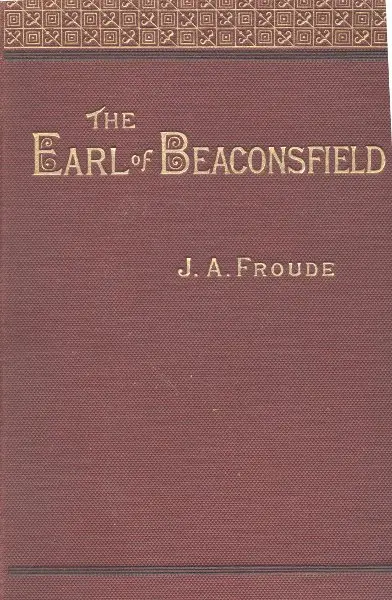
The Earl of Beaconsfield
James Anthony Froude
THE CLASSIC COLLECTION · 1880
"Bunyan" by James Anthony Froude is a historical account written in the late 19th century. The book delves into the early life of John Bunyan, the author of "The Pilgrim's Progress," and the profound spiritual struggles he faced that shaped his thoughts and writings. Froude explores Bunyan's humble beginnings, his tumultuous path to faith, and the moral conflicts that defined his character, offering readers insight into how such experiences influenced his later works. The opening of the book introduces readers to John Bunyan as a boy of low birth born in 1628, in a period of significant political upheaval in England. Froude describes Bunyan's upbringing in a poor household, detailing his early mischievous behavior and struggles with sin and moral conviction, often exacerbated by nightmares and an intense consciousness of evil. Despite growing up ignorant of formal schooling, Bunyan's life was heavily influenced by the deeply ingrained religious beliefs surrounding him, causing him to grapple with inner turmoil. This conflict between his sinful nature and his yearning for redemption sets the stage for his eventual calling to ministry, shedding light on the extraordinary faith journey that would culminate in the creation of his enduring literary masterpiece.
Introduction adapted from the source catalogue; source summaries may be automatically generated.
Free to read · English · 56,229 words · No account needed
MAKE TIME FOR A GOOD BOOK
On by default. Untick to stop anonymous reading totals. Each page counts after 10 seconds in view. How this works.
Anonymous counting is on unless you have switched it off.
The 'Pilgrim's Progress' is the history of the struggle of human nature to overcome temptation and shake off the bondage of sin, under the convictions which prevailed among serious men in England in the seventeenth century. The allegory is the life of its author cast in an imaginative form. Every step in Christian's journey had been first trodden by Bunyan himself; every pang of fear and shame, every spasm of despair, every breath of hope and consolation, which is there described, is but a reflexion as on a mirror from personal experience. It has spoken to the hearts of all later generations of Englishmen because it came from the heart; because it is the true record of the genuine emotions of a human soul; and to such a record the emotions of other men will respond, as one stringed instrument vibrates responsively to another. The poet's power lies in creating sympathy; but he cannot, however richly gifted, stir feelings which he has not himself known in all their intensity.
Ut ridentibus arrident ita flentibus adflent
Humani vultus. Si vis me flere dolendum est
Primum ipsi tibi.
The religious history of man is essentially the same in all ages. It takes its rise in the duality of his nature. He is an animal, and as an animal he desires bodily pleasure and shrinks from bodily pain. As a being capable of morality, he is conscious that for him there exists a right and wrong. Something, whatever that something may be, binds him to choose one and avoid the other. This is his religion, his religatio, his obligation, in the sense in which the Romans, from whom we take it, used the word; and obligation implies some superior power to which man owes obedience. The conflict between his two dispositions agitates his heart, and perplexes his intellect. To do what the superior power requires of him, he must thwart his inclinations. He dreads punishment, if he neglects to do it. He invents methods by which he can indulge his appetites, and finds a substitute by which he can propitiate his invisible ruler or rulers. He offers sacrifices; he institutes ceremonies and observances. This is the religion of the body, the religion of fear. It is what we call superstition. In his nobler moods he feels that this is but to evade the difficulty. He perceives that the sacrifice required is the sacrifice of himself. It is not the penalty for sin which he must fear, but the sin itself. He must conquer his own lower nature. He must detach his heart from his pleasures, and he must love good for its own sake, and because it is his only real good; and this is spiritual religion or piety. Between these two forms of worship of the unseen, the human race has swayed to and fro from the first moment in which they learnt to discern between good and evil. Superstition attracts, because it is indulgent to immorality by providing means by which God can be pacified. But it carries its antidote along with it, for it keeps alive the sense of God's existence; and when it has produced its natural effects, when the believer rests in his observances and lives practically as if there was no God at all, the conscience again awakes. Sacrifices and ceremonies become detested as idolatry, and religion becomes conviction of sin, a fiery determination to fight with the whole soul against appetite, vanity, self-seeking, and every mean propensity which the most sensitive alarm can detect. The battle unhappily is attended with many vicissitudes. The victory, though practically it may be won, is never wholly won. The struggle brings with it every variety of emotion, alternations of humility and confidence, despondency and hope. The essence of it is always the same--the effort of the higher nature to overcome the lower. The form of it varies from period to period, according to the conditions of the time, the temperament of different people, the conception of the character of the Supreme Power, which the state of knowledge enables men to form. It will be found even when the puzzled intellect can see no light in Heaven at all, in the stern and silent fulfilment of moral duty. It will appear as enthusiasm; it will appear as asceticism. It will appear wherever there is courage to sacrifice personal enjoyment for a cause believed to be holy. We must all live. We must all, as we suppose, in one shape or other give account for our actions; and accounts of the conflict are most individually interesting when it is an open wrestle with the enemy; as we find in the penances and austerities of the Catholic saints, or when the difficulties of belief are confessed and detailed, as in David's Psalms, or in the Epistles of St. Paul. St. Paul, like the rest of mankind, found a law in his members warring against the law which was in his heart. The problem presented to him was how one was to be brought into subjection to the other, and the solution was by 'the putting on of Christ.' St. Paul's mind was charged with the ideas of Oriental and Greek philosophy then prevalent in the Roman Empire. His hearers understood him, because he spoke in the language of the prevailing speculations. We who have not the clue cannot, perhaps, perfectly understand him; but his words have been variously interpreted as human intelligence has expanded, and have formed the basis of the two great theologies which have been developed out of Christianity. The Christian religion taught that evil could not be overcome by natural human strength. The Son of God had come miraculously upon earth, had lived a life of stainless purity, and had been offered as a sacrifice to redeem men conditionally from the power of sin. The conditions, as English Protestant theology understands them, are nowhere more completely represented than in the 'Pilgrim's Progress.' The Catholic theology, rising as it did in the two centuries immediately following St. Paul, approached probably nearer to what he really intended to say.
Your reading position is saved on this browser. Take it to another device with a library code. Reading pages adapt to text, rather than matching a printed edition.
James Anthony Froude
James Anthony Froude
James Anthony Froude
James Anthony Froude
BEHIND THE BOOK
This eBook is for the use of anyone anywhere in the United States and most other parts of the world at no cost and with almost no restrictions whatsoever. You may copy it, give it away or re-use it under the terms of the Project Gutenberg License included with this eBook or online at www.gutenberg.org. If you are not located in the United States, you will have to check the laws of the country where you are located before using this eBook. Read the source licence.
The original source file, including credits and licence, is retained by this library. Request an original-format copy at no charge. Please include the book title and Project Gutenberg identifier #29929.
KEEP YOUR CURIOSITY GOING

David Patterson (Spirit) Hatch

David Patterson (Spirit) Hatch

David Patterson (Spirit) Hatch
Cécile Tormay

Moritz Busch
John L. Ransom