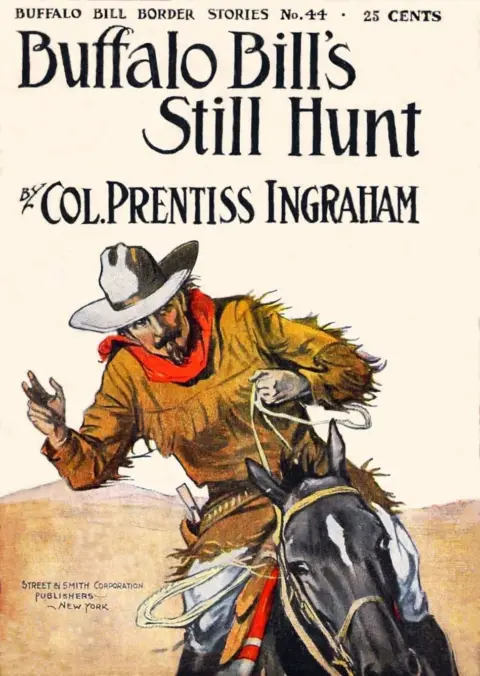
Buffalo Bill’s still hunt
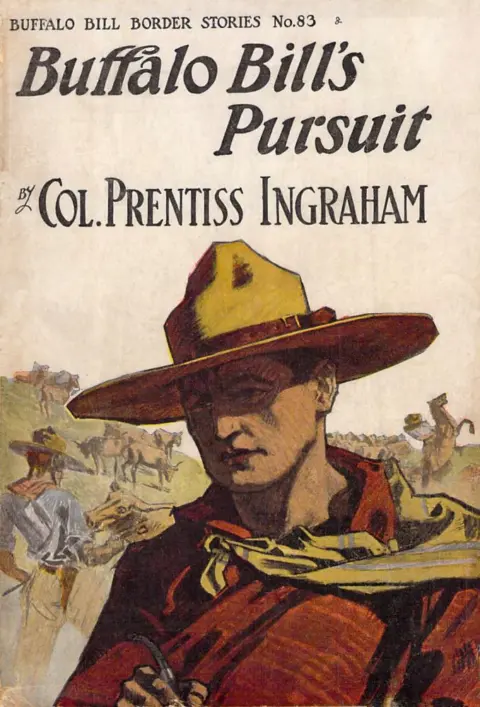
Prentiss Ingraham
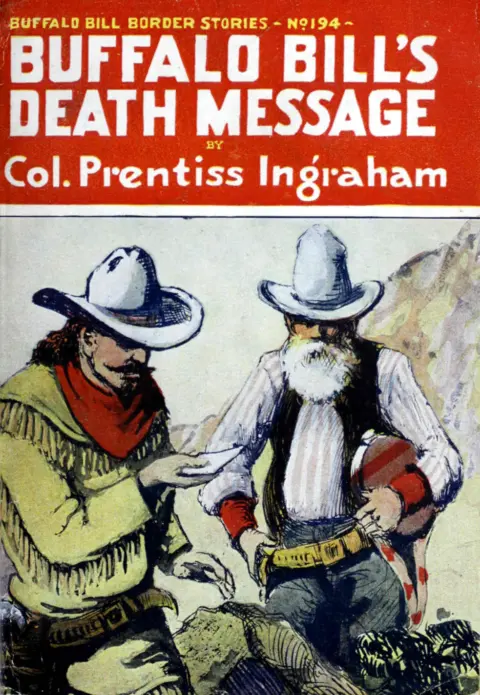
THE CLASSIC COLLECTION · 1907
Buffalo Bill's death message by Prentiss Ingraham. Explore this classic work in a free online edition. Subjects include Western stories; Dime novels; Buffalo Bill, 1846-1917 -- Fiction. Read the locally hosted text below, adjust the reading display, and continue where you left off.
Introduction adapted from the source catalogue; source summaries may be automatically generated.
Free to read · English · 80,049 words · No account needed
MAKE TIME FOR A GOOD BOOK
On by default. Untick to stop anonymous reading totals. Each page counts after 10 seconds in view. How this works.
Anonymous counting is on unless you have switched it off.
As the elevator thus came to a standstill the scout and those with him dimly saw in the gloom an open door.
As explained, the elevator was nothing but a framework of decaying wood, hence it was plain that this door was in the wall of the elevator well.
Buffalo Bill, unhesitating, struck another match, while his companions were variously expressing their astonishment. Its light showed that the door opened into a small, square room, which, except for that light, was perfectly dark. The only door it had was the one entering from the elevator.
Not without some hesitation did the scout step forth into this room. As the light of the match flamed higher he beheld a sight which called another exclamation from his lips.
An Indian sat in a crouched attitude in a corner.
Lawler saw the Indian at the same instant, and Buffalo Bill heard the clicking of the boy’s revolver.
“Don’t shoot!” was the scout’s warning, and he thrust the match down toward the Indian. “He is dead!”
The match went out, and it was necessary to ignite another before further examinations could be made.
Then they discovered that the Indian was not only dead, but that he was, in fact, a mummy, but so well preserved that he was not like the dried-up specimens of Indian mummies usually seen. He had the appearance of an Indian who had been not long dead.
In his mouth, projecting from between his teeth, he held a queer-looking flat stone. The scout flashed upon it the fight of the match, and saw that the stone held written characters, or what appeared to be written characters.
“See here, professor!” he said, and Bounderby came forward, trying hard to suppress any manifestation of his really great excitement. “There is something written on this stone, professor; it seems to be a message, or a letter, or, perhaps, instructions. I should guess instructions. But it’s in a writing I never saw before.”
Professor Bounderby gravely produced his eyeglasses, strung them across his nose, and bent to look at the flat stone projecting from between the lips of the mummy.
“It’s only visible in part,” he urged. “I——”
The scout took hold of the stone, and it came away easily. It was flat and round and covered on both sides with what seemed to be figures, or writing in hieroglyphics.
“Can you make it out, professor? It’s beyond me, I confess.”
All stared at Bounderby, and at the stone which the scout placed in his
hands.
Your reading position is saved on this browser. Take it to another device with a library code. Reading pages adapt to text, rather than matching a printed edition.
Prentiss Ingraham
Prentiss Ingraham
Prentiss Ingraham
Prentiss Ingraham
BEHIND THE BOOK
This eBook is for the use of anyone anywhere in the United States and most other parts of the world at no cost and with almost no restrictions whatsoever. You may copy it, give it away or re-use it under the terms of the Project Gutenberg License included with this eBook or online at www.gutenberg.org. If you are not located in the United States, you will have to check the laws of the country where you are located before using this eBook. Read the source licence.
The original source file, including credits and licence, is retained by this library. Request an original-format copy at no charge. Please include the book title and Project Gutenberg identifier #79255.
KEEP YOUR CURIOSITY GOING
Coulson Kernahan

Maurice Baring
Frances Wright
Cécile Tormay

Frederic Jesup Stimson

W. H. P. (William Henry Pope) Jarvis