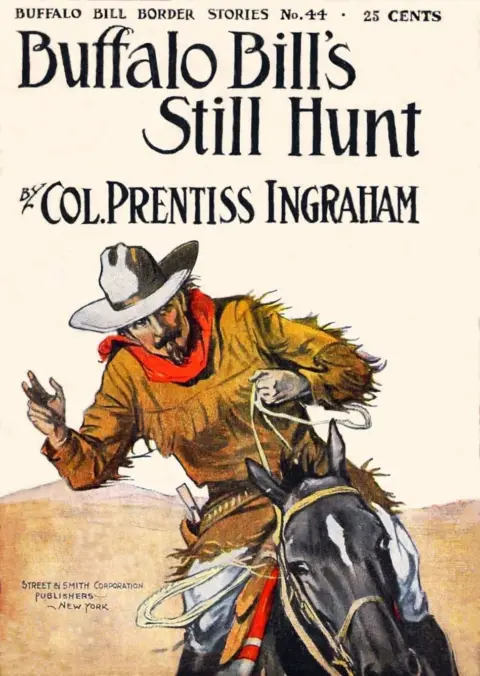
Buffalo Bill’s still hunt
Prentiss Ingraham
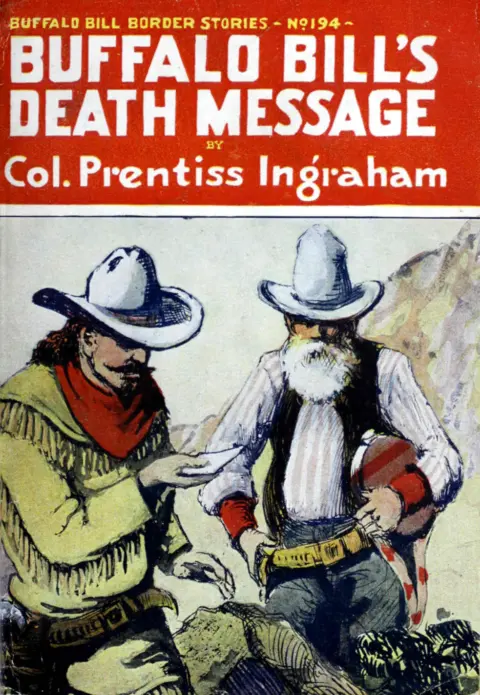
THE CLASSIC COLLECTION · 1907
Buffalo Bill's death message by Prentiss Ingraham. Explore this classic work in a free online edition. Subjects include Western stories; Dime novels; Buffalo Bill, 1846-1917 -- Fiction. Read the locally hosted text below, adjust the reading display, and continue where you left off.
Introduction adapted from the source catalogue; source summaries may be automatically generated.
Free to read · English · 80,049 words · No account needed
MAKE TIME FOR A GOOD BOOK
On by default. Untick to stop anonymous reading totals. Each page counts after 10 seconds in view. How this works.
Anonymous counting is on unless you have switched it off.
He took out his eyeglasses, hooked them over his nose, and stared hard at the rock where he had seen the moving light spots. Nothing of the kind showed there now.
The German had risen, or, rather, had rolled, to his feet, and he, too, was inspecting the white face of rock.
“By yiminy, id puzzle me alretty!” he admitted. “Maybe dis rock is vat you call dransparent, so dot de lighd uff de sun can shood t’rough id. Nein?”
“Impossible, Henselman. We are here in the presence of one of nature’s great mysteries. If we can elucidate it, fame may be ours. I shall add the discovery to those notes on my lecture on——”
He stopped. Buffalo Bill was coming up briskly, and the professor became
aware of the fact.
“Welcome!” he said. “Mr. Cody, we have here a strange thing. Though the sun is behind this rock, yet white spots of light from it strike with a dancing effect on this side of the rock. I have wondered if there can be extra brilliant points of light in the sun, the opposite of sun spots in effect, which would produce anything like that? There would need to be some reflecting surface, however, and——”
The dancing spots came again, flickering in a queer and irregular way
over the rock.
The scout saw them for the first time. He watched them, as they flashed and flickered for nearly a minute, then they were gone.
“Every phenomenon of nature has a perfectly natural solution, Cody, if it can be known,” said the amazed Bounderby.
“Very true, professor,” the scout answered. “In this instance, the explanation isn’t far to seek. Those are telegraphic spots of light from a heliographic instrument.”
They came again, and the scout stared at them. He was reading them:
“‘We are at the red bluff. Join us at once. She is still missing and we
need you.’”
The spots disappeared.
Buffalo Bill repeated to Bounderby and Henselman what he had read.
“Over in the hills, there, at a point where its mirrors catch the sunlight, is a heliograph instrument. By means of it a message was flashed on that white rock, the flashes representing in their duration the dots and dashes of the Morse telegraphic code. Fortunately, I learned the code, and have practiced it enough to be able to read those flashes.”
“Yaw! Dot iss a telegraph?”
“It is a sunlight telegraph. The light of the sun falls on its mirrors, and is then reflected, or thrown, to this spot.”
The flashes were reappearing, and again the scout studied them.
“The same message again,” he said.
Your reading position is saved on this browser. Take it to another device with a library code. Reading pages adapt to text, rather than matching a printed edition.
Prentiss Ingraham
Prentiss Ingraham
Prentiss Ingraham
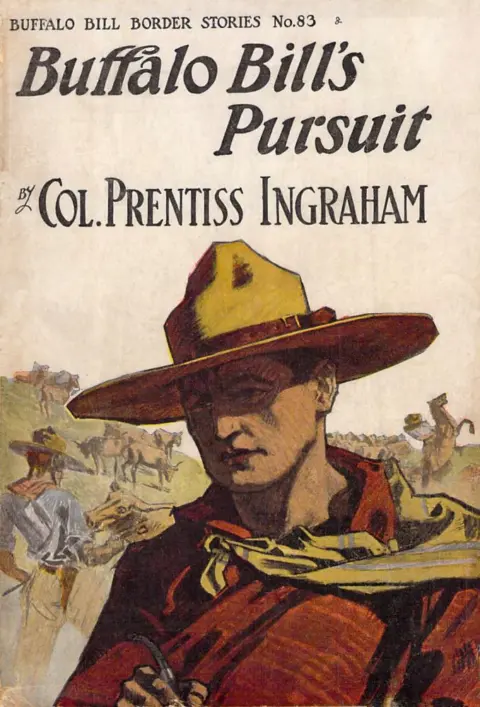
Prentiss Ingraham
BEHIND THE BOOK
This eBook is for the use of anyone anywhere in the United States and most other parts of the world at no cost and with almost no restrictions whatsoever. You may copy it, give it away or re-use it under the terms of the Project Gutenberg License included with this eBook or online at www.gutenberg.org. If you are not located in the United States, you will have to check the laws of the country where you are located before using this eBook. Read the source licence.
The original source file, including credits and licence, is retained by this library. Request an original-format copy at no charge. Please include the book title and Project Gutenberg identifier #79255.
KEEP YOUR CURIOSITY GOING
Coulson Kernahan

Maurice Baring
Frances Wright
Cécile Tormay

Frederic Jesup Stimson

W. H. P. (William Henry Pope) Jarvis