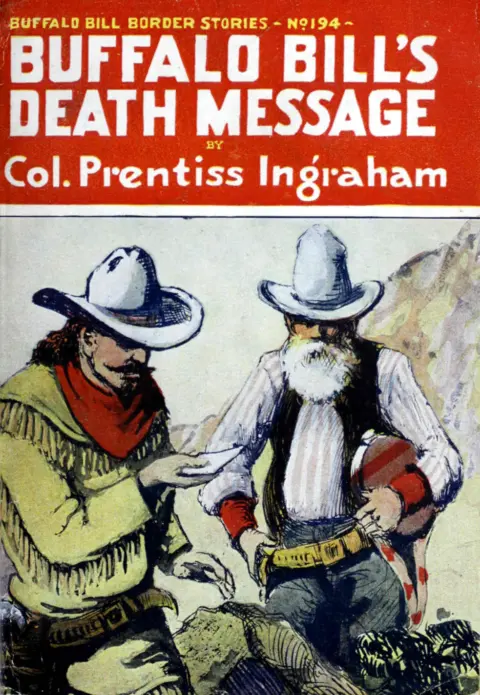
Buffalo Bill’s death message
Prentiss Ingraham
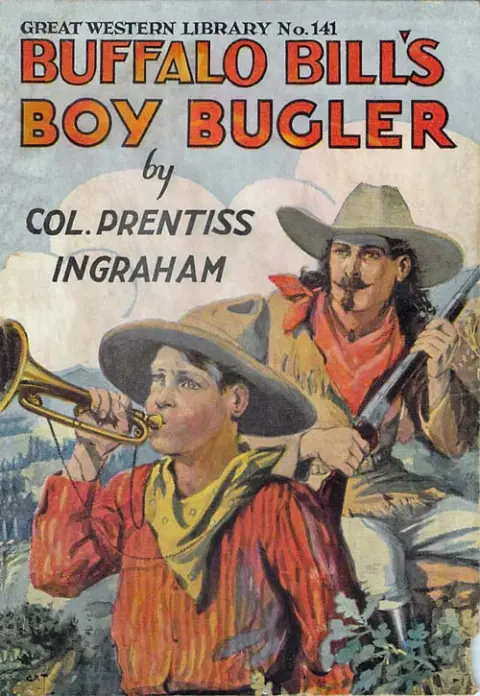
THE CLASSIC COLLECTION · 1909
"Buffalo Bill's Boy Bugler; Or, The Last of the Indian Ring" by Colonel Prentiss Ingraham is a historical novel written in the early 20th century. The narrative centers around the legendary figure Buffalo Bill (William F. Cody) and his associates as they navigate the tumultuous interactions between cattlemen and sheepmen in the Wild West, along with the impending complications involving Native American tribes. The main characters introduced include Buffalo Bill himself and a range of colorful figures such as "Red Dick," "Fighting Dan," and "Wild Bill," each embodying the fierce spirit and lawlessness of the era. At the start of the story, tensions rise in Bozeman as Red Dick and Doc Downs face trial for their violent altercations with sheep herders, which stir the local populace into a frenzy. Amidst this chaos, Buffalo Bill arrives with his companions on a government mission to address the encroachments by settlers on Native lands and to investigate corrupt government officials. As public sentiment becomes increasingly charged, Buffalo Bill's reputation precedes him, leading to confrontations with local bad men, including Fighting Dan Grey, who enters the scene with much bravado. The opening portion sets the stage for a gripping tale of adventure, conflict, and the social struggle between different factions in the evolving western landscape.
Introduction adapted from the source catalogue; source summaries may be automatically generated.
Free to read · English · 84,411 words · No account needed
MAKE TIME FOR A GOOD BOOK
On by default. Untick to stop anonymous reading totals. Each page counts after 10 seconds in view. How this works.
Anonymous counting is on unless you have switched it off.
Ominously the words sounded in the hush that followed the pronunciation of the death sentence on Buffalo Bill--“One, two, three!”
The scout had been dazed by the long flight through the air and impact with the water. He scarcely realized the import of the words.
“Four, five, six!” the counting continued slowly, while the arms of four men settled into rigidity, holding four frowning rifle muzzles on the human target.
“Seven, eight, nine!” the counting went on relentlessly, while four checks settled more firmly on the rifle stocks and four eyes gleamed along the shining steel.
“Ten, eleven, twelve!” and the scout had begun to understand the
situation.
“Thirteen, fourteen, fifteen!”
Standing waist-deep in the muddy water, the scout suddenly realized that four shining rifles were aimed at his heart, and a sonorous voice was saying:
“Sixteen, seventeen, eighteen!”
Two seconds more and those leaden messengers would pierce his body.
In his hazy struggle to reclaim his mind the scout had dropped his hands helplessly into the water at his sides. Now both came up suddenly, sending a shower, and at the same instant he threw himself sidewise with a great splash.
Four rifles cracked as one, and as many bullets cut the spray where the
scout had stood.
The marksmen had been startled and confused by the manoeuvre, and blazed away together at the spot they were holding on. But the scout was not there, and before they had recovered from their surprise he was bounding up the bank like a deer.
Two other shots went wild, and then Buffalo Bill’s revolvers got busy from somewhere in the underbrush along the bank, and the four riflemen and the one who had pronounced the death sentence ducked for cover.
In spite of their wetting the scout’s revolvers were in working
condition.
“One! two! three!” he shouted, sending as many bullets into the bushes after the tumbling, panicky thugs, who had heard Buffalo Bill’s reputation as a shot.
“Here, Bear Paw, lively now!” called the scout to his horse, as he darted into a dense thicket. The intelligent animal hastened after his master.
As the scout was swinging into the saddle an Indian appeared before him
and said:
“Come, Pa-e-has-ka.”
The scout recognized White-man-runs-him, the friendly trailer who was destined, within a few months, to play a prominent part in one of the most thrilling dramas in the history of conflicts with American Indians.
The Indian sprang across a little open space, with Bear Paw at his heels. After many devious turns and manoeuvres among the rocks the Indian emerged upon the plain and pointed a little to the south of the setting sun.
Your reading position is saved on this browser. Take it to another device with a library code. Reading pages adapt to text, rather than matching a printed edition.
Prentiss Ingraham
Prentiss Ingraham
Prentiss Ingraham
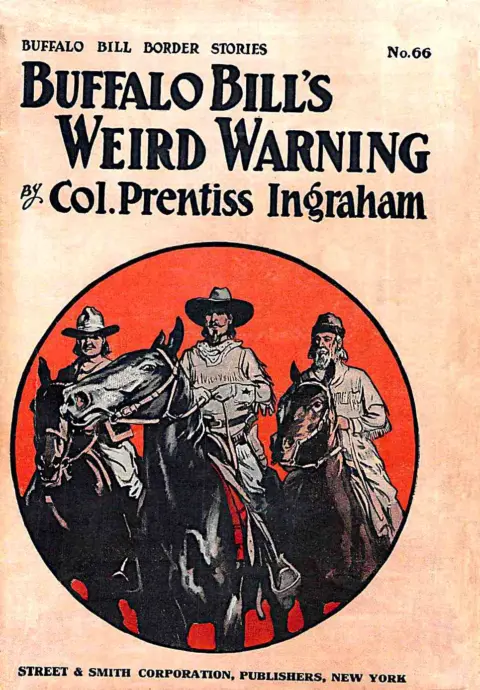
Prentiss Ingraham
BEHIND THE BOOK
This eBook is for the use of anyone anywhere in the United States and most other parts of the world at no cost and with almost no restrictions whatsoever. You may copy it, give it away or re-use it under the terms of the Project Gutenberg License included with this eBook or online at www.gutenberg.org. If you are not located in the United States, you will have to check the laws of the country where you are located before using this eBook. Read the source licence.
The original source file, including credits and licence, is retained by this library. Request an original-format copy at no charge. Please include the book title and Project Gutenberg identifier #62057.
KEEP YOUR CURIOSITY GOING
Cécile Tormay

Moritz Busch
Coulson Kernahan
John L. Ransom

Maurice Baring
Frances Wright