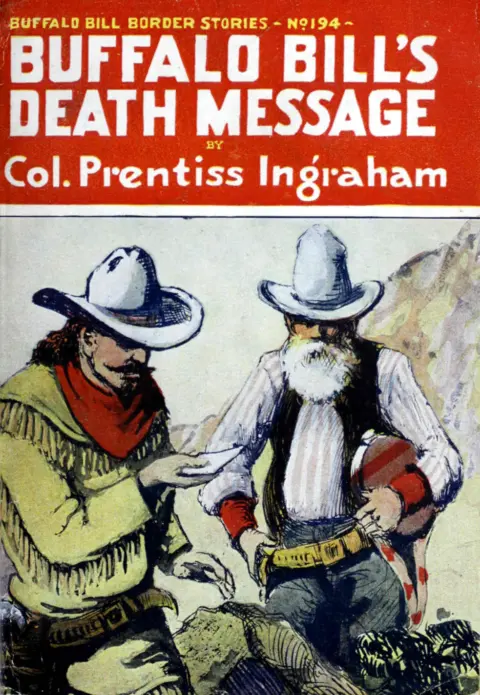
Buffalo Bill’s death message
Prentiss Ingraham
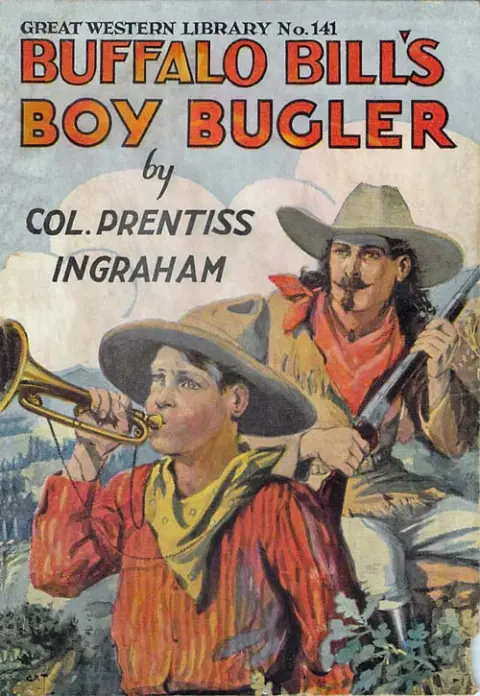
THE CLASSIC COLLECTION · 1909
"Buffalo Bill's Boy Bugler; Or, The Last of the Indian Ring" by Colonel Prentiss Ingraham is a historical novel written in the early 20th century. The narrative centers around the legendary figure Buffalo Bill (William F. Cody) and his associates as they navigate the tumultuous interactions between cattlemen and sheepmen in the Wild West, along with the impending complications involving Native American tribes. The main characters introduced include Buffalo Bill himself and a range of colorful figures such as "Red Dick," "Fighting Dan," and "Wild Bill," each embodying the fierce spirit and lawlessness of the era. At the start of the story, tensions rise in Bozeman as Red Dick and Doc Downs face trial for their violent altercations with sheep herders, which stir the local populace into a frenzy. Amidst this chaos, Buffalo Bill arrives with his companions on a government mission to address the encroachments by settlers on Native lands and to investigate corrupt government officials. As public sentiment becomes increasingly charged, Buffalo Bill's reputation precedes him, leading to confrontations with local bad men, including Fighting Dan Grey, who enters the scene with much bravado. The opening portion sets the stage for a gripping tale of adventure, conflict, and the social struggle between different factions in the evolving western landscape.
Introduction adapted from the source catalogue; source summaries may be automatically generated.
Free to read · English · 84,411 words · No account needed
MAKE TIME FOR A GOOD BOOK
On by default. Untick to stop anonymous reading totals. Each page counts after 10 seconds in view. How this works.
Anonymous counting is on unless you have switched it off.
The scout laughed and Hickok and Skibo asked for information. They hadn’t heard the joke. Nomad galloped on ahead and the scout told of the trapper’s attempt to fool Price and Bloody Ike in the cañon, by tearing out a shirt sleeve and filling it with sand to throw in the darkness for them to shoot at.
“Did they shoot at it?” asked Hickok.
“No, they threw some sort of a torch that Ike fixed up, and which lighted up the whole place so that Nomad had to skedaddle.”
The pards laughed so heartily that Nomad looked around and shook his fist at them, and then put spurs to Hide-rack and came up with the boy.
“What shall we call the boy for short?” asked the scout.
“‘Make-um-noise’ plenty short for him,” said Cayuse.
“‘Billie,’” said Skibo, “then we hab Buffalo Bill, Wild Bill, an’
Billie.”
“We are getting too many Bills and not enough receipts,” said the scout.
“Why not call him ‘Tootsie,’ in honor of his profession?” asked the
Laramie man.
“Good!” was the chorus, and “Tootsie, the boy bugler,” stuck to the boy
from that day.
At noon the party halted the horses to graze an hour, and all the others found that “Tootsie” had regained his usual demeanor and was the life of the party. His new name amused him, but he accepted it with good grace, and sang, after pulling his bugle from his saddle horn:
When Indians get funny just give ’em a toot And send ’em a-whoopin’ an’ crazy; But when you want noises, why call the galoot Called “Corey,” and “Billie,” and “Tootsie.”
Tootsie waved his bugle, danced a jig, and wound up with a
toot-toot-ta-tar-rum.
“Thet’s ther stuff, Tootsie, wake us up, er I may git ter dreamin’
ergin.”
That night they camped at the mouth of a little ravine which offered water and tender grass for the horses.
It was a beautiful night, and the scout, when the moon arose, was tempted to “stretch his legs a bit,” after a long day in the saddle, and look about the country.
Tootsie asked permission to accompany him and the request was promptly
granted.
They set out, keeping a southerly course along the bank of the ravine until they came out on a flat-topped and vertical-sided butte of considerable height.
In the hazy light they could not see far, but the soft evening breezes from the almost limitless plains came sweet and pure and dream-inducing.
Your reading position is saved on this browser. Take it to another device with a library code. Reading pages adapt to text, rather than matching a printed edition.
Prentiss Ingraham
Prentiss Ingraham
Prentiss Ingraham
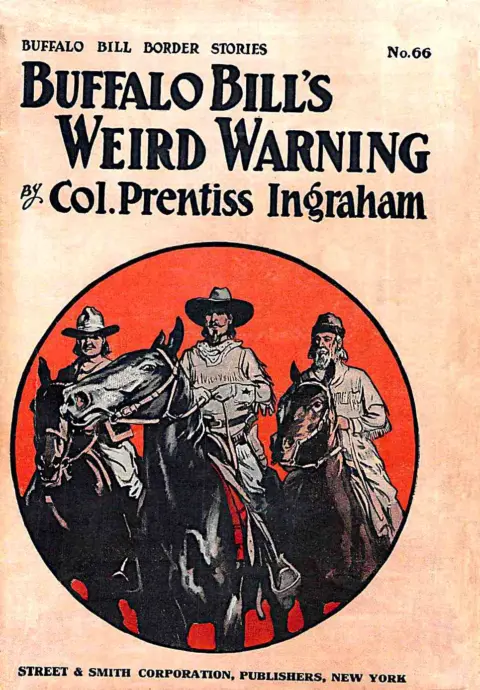
Prentiss Ingraham
BEHIND THE BOOK
This eBook is for the use of anyone anywhere in the United States and most other parts of the world at no cost and with almost no restrictions whatsoever. You may copy it, give it away or re-use it under the terms of the Project Gutenberg License included with this eBook or online at www.gutenberg.org. If you are not located in the United States, you will have to check the laws of the country where you are located before using this eBook. Read the source licence.
The original source file, including credits and licence, is retained by this library. Request an original-format copy at no charge. Please include the book title and Project Gutenberg identifier #62057.
KEEP YOUR CURIOSITY GOING
Cécile Tormay

Moritz Busch
Coulson Kernahan
John L. Ransom

Maurice Baring
Frances Wright