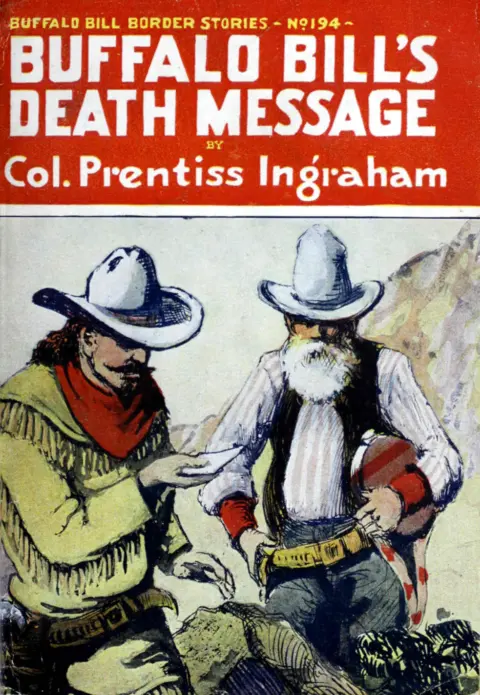
Buffalo Bill’s death message
Prentiss Ingraham
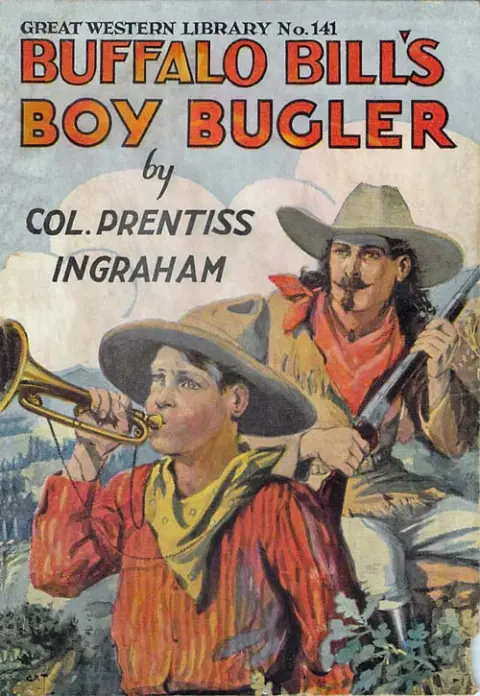
THE CLASSIC COLLECTION · 1909
"Buffalo Bill's Boy Bugler; Or, The Last of the Indian Ring" by Colonel Prentiss Ingraham is a historical novel written in the early 20th century. The narrative centers around the legendary figure Buffalo Bill (William F. Cody) and his associates as they navigate the tumultuous interactions between cattlemen and sheepmen in the Wild West, along with the impending complications involving Native American tribes. The main characters introduced include Buffalo Bill himself and a range of colorful figures such as "Red Dick," "Fighting Dan," and "Wild Bill," each embodying the fierce spirit and lawlessness of the era. At the start of the story, tensions rise in Bozeman as Red Dick and Doc Downs face trial for their violent altercations with sheep herders, which stir the local populace into a frenzy. Amidst this chaos, Buffalo Bill arrives with his companions on a government mission to address the encroachments by settlers on Native lands and to investigate corrupt government officials. As public sentiment becomes increasingly charged, Buffalo Bill's reputation precedes him, leading to confrontations with local bad men, including Fighting Dan Grey, who enters the scene with much bravado. The opening portion sets the stage for a gripping tale of adventure, conflict, and the social struggle between different factions in the evolving western landscape.
Introduction adapted from the source catalogue; source summaries may be automatically generated.
Free to read · English · 84,411 words · No account needed
MAKE TIME FOR A GOOD BOOK
On by default. Untick to stop anonymous reading totals. Each page counts after 10 seconds in view. How this works.
Anonymous counting is on unless you have switched it off.
The scout determined to return directly to the mountain retreat of the miners and hear the reports of the other parties before continuing the hunt.
He was anxious to capture Price and Ike, and he was just as desirous of getting in touch with White-man-runs-him, who had promised to guide him to the headquarters of Sitting Bull himself, somewhere along the Big Horn Cañon.
The scout had little fear of the red trailer disappointing him, for he knew Indian traits so well. He also knew that it would be useless to hunt for White-man-runs-him, and felt quite confident the trailer would show up by the allotted day on the next moon, but he wondered where the Indian could be spending the time, meanwhile.
Several days passed and the search for Price and Ike was still unrewarded. The scout and his pards had scoured the mountains for miles in every direction unavailingly. If the outlaws were there they had a safe hiding place and food supply.
But the search had brought its reward in one way, for the miners had discovered gold and a lead that promised fortune. They were happy, in consequence, and already were talking of the joys of returning East with money to pay off mortgages, buy homes, educate children, etc.
It was such as these who blazed the trail--men driven to face with grim determination the hardships of such a life, by the necessities of loved ones--wives or aged parents, who needed homes; children who deserved opportunities in the future.
One morning very early an Indian stalked into camp, much to the surprise and alarm of the miners, at first.
“How?” he said, and sat by the fire without another word.
Buffalo Bill had not arisen from his blanket, but came out, extended his hand, said “how,” and sat beside the Indian.
Neither spoke until breakfast had been prepared and eaten and the pipes had been lighted, then the Indian asked:
“Is Pa-e-has-ka ready?”
“He is, White-man-runs-him,” the scout answered.
“It is good,” said the Indian, pulling steadily at his pipe.
At last the Indian arose and said:
“Come.”
“How far?” asked the scout.
“Two suns.”
“With ponies?”
“One sun.”
“We will go with ponies,” said the scout.
“Good.”
Cayuse saddled Bear Paw and brought out the pony that had followed from the plain, for the Indian.
White-man-runs-him examined the pony carefully and expressed himself
with:
“Heap good pony.”
“Yes,” answered the scout; “he is a very good pony; he is yours.”
“Ugh!” grunted the Indian, once more going over the handsome little animal, and then swinging upon his back with evident satisfaction.
Your reading position is saved on this browser. Take it to another device with a library code. Reading pages adapt to text, rather than matching a printed edition.
Prentiss Ingraham
Prentiss Ingraham
Prentiss Ingraham
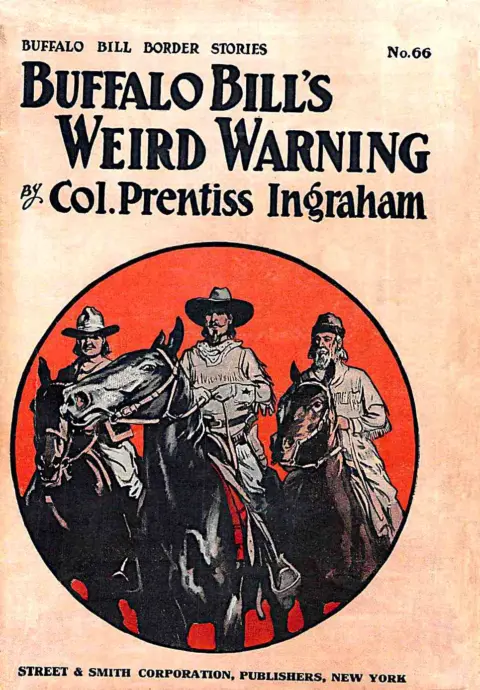
Prentiss Ingraham
BEHIND THE BOOK
This eBook is for the use of anyone anywhere in the United States and most other parts of the world at no cost and with almost no restrictions whatsoever. You may copy it, give it away or re-use it under the terms of the Project Gutenberg License included with this eBook or online at www.gutenberg.org. If you are not located in the United States, you will have to check the laws of the country where you are located before using this eBook. Read the source licence.
The original source file, including credits and licence, is retained by this library. Request an original-format copy at no charge. Please include the book title and Project Gutenberg identifier #62057.
KEEP YOUR CURIOSITY GOING
Cécile Tormay

Moritz Busch
Coulson Kernahan
John L. Ransom

Maurice Baring
Frances Wright