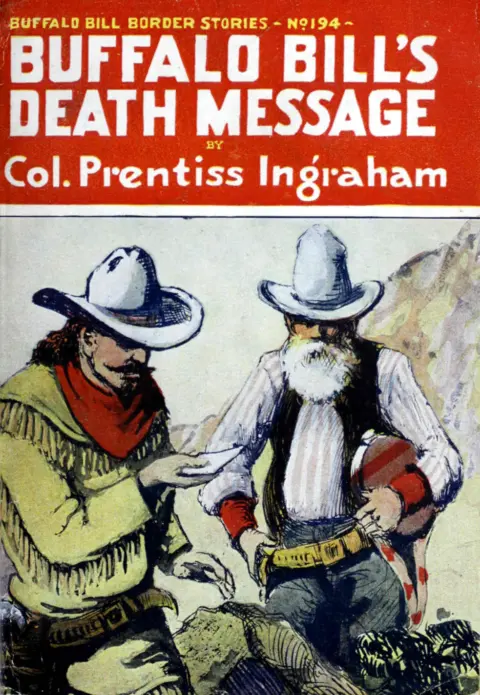
Buffalo Bill’s death message
Prentiss Ingraham
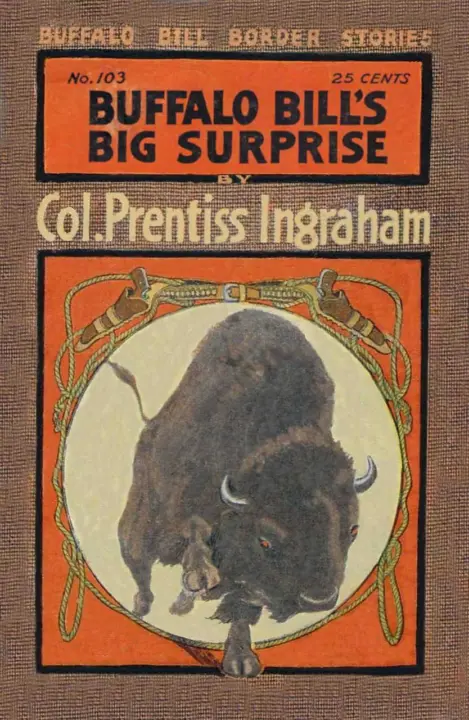
THE CLASSIC COLLECTION · 1914
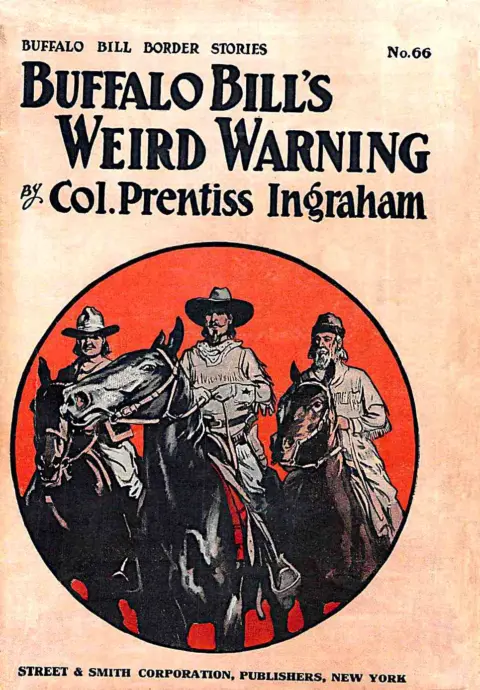
"Buffalo Bill's Big Surprise; Or, The Biggest Stampede on Record" by Colonel Prentiss Ingraham is a novel written in the early 20th century. The story revolves around the legendary figure Buffalo Bill, who, alongside his friend Colonel Carr, grapples with rising tensions as tensions escalate on the frontier due to an impending Indian uprising led by the outlaw Eagle. The novel showcases themes of adventure and heroism set against the backdrop of the American West. At the start of the book, we are introduced to Buffalo Bill and Colonel Carr at Fort Advance, where they receive alarming news from scout Hugh Hardin about a growing threat involving a large group of Native Americans and the notorious outlaw Eagle. Concerned for the safety of the region, Colonel Carr prepares his troops for a confrontation while Buffalo Bill seeks to scout ahead and gather intelligence. As the narrative unfolds, we see Sergeant Fallon preparing for a clandestine mission to infiltrate the Indian camp, setting the stage for conflicts, betrayals, and a daring rescue. The dynamic between these characters evokes a sense of tension and anticipation, foreshadowing the action-packed events to come.
Introduction adapted from the source catalogue; source summaries may be automatically generated.
Free to read · English · 70,139 words · No account needed
MAKE TIME FOR A GOOD BOOK
On by default. Untick to stop anonymous reading totals. Each page counts after 10 seconds in view. How this works.
Anonymous counting is on unless you have switched it off.
“Yellow Bird will do as the white chief bids her.”
Then they rode on, and soon halted before the cabin, which was built of hewn logs, with boards roughly sawed out of hewn timber serving as roofing. There was a porch along the front, and it was certainly a very fine cabin to find in an Indian village.
The chief took a key from a hiding place, which he appeared to know
of, and unlocked the door.
There were four rooms in the cabin, and Lucille saw that it was furnished, though rudely, for the renegade had brought his belongings with him when he had fled from his own people.
“You will be at home here, Miss Fallon.”
“Yes, at home!” repeated Lucille, with sarcasm, to add quickly:
“But it is so much better than I expected, you have treated me so much differently than I anticipated, that I thank you.”
The moment that she was left alone by the outlaw, and she saw him and his braves ride away, Lucille Fallon yielded to the prerogative of a woman, and, seating herself in the cabin, burst into tears.
“At home! Ah! if this were to be my home, I would rather that the grave should be,” she cried bitterly.
She had totally forgotten about the Indian woman until she heard the
gently uttered words:
“Don’t cry, paleface.”
She started to her feet, for she was too proud to wish any one to see
her weeping.
Before her stood Yellow Bird, the half-breed Indian woman. She had tidied herself up, and had a bundle under her arms. Her face was a good one, not cruel, and she said again:
“Don’t cry, Yellow Bird be good to you.”
Lucille stepped forward and grasped the woman’s hand.
“You are good, I can see that. You have lived among the palefaces,
the outlaw told me?”
“Yes, my mother was a paleface squaw, my father a great Indian chief. He died, and my mother went back to her people, taking me with her. She died, and I work hard for officer’s family at fort far away. I hear them say: ‘She only half-breed Injun; watch her.’ I feel mad, I feel bad, and run away back to my people. But some treat me good, one young squaw pretty, just like you, and I love her. I love you for her. Yellow Bird be good to you.”
The tears came into the eyes of Lucille, and, stepping close up to
the woman, she kissed her.
It was under the impulse of her loneliness, her sorrow, her helplessness, and the kind words spoken to her.
Your reading position is saved on this browser. Take it to another device with a library code. Reading pages adapt to text, rather than matching a printed edition.
Prentiss Ingraham
Prentiss Ingraham
Prentiss Ingraham
Prentiss Ingraham
BEHIND THE BOOK
This eBook is for the use of anyone anywhere in the United States and most other parts of the world at no cost and with almost no restrictions whatsoever. You may copy it, give it away or re-use it under the terms of the Project Gutenberg License included with this eBook or online at www.gutenberg.org. If you are not located in the United States, you will have to check the laws of the country where you are located before using this eBook. Read the source licence.
The original source file, including credits and licence, is retained by this library. Request an original-format copy at no charge. Please include the book title and Project Gutenberg identifier #64262.
KEEP YOUR CURIOSITY GOING
Coulson Kernahan

Maurice Baring
Frances Wright
Cécile Tormay

Frederic Jesup Stimson

W. H. P. (William Henry Pope) Jarvis