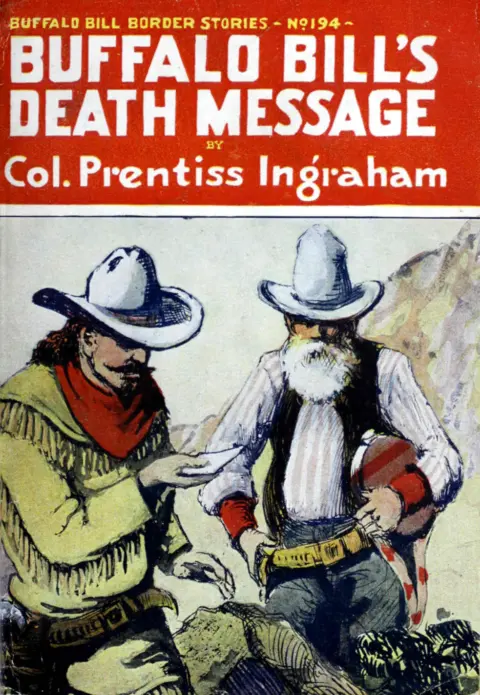
Buffalo Bill’s death message
Prentiss Ingraham
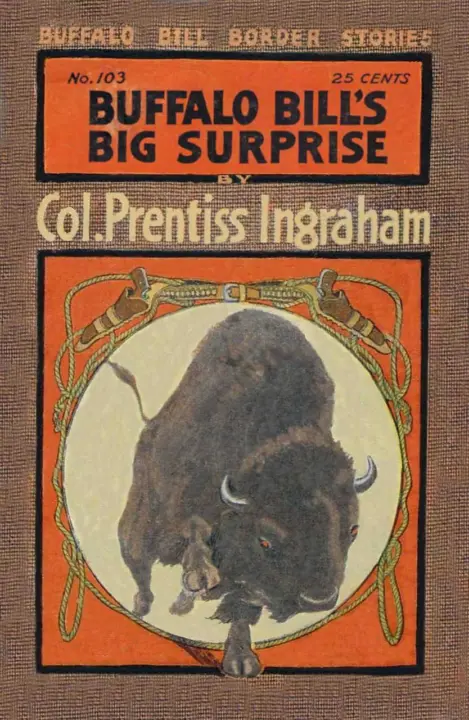
THE CLASSIC COLLECTION · 1914
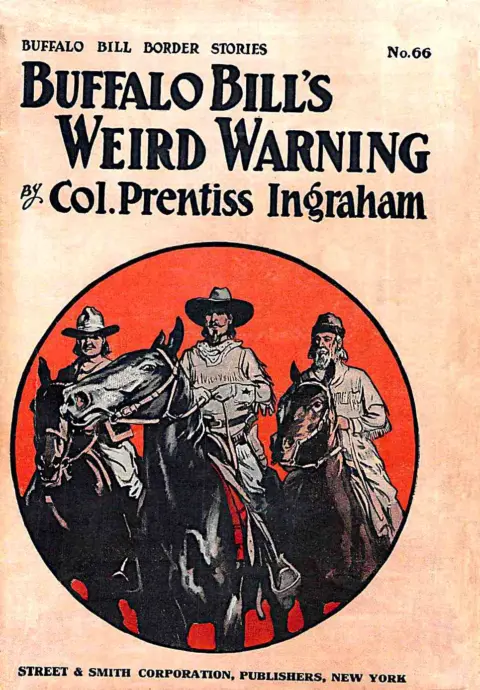
"Buffalo Bill's Big Surprise; Or, The Biggest Stampede on Record" by Colonel Prentiss Ingraham is a novel written in the early 20th century. The story revolves around the legendary figure Buffalo Bill, who, alongside his friend Colonel Carr, grapples with rising tensions as tensions escalate on the frontier due to an impending Indian uprising led by the outlaw Eagle. The novel showcases themes of adventure and heroism set against the backdrop of the American West. At the start of the book, we are introduced to Buffalo Bill and Colonel Carr at Fort Advance, where they receive alarming news from scout Hugh Hardin about a growing threat involving a large group of Native Americans and the notorious outlaw Eagle. Concerned for the safety of the region, Colonel Carr prepares his troops for a confrontation while Buffalo Bill seeks to scout ahead and gather intelligence. As the narrative unfolds, we see Sergeant Fallon preparing for a clandestine mission to infiltrate the Indian camp, setting the stage for conflicts, betrayals, and a daring rescue. The dynamic between these characters evokes a sense of tension and anticipation, foreshadowing the action-packed events to come.
Introduction adapted from the source catalogue; source summaries may be automatically generated.
Free to read · English · 70,139 words · No account needed
MAKE TIME FOR A GOOD BOOK
On by default. Untick to stop anonymous reading totals. Each page counts after 10 seconds in view. How this works.
Anonymous counting is on unless you have switched it off.
When the three forces got under way they marched at a speed according to the distance they had to travel, that all might make the same camp the first night on the way.
The command from the lower ford made twenty miles, and, camping
early, they were joined in the afternoon by the party under
Lieutenant Worth.
At dark the third command, under Lieutenant Percy, came in, and
Walter Worth surveyed his little army with pride at being the
superior officer.
When they pulled out from camp early the next morning, seeing that the news that the outlaw had gone to Pioneer City made Sergeant Fallon anxious, he said to him:
“Sergeant, you and Buffalo Bill can push on ahead to the fort, for the command cannot get in to-night without crowding the horses very hard and riding late, and there is no necessity for either.”
The face of the sergeant brightened at the order of the lieutenant,
and he said:
“Thank you, sir; I shall be most happy to go on ahead.”
“Say to Colonel Carr I will arrive with the command to-morrow, not caring to push the cattle.”
“Yes, sir.”
The sergeant at once reported to Buffalo Bill what the lieutenant had said, and the two started off at a pace more than double that at which the troops were traveling, retarded as they were by the guns, a couple of ambulances, and some pack mules.
The sun was yet above the horizon when the sentinel on the watchtower reported the coming of two horsemen by the trail leading to the Indian country.
The coming of the scout and Sergeant Fallon was soon reported to the
colonel.
Their stories were told, the sergeant telling his first, and both
were listened to with the greatest attention by the colonel, who then
said:
“Sergeant, your daring and gallant conduct shall be reported, with a strong recommendation, added to others already sent to Washington, for your promotion to a lieutenancy.”
“I thank you, sir.”
“It will be a well-won appointment, sergeant, but, as you request it, it will be best to say as little as possible about your going into the Indian lines, as it might reach the ears of the outlaw, who you say left the camps after your first visit, presumably going to Pioneer City.”
“Yes, sir.”
“Then he will be up to more deviltry, I fear; but, sergeant, your daughter is not here, you know, or had you heard of her departure?”
“My daughter not here, sir?” Sergeant Fallon’s face turned to the hue
of death.
Your reading position is saved on this browser. Take it to another device with a library code. Reading pages adapt to text, rather than matching a printed edition.
Prentiss Ingraham
Prentiss Ingraham
Prentiss Ingraham
Prentiss Ingraham
BEHIND THE BOOK
This eBook is for the use of anyone anywhere in the United States and most other parts of the world at no cost and with almost no restrictions whatsoever. You may copy it, give it away or re-use it under the terms of the Project Gutenberg License included with this eBook or online at www.gutenberg.org. If you are not located in the United States, you will have to check the laws of the country where you are located before using this eBook. Read the source licence.
The original source file, including credits and licence, is retained by this library. Request an original-format copy at no charge. Please include the book title and Project Gutenberg identifier #64262.
KEEP YOUR CURIOSITY GOING
Coulson Kernahan

Maurice Baring
Frances Wright
Cécile Tormay

Frederic Jesup Stimson

W. H. P. (William Henry Pope) Jarvis