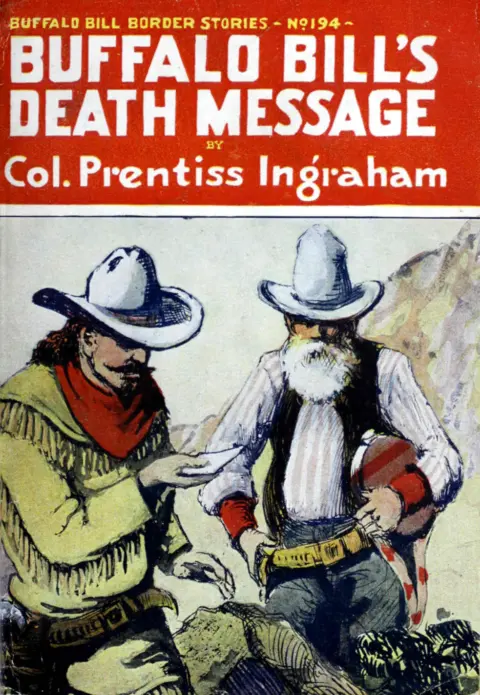
Buffalo Bill’s death message
Prentiss Ingraham
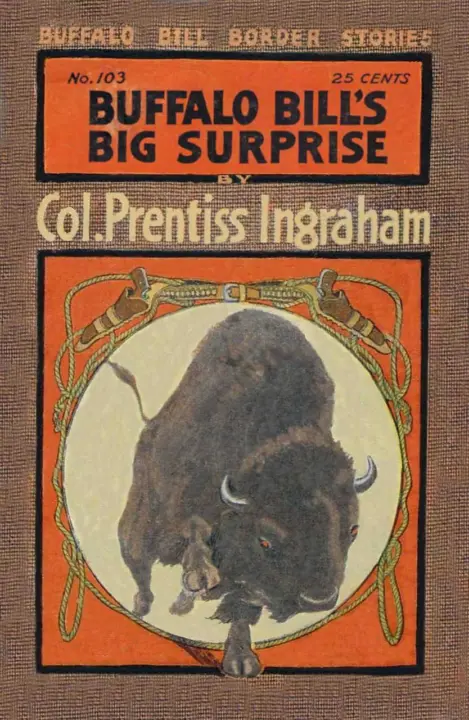
THE CLASSIC COLLECTION · 1914
"Buffalo Bill's Big Surprise; Or, The Biggest Stampede on Record" by Colonel Prentiss Ingraham is a novel written in the early 20th century. The story revolves around the legendary figure Buffalo Bill, who, alongside his friend Colonel Carr, grapples with rising tensions as tensions escalate on the frontier due to an impending Indian uprising led by the outlaw Eagle. The novel showcases themes of adventure and heroism set against the backdrop of the American West. At the start of the book, we are introduced to Buffalo Bill and Colonel Carr at Fort Advance, where they receive alarming news from scout Hugh Hardin about a growing threat involving a large group of Native Americans and the notorious outlaw Eagle. Concerned for the safety of the region, Colonel Carr prepares his troops for a confrontation while Buffalo Bill seeks to scout ahead and gather intelligence. As the narrative unfolds, we see Sergeant Fallon preparing for a clandestine mission to infiltrate the Indian camp, setting the stage for conflicts, betrayals, and a daring rescue. The dynamic between these characters evokes a sense of tension and anticipation, foreshadowing the action-packed events to come.
Introduction adapted from the source catalogue; source summaries may be automatically generated.
Free to read · English · 70,139 words · No account needed
MAKE TIME FOR A GOOD BOOK
On by default. Untick to stop anonymous reading totals. Each page counts after 10 seconds in view. How this works.
Anonymous counting is on unless you have switched it off.
Again startled yells answered, and then half a dozen more shells went crashing into the timber on the other side.
“Give them a couple of shots just at dawn, Benedict, and the other camps will do the same to show them that we have guns at each ford.
“We will camp at the fords for a couple of days yet, and then return by easy marches to the fort, for I do not believe a redskin will venture across the river for a long while to come. Eh, Cody?”
“I do not think so, either, sir, unless Eagle, the outlaw, puts them up to some act of deviltry,” was the scout’s answer, and, after a snack, the lieutenant and his two companions returned to their own camp.
The stay of the commands at the fords was continued for three days longer, and every morning and evening what the troops called the “sunrise and sunset guns” were fired across the river at the Indian camps, the guns being loaded with shell.
Since the first night of the firing not an Indian had been seen or heard. They were either gone or in hiding farther off.
Sergeant Fallon volunteered to go across and discover, making the site of the three fords in the night along the trail upon the other side, but Lieutenant Worth said that he did not care to have him take any more chances.
Then the sergeant said it would be well for him to cross just where he had before, and let the Indians feel that he was still trying to serve them, also giving them another ghost story about the troops intending to remain for some time.
Thus urged, the lieutenant yielded, and, rigging out in his Indian costume once more, Sergeant Fallon rode slowly away from the fort after supper one night.
Lieutenant Worth and Buffalo Bill accompanied him to the river, and
then waited.
It was bright moonlight, and the other shore could be plainly seen, the officer and the scout watching the sergeant all the way across and until he disappeared in the shadows of the other side.
They waited two hours before they saw him come again into sight. He rode into the river, came across, and joined them back in the shadows on the ridge.
“Have they gone, sergeant?” asked the officer.
“No, sir, they are there, only camped well back, and with half a dozen braves on guard at a time, while their force now numbers a couple of hundred men at each ford.”
“Give me the location of their camp, and we will toss a shell over
there in the morning.”
Your reading position is saved on this browser. Take it to another device with a library code. Reading pages adapt to text, rather than matching a printed edition.
Prentiss Ingraham
Prentiss Ingraham
Prentiss Ingraham
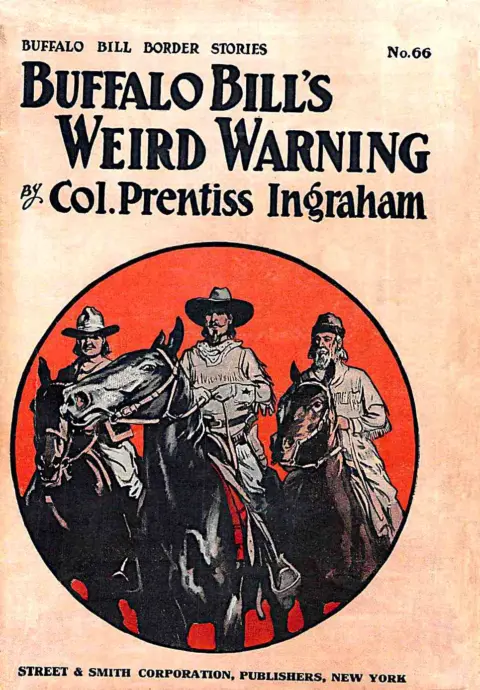
Prentiss Ingraham
BEHIND THE BOOK
This eBook is for the use of anyone anywhere in the United States and most other parts of the world at no cost and with almost no restrictions whatsoever. You may copy it, give it away or re-use it under the terms of the Project Gutenberg License included with this eBook or online at www.gutenberg.org. If you are not located in the United States, you will have to check the laws of the country where you are located before using this eBook. Read the source licence.
The original source file, including credits and licence, is retained by this library. Request an original-format copy at no charge. Please include the book title and Project Gutenberg identifier #64262.
KEEP YOUR CURIOSITY GOING
Coulson Kernahan

Maurice Baring
Frances Wright
Cécile Tormay

Frederic Jesup Stimson

W. H. P. (William Henry Pope) Jarvis