The Treasure of Hidden Valley
Willis George Emerson
THE CLASSIC COLLECTION · 1902
"Buell Hampton" by Willis George Emerson is a novel written in the early 20th century. The story is set against the backdrop of the American Southwest and revolves around themes of ambition, social status, and romantic entanglements, primarily through the experiences of young Ethel Horton and the significant figures surrounding her, including her mother, Mrs. J. Bruce-Horton, and the cattle king John Horton. The opening portion introduces Ethel Horton, an American girl returning from an English education, and her mother, who longs for her daughter to marry into titled society. The narrative begins with a lively tennis match that reveals Ethel's spirited nature, while her mother engages in conversation with a friend, setting the stage for the societal aspirations that drive their lives. Mere moments later, Ethel’s interactions, as well as her delight in returning home, quickly set up the implications of family expectations and societal pressures. As the story unfolds, it hints at the growing tensions between the well-to-do and the farmers in their community, particularly with the cattle baron Horton at the center of the local landscape. This context establishes a rich setting filled with potential conflicts based on class, ambition, and the characters' personal journeys.
Introduction adapted from the source catalogue; source summaries may be automatically generated.
Free to read · English · 87,915 words · No account needed
MAKE TIME FOR A GOOD BOOK
On by default. Untick to stop anonymous reading totals. Each page counts after 10 seconds in view. How this works.
Anonymous counting is on unless you have switched it off.
“Papa says he fears you will also go away now that the hot winds have destroyed the crops and the big fire has generally devastated the country.”
Hugh shrugged his shoulders. “The greater the pressure, the better the wine.” He laughed a little and continued, “The test has been a crucial one. Perhaps I will be compelled to go. When one is conquered, the surrender should be unconditional.”
“That might be true of a woman,” said Marie, “but a man should resist.”
“And why of a woman more than of a man?” inquired Hugh.
“A man has greater strength,” she replied. “A woman is all heart and sentiment, and, while her fortress is a strong one, yet she expects to be conquered, and once she surrenders, she loves no one more than her conqueror.”
Hugh thought for a moment and then said, “Yes, I presume that is the rule.”
“Not the rule, but the condition,” replied Marie.
“But there are rules that govern lives,” persisted Hugh. “Do you not think so?”
“Perhaps in a commercial sense, but not in love affairs,” said Marie, laughing. “Now what sort of a rule could possibly have governed Ethel and her lover?”
“Certainly a poor one,” replied Hugh.
“Are you quite sure, Mr. Stanton, that this Dr. Jack Redfield loves Ethel as a hero in a novel seems to love his fiancie?”
“The illusion seems to be perfect,” replied Hugh, smiling.
“Do you believe in love, Mr. Stanton?” asked Marie, demurely.
“Yes, I presume there is such a sentiment,” replied Hugh.
“And do you think,” Marie went on, “that true love will endure any sort of a test?”
“I do not know, I’m sure,” said Hugh.
“Well,” persisted Marie, “what is the test of a man’s love for a woman?”
“The test,” replied Hugh, “of a man’s love for a woman?” He looked afar across the valley as if meditatively weighing the question that has perplexed the sages of all centuries. Finally he said, “A man not infrequently lies with reckless prodigality to the woman he truly loves, while to those toward whom he entertains sentiments of indifference he will confess the truth without clothing it with sufficient covering to even hide its nakedness.”
“I do not believe in your definition at all,” said Marie, with heightened color, “and I look upon rules as the most worthless baggage with which a life can be encumbered. A principle may apply to all conditions, but a rule is narrow; while your idea of love’s test is horrid.”
Your reading position is saved on this browser. Take it to another device with a library code. Reading pages adapt to text, rather than matching a printed edition.
Willis George Emerson
Willis George Emerson
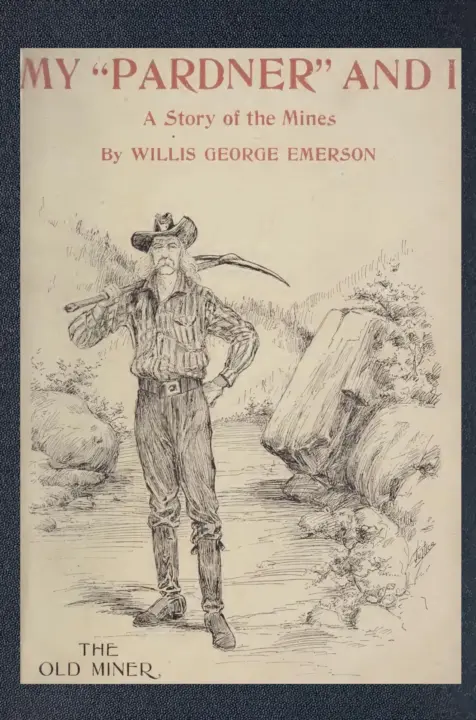
Willis George Emerson
Willis George Emerson
BEHIND THE BOOK
This eBook is for the use of anyone anywhere in the United States and most other parts of the world at no cost and with almost no restrictions whatsoever. You may copy it, give it away or re-use it under the terms of the Project Gutenberg License included with this eBook or online at www.gutenberg.org. If you are not located in the United States, you will have to check the laws of the country where you are located before using this eBook. Read the source licence.
The original source file, including credits and licence, is retained by this library. Request an original-format copy at no charge. Please include the book title and Project Gutenberg identifier #52449.
KEEP YOUR CURIOSITY GOING
Coulson Kernahan

Maurice Baring
Frances Wright
Cécile Tormay

Frederic Jesup Stimson

W. H. P. (William Henry Pope) Jarvis