The Treasure of Hidden Valley
Willis George Emerson
THE CLASSIC COLLECTION · 1902
"Buell Hampton" by Willis George Emerson is a novel written in the early 20th century. The story is set against the backdrop of the American Southwest and revolves around themes of ambition, social status, and romantic entanglements, primarily through the experiences of young Ethel Horton and the significant figures surrounding her, including her mother, Mrs. J. Bruce-Horton, and the cattle king John Horton. The opening portion introduces Ethel Horton, an American girl returning from an English education, and her mother, who longs for her daughter to marry into titled society. The narrative begins with a lively tennis match that reveals Ethel's spirited nature, while her mother engages in conversation with a friend, setting the stage for the societal aspirations that drive their lives. Mere moments later, Ethel’s interactions, as well as her delight in returning home, quickly set up the implications of family expectations and societal pressures. As the story unfolds, it hints at the growing tensions between the well-to-do and the farmers in their community, particularly with the cattle baron Horton at the center of the local landscape. This context establishes a rich setting filled with potential conflicts based on class, ambition, and the characters' personal journeys.
Introduction adapted from the source catalogue; source summaries may be automatically generated.
Free to read · English · 87,915 words · No account needed
MAKE TIME FOR A GOOD BOOK
On by default. Untick to stop anonymous reading totals. Each page counts after 10 seconds in view. How this works.
Anonymous counting is on unless you have switched it off.
They talked far into the night, but this did not deter them from arising early next morning and making ready for a horseback ride. Immediately after breakfast they set out for Martilla, a little village some fifteen miles to the northwest.
“I want to show you Kansas,” said Hugh, “and there is no better way for you to meet the people and familiarize yourself with their customs. The recent heavy rain has made the country look habitable again. If the rains had only come before the hot winds, why—we would have had no hot winds, and plenty instead of poverty would now be the farmer’s lot, to say nothing of my own condition.”
The morning was an ideal one. There was an exhilarating tonic in the soft west winds. Vast herds dotted the prairie. The catde, in their lazy, contented way, went on biting shorter the short, green buffalo-grass.
A little way on, at the side of the road, lay a cowboy reading, while his bronco was near him, munching and browsing. As they drew near, Hugh exclaimed, “Why, it’s Seaton Cornwall, my English friend!” They reined their horses and dismounted.
Seaton Cornwall arose from where he had been lying, laid aside his book and came toward them. After an introduction, Doctor Redfield observed: “I see you pass some of your time reading. An interesting novel, I suppose?”
“No, I was reading ‘Plutarch’s Lives,’ replied Cornwall. Since leaving Oxford I have never been able to give up entirely my admiration for some of the old masters, and, notwithstanding my home is on a catde range, I still find great pleasure in keeping up my studies.”
“Mr. Cornwall,” interposed Hugh, “is one of my earliest acquaintances in Kansas, and, while he is of English birth and a lover of his native land, still, he admires America and American institutions.”
“Yes,” said Cornwall, “instead of hearing the music of ‘God Save the Queen’ out here, or even my ‘My Country, ‘T is of Thee,’ I listen to the lowing of herds, the bawl of mavericks, the yelp of coyotes, and the howl of wolves. However, I am not lonely, for I have quite a number of books with me.”
“I hope you like America?” Doctor Redfield interrogated.
“Very much, indeed,” replied Cornwall. “There are opportunities here which England can never give to her people. I love the land of my birth, I love Englishmen and English ways,—I none the less, however, love democratic America and the opportunities that it affords. We are one race, anyway, speaking a common language and closely allied on all international subjects.”
Your reading position is saved on this browser. Take it to another device with a library code. Reading pages adapt to text, rather than matching a printed edition.
Willis George Emerson
Willis George Emerson
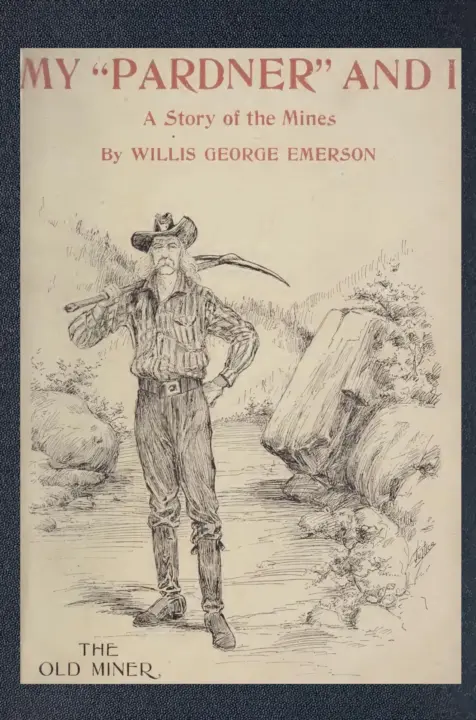
Willis George Emerson
Willis George Emerson
BEHIND THE BOOK
This eBook is for the use of anyone anywhere in the United States and most other parts of the world at no cost and with almost no restrictions whatsoever. You may copy it, give it away or re-use it under the terms of the Project Gutenberg License included with this eBook or online at www.gutenberg.org. If you are not located in the United States, you will have to check the laws of the country where you are located before using this eBook. Read the source licence.
The original source file, including credits and licence, is retained by this library. Request an original-format copy at no charge. Please include the book title and Project Gutenberg identifier #52449.
KEEP YOUR CURIOSITY GOING
Coulson Kernahan

Maurice Baring
Frances Wright
Cécile Tormay

Frederic Jesup Stimson

W. H. P. (William Henry Pope) Jarvis