
Last letters from the living dead man
David Patterson (Spirit) Hatch
THE CLASSIC COLLECTION · 1890
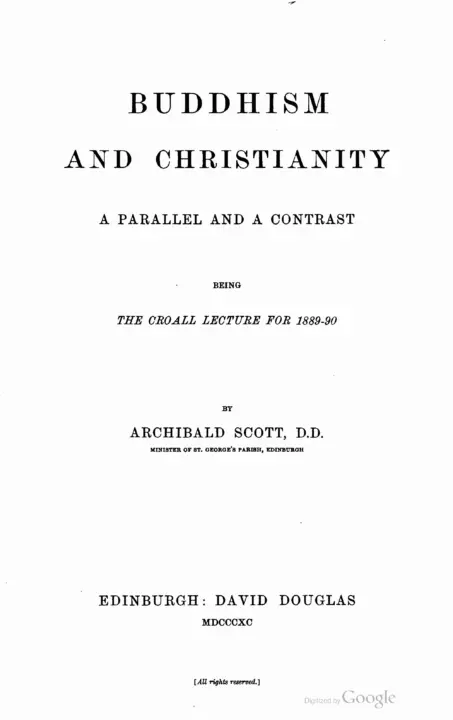
"Buddhism and Christianity: A Parallel and a Contrast" by Archibald Scott is a scholarly examination of the similarities and differences between Buddhism and Christianity, written in the late 19th century. This work presents a series of lectures, focusing on a comparative analysis of the two religions, to illuminate their unique features as well as their shared elements. Scott aims to foster a deeper understanding of both faiths, suggesting that studying these religions can enhance Christian appreciation for its own beliefs. The opening of the text provides a preface where Scott acknowledges the complexity of both religions and expresses a commitment to presenting Buddhism fairly, despite its historical misrepresentations. He highlights the significance of Buddhism as a major world religion that offers insights into human life and ethics. Scott also stresses the importance of comparative theology in strengthening Christianity rather than undermining it, encouraging an impartial study to discern universal truths that resonate within both traditions. He outlines the necessity to explore the distinct origins and developments of each faith while establishing a framework for a fruitful dialogue between the two.
Introduction adapted from the source catalogue; source summaries may be automatically generated.
Free to read · English · 95,734 words · No account needed
MAKE TIME FOR A GOOD BOOK
On by default. Untick to stop anonymous reading totals. Each page counts after 10 seconds in view. How this works.
Anonymous counting is on unless you have switched it off.
Footnote 120:
E.g. Sinai = Hagar (Gal. iv. 24-31); also Claudius = ὁ κατέχων (2 Thess. ii. 6, 7); Hausrath, Life and Times of Jesus, vol. i. p. 77.
Footnote 121:
Derenbourg, Hist. de la Palestine d’après les Talmuds, pp. 159, 202.
Footnote 122:
Wellhausen, The Pharisees and Sadducees, pp. 8, 26-43; Greifswald,
1874.
Footnote 123:
Jos. Antiq. xiii. 5. 9, xv. 10. 4, 5; Bell. Jud. ii. 8. 2, 14.
Footnote 124:
Keim, Jesus of Nazara, vol. i. p. 392.
Footnote 125:
Delitzsch, Jesus and Hillel, pp. 31 seq.; Pirké Abôth, Cambridge,
1877, passim.
Footnote 126:
Jos. Antiq. xvii. 4.
Footnote 127:
Philo, Quod omnis Probus Liber, p. 12.
Footnote 128:
Bühler, Ind. Ant. vol. vii. p. 143; Jacobi, “Mahâvira and his Predecessors,” Ind. Ant. vol. viii. pp. 311-314; Kern, History of Buddhism in India, vol. i. p. 143; Colebrooke’s Essays, vol. i. p. 380.
Footnote 129:
See “Jainism,” by Dr. Shoolbred—Report of the Missionary Conference, 1888, vol. i. p. 41; Wilson’s Essays, vol. i. p. 427 seq.
Footnote 130:
“Sramana,” in Brahman speech, was a man who performed hard penances, from sram, to work hard. There is another Sanscrit root, sam, to quiet, and from it afterwards the popular etymology derived the word. See Professor Max Müller’s translation of the Dhammapada in Sacred Books of the East, vol. x. p. 65 note.
Footnote 131:
There seems to have been four great divisions of Sramanas, with as many as sixty-three philosophical systems represented by them. The Brahmanas were also similarly divided. See Sutta Nipâta, Sacred Books of the East, vol. xi. Part ii. pp. 15, 16, 88, 93.
Footnote 132:
Oldenberg, Buddha, etc., p. 71.
Footnote 133:
See Year-Book of Protestant Theology for 1883 for an account of the views of Professor Loman of Amsterdam.
Footnote 134:
M. Senart, Legend of Buddha, Paris, 1875; Kern, History of Buddhism in India: Schoebel. Buddh. Actes de la Soc. Philol.; Paris, 1874, vol iv. pp. 160 seq.
Footnote 135:
Annual Report of the Asiatic Society; Paris, July 1875.
Footnote 136:
Cunningham, Ancient Geog. of India, vol. i. p. 147; Oldenberg, Buddha, etc., p. 95; Beal, Chinese Buddhism, p. 67.
Footnote 137:
“Mâra eat le démon de l’amour, du péché et de la mort,” says Burnouf in his Introduction to the Study of Indian Buddism, p. 76; see also Sutta Nipâta, Sacred Books of the East, vol. x. Part ii. p. 159, for the popular conception of Buddha’s temptation; the arrows of Mâra are “flower-pointed,” like Kama’s, the Hindu god of love. See Dhammapada, Sacred Books of the East, vol. x. Part i. p. 17.
Footnote 138:
Geikie, Life of Christ, vol. i. p. 449.
Footnote 139:
Mahavagga, i. 5. 2; Sacred Books of the East, vol. xvii.
Footnote 140:
Your reading position is saved on this browser. Take it to another device with a library code. Reading pages adapt to text, rather than matching a printed edition.
BEHIND THE BOOK
This eBook is for the use of anyone anywhere in the United States and most other parts of the world at no cost and with almost no restrictions whatsoever. You may copy it, give it away or re-use it under the terms of the Project Gutenberg License included with this eBook or online at www.gutenberg.org. If you are not located in the United States, you will have to check the laws of the country where you are located before using this eBook. Read the source licence.
The original source file, including credits and licence, is retained by this library. Request an original-format copy at no charge. Please include the book title and Project Gutenberg identifier #67171.
KEEP YOUR CURIOSITY GOING
David Patterson (Spirit) Hatch

David Patterson (Spirit) Hatch

David Patterson (Spirit) Hatch

Edwin Abbott Abbott

Richard Watson
T. G. (Theophilus Gould) Steward