
Last letters from the living dead man
David Patterson (Spirit) Hatch
THE CLASSIC COLLECTION · 1890
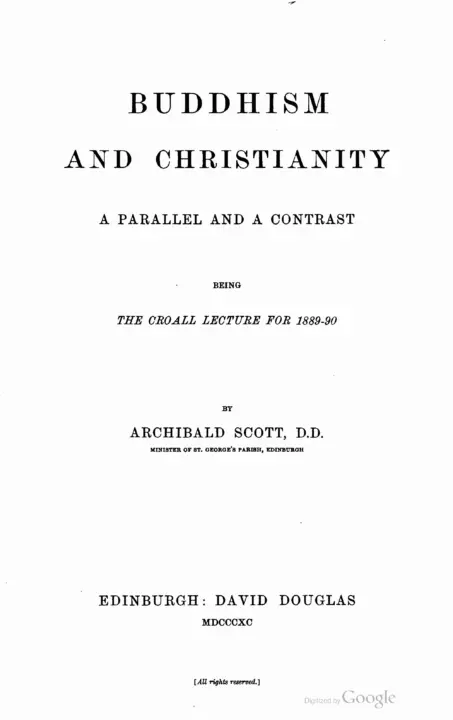
"Buddhism and Christianity: A Parallel and a Contrast" by Archibald Scott is a scholarly examination of the similarities and differences between Buddhism and Christianity, written in the late 19th century. This work presents a series of lectures, focusing on a comparative analysis of the two religions, to illuminate their unique features as well as their shared elements. Scott aims to foster a deeper understanding of both faiths, suggesting that studying these religions can enhance Christian appreciation for its own beliefs. The opening of the text provides a preface where Scott acknowledges the complexity of both religions and expresses a commitment to presenting Buddhism fairly, despite its historical misrepresentations. He highlights the significance of Buddhism as a major world religion that offers insights into human life and ethics. Scott also stresses the importance of comparative theology in strengthening Christianity rather than undermining it, encouraging an impartial study to discern universal truths that resonate within both traditions. He outlines the necessity to explore the distinct origins and developments of each faith while establishing a framework for a fruitful dialogue between the two.
Introduction adapted from the source catalogue; source summaries may be automatically generated.
Free to read · English · 95,734 words · No account needed
MAKE TIME FOR A GOOD BOOK
On by default. Untick to stop anonymous reading totals. Each page counts after 10 seconds in view. How this works.
Anonymous counting is on unless you have switched it off.
But Christianity from the very earliest possessed what Buddhism for a long period lacked. In its canonical writings it conserved not only a check upon this apostasy, but a security for reformation. Mechanical though it seems, there was a providence in the early committal to writing of such books as compose our Bibles. In the fact that their successive disclosures of truth were thus registered there is more significance than at first appears. It is admitted by all that man’s progress depends in no small degree on his ability to secure and hand down the treasures of his wisdom and experience. The art of writing is thus recognised to be one of the most moving powers in the world. The nations that have depended upon it for the transmission of knowledge inherited or acquired, have certainly made more progress in religion and civilisation than those that have neglected or despised it. It is significant that the writers of the Bible have all recognised this condition of human progress, and that many of them have represented themselves as instructed by the Divine authority, from whom they profess to have received their communications, to make them permanent in popular language and in plain written form.[79]
In the history of the Hebrews there is not a single recorded instance of religious reformation in which the law and the testimony, or the scrolls of the prophets, did not play an important part. In like manner the New Testament, which embodies the ideals and perpetuates the standard which is to regulate its course, not only saved Christianity from the perils which threatened its earliest spread, but has often rescued it from the degradation into which it has fallen. Canonical books may only give, as it has been said, “the reflected image of the real doctrines of the founder of a religion, an image always blurred and distorted by the medium through which it has to pass”;[80] but in the case of the New Testament the Church has never developed, or thought it possible to develop, a purer reflection. Advance as it may, the Church never can outgrow the ideals of its youth, and change what it pleases, it never can improve them. Whenever the Church assumed supremacy over its law, and whenever tradition superseded its testimony, it yielded to the disintegrating influences of heathenism. It was rapidly lapsing into polytheism when Mohammed rose with a spurious and mutilated version of the Scriptures to recall it to the witness of true Scriptures to the unity and sovereignty of God. Later on, when sinking through formalism into superstition and sorcery almost as degrading as any Indian, Luther, by the re-discovery of the Greek Testament, brought about a reformation which not only saved Europe, but has created a new Western and Southern world. In every revival and every advance which has taken place since then there may be traced, directly or indirectly, the regenerative influences of the Christian originals. On its human side the Christian Church will always be in danger of losing its pure conceptions and noble aims in grosser forms of belief and in lower ambitions; but high over all its degradation towers in its early Scriptures the majesty and spirituality of its Divine authority, and we have only to look up to be first convicted, then attracted and redeemed. The purest sections of the Christian Church, the surest and the first to outgrow all unworthy expressions of Christianity, are those which adhere most closely to the original rule of faith and worship. It is quite possible that we “may be only too apt to make a fetich of our sacred books”;[81] but somehow the Christian communities that most revere their sacred books show that they are least likely to fall into this danger. The more we obey the Scriptures, the less likely are we to idolise them. The New Testament, so far from attaching any mystical or talismanic value to its contents, tells us that the letter killeth, and the spirit alone giveth life. It is otherwise with the Buddhist Tripitaka. Its authors claim meritorious efficacy not only for the repetition of its sentences, but for the very sound of its words, “as if they were capable of elevating every one who hears them to heavenly abodes in future existence.” Sir Monier Williams has illustrated this by a legend long current, not in northern Buddhist countries, but in Ceylon, where a purer Buddhism prevails. According to it, two monks were heard by five hundred bats reciting in a cave the law of Buddha, and they by merely hearing gained such merit that in death they were re-born as men, and ultimately through successive re-births were raised to the fellowship of the gods.[82] Of course this is simply a legend, a thing of hay or straw that has got mixed with the purer primitive faith; but it indicates that the course of the current flows in quite an opposite direction from the faith which allows itself to be dominated and guided by the canon of Holy Scriptures.
Your reading position is saved on this browser. Take it to another device with a library code. Reading pages adapt to text, rather than matching a printed edition.
BEHIND THE BOOK
This eBook is for the use of anyone anywhere in the United States and most other parts of the world at no cost and with almost no restrictions whatsoever. You may copy it, give it away or re-use it under the terms of the Project Gutenberg License included with this eBook or online at www.gutenberg.org. If you are not located in the United States, you will have to check the laws of the country where you are located before using this eBook. Read the source licence.
The original source file, including credits and licence, is retained by this library. Request an original-format copy at no charge. Please include the book title and Project Gutenberg identifier #67171.
KEEP YOUR CURIOSITY GOING
David Patterson (Spirit) Hatch

David Patterson (Spirit) Hatch

David Patterson (Spirit) Hatch

Edwin Abbott Abbott

Richard Watson
T. G. (Theophilus Gould) Steward