
Last letters from the living dead man
David Patterson (Spirit) Hatch
THE CLASSIC COLLECTION · 1890
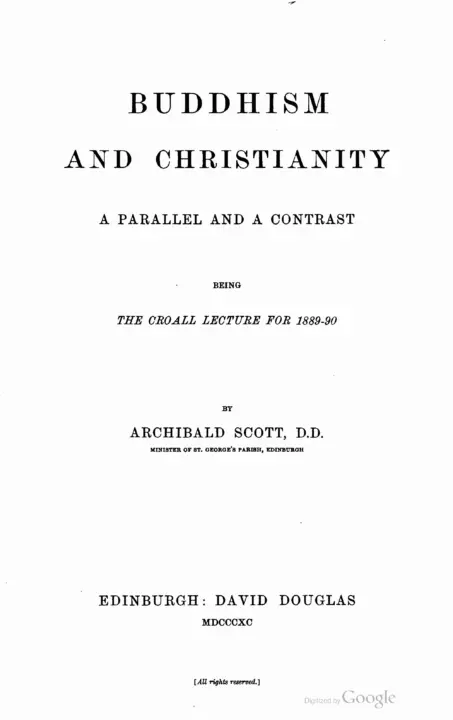
"Buddhism and Christianity: A Parallel and a Contrast" by Archibald Scott is a scholarly examination of the similarities and differences between Buddhism and Christianity, written in the late 19th century. This work presents a series of lectures, focusing on a comparative analysis of the two religions, to illuminate their unique features as well as their shared elements. Scott aims to foster a deeper understanding of both faiths, suggesting that studying these religions can enhance Christian appreciation for its own beliefs. The opening of the text provides a preface where Scott acknowledges the complexity of both religions and expresses a commitment to presenting Buddhism fairly, despite its historical misrepresentations. He highlights the significance of Buddhism as a major world religion that offers insights into human life and ethics. Scott also stresses the importance of comparative theology in strengthening Christianity rather than undermining it, encouraging an impartial study to discern universal truths that resonate within both traditions. He outlines the necessity to explore the distinct origins and developments of each faith while establishing a framework for a fruitful dialogue between the two.
Introduction adapted from the source catalogue; source summaries may be automatically generated.
Free to read · English · 95,734 words · No account needed
MAKE TIME FOR A GOOD BOOK
On by default. Untick to stop anonymous reading totals. Each page counts after 10 seconds in view. How this works.
Anonymous counting is on unless you have switched it off.
It is not in the anthropoid ape that we may hope to find the origin of man, and it is not in the terror of the savage cowering before the majesty and mystery of nature that we are likely to find the genesis of his religion. Even if anthropology succeeded in proving that savagery was the first type in which humanity was expressed, and that its bestial rites inspired by terror was the first form of human religion, it would not then have accounted for their origin. The gulf between the religious savage and the non-religious speechless ape would remain as vast as ever. The first manifested beginning of a work may be rude enough, “as is the rough block which receives the first stroke of the sculptor who has designed to produce a statue; but the real beginning,” as we have been eloquently reminded, “is in the plan of the artist, and to perceive his ideal we have to wait for the final result.”[48] It is in the end therefore that we may be said to find and understand the author. So the origin of man, and the genesis of his religion, is more likely to be indicated by that divine fiat which one of the ancient authors of Genesis has dared to formulate, “Let us make man in our image, and after our likeness.” According to that conception, man is a creature, neither equal with, nor perfect as the Being who conceived him, but having affinity with his Creator, and from the very first manifesting capacity and potentiality of indefinite progress to be gained by the divine education to which he is everlastingly subjected.
It is not in the plan of our lecture to discuss these momentous questions, or to enter the lists against the representatives of the sciences of Anthropology or Religion. Anthropology is not sufficiently advanced to scatter the mystery that surrounds the cradle of the human race: and it would be rash for the apostles of the other science to maintain that they have succeeded in tracing the lines of that process, out of which Christianity or even Buddhism is alleged to have evolved from the shapeless superstitions of the primitive savage, before they confront us as facts in the history of human thought. Observation and experience alike seem to counsel greater caution in making our deductions and drawing our inferences. Indeed there seems to be almost as much evidence in favour of the theory of degradation as there is in favour of that of evolution. There is no inherent tendency in human society to pass ever on and ever up to something better and nobler. No race, by its own inherent strength, seems to have raised itself from barbarism into anything that can be called true civilisation; but we have abundant proof in the Aztecs of former generations, and the negroes of the Black Republic in the present day, that races can terribly decline. A state of civilisation is very difficult to keep, as well as difficult to gain.[49] And so far as observation goes, savage life and religion appear to be “not the dawning of a society about to rise, but the fading remains of one sinking in storms, overthrown and shattered by overwhelming catastrophes.” Humboldt and Niebuhr, quoted by Whately in his lecture on the Origin of Civilisation, both protest as strongly as he did himself against those who profess to find in the wreck of the civilised and religious man his original representative,[50] and our best authority in the science of religion assures us that Fetichism, far from being the initial of an upward course, marks the very last stage in the downward course of religion.[51] It should content us, in the present state of our knowledge, to find that humanity is capable both of development and degradation. Savagery and civilisation are not separated from each other by impassable barriers: savagery is at least a possibility to a civilised race;[52] civilisation is not beyond the reach of the savage. On the surface of the very highest civilisation many things appear which are also to be seen in the lowest: and just as in the lowest organisms certain rudimentary traces are found of members which are perfected in organisms above them, so the very lowest savagery seems to exhibit an upward tendency. In the same way the very purest religions have clinging to them traces of the lowest superstitions. Not in Buddhism only, but even in Christianity, we find forms of Animism and Fetichism; but the question whether both religions first manifested themselves in these lower forms, with which they are still partly incrusted, must not be held to be settled in the affirmative because these traces of them exist. Instead of being survivals which they have not yet sloughed off or outgrown, they may be parasitical growths indicating degradation and disease.
Your reading position is saved on this browser. Take it to another device with a library code. Reading pages adapt to text, rather than matching a printed edition.
BEHIND THE BOOK
This eBook is for the use of anyone anywhere in the United States and most other parts of the world at no cost and with almost no restrictions whatsoever. You may copy it, give it away or re-use it under the terms of the Project Gutenberg License included with this eBook or online at www.gutenberg.org. If you are not located in the United States, you will have to check the laws of the country where you are located before using this eBook. Read the source licence.
The original source file, including credits and licence, is retained by this library. Request an original-format copy at no charge. Please include the book title and Project Gutenberg identifier #67171.
KEEP YOUR CURIOSITY GOING
David Patterson (Spirit) Hatch

David Patterson (Spirit) Hatch

David Patterson (Spirit) Hatch

Edwin Abbott Abbott

Richard Watson
T. G. (Theophilus Gould) Steward