
Last letters from the living dead man
David Patterson (Spirit) Hatch
THE CLASSIC COLLECTION · 1890
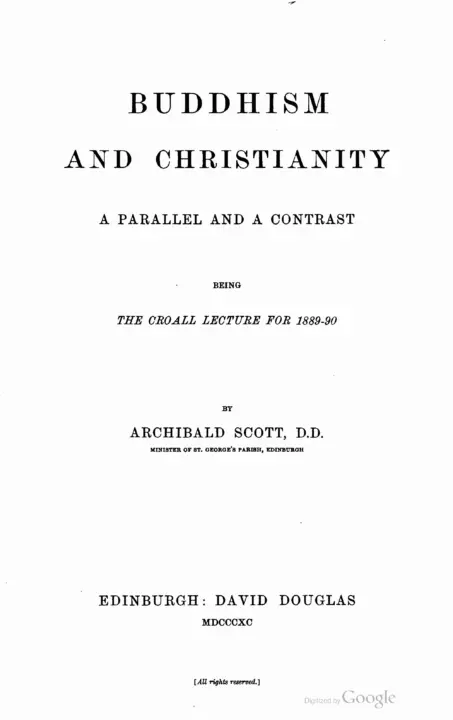
"Buddhism and Christianity: A Parallel and a Contrast" by Archibald Scott is a scholarly examination of the similarities and differences between Buddhism and Christianity, written in the late 19th century. This work presents a series of lectures, focusing on a comparative analysis of the two religions, to illuminate their unique features as well as their shared elements. Scott aims to foster a deeper understanding of both faiths, suggesting that studying these religions can enhance Christian appreciation for its own beliefs. The opening of the text provides a preface where Scott acknowledges the complexity of both religions and expresses a commitment to presenting Buddhism fairly, despite its historical misrepresentations. He highlights the significance of Buddhism as a major world religion that offers insights into human life and ethics. Scott also stresses the importance of comparative theology in strengthening Christianity rather than undermining it, encouraging an impartial study to discern universal truths that resonate within both traditions. He outlines the necessity to explore the distinct origins and developments of each faith while establishing a framework for a fruitful dialogue between the two.
Introduction adapted from the source catalogue; source summaries may be automatically generated.
Free to read · English · 95,734 words · No account needed
MAKE TIME FOR A GOOD BOOK
On by default. Untick to stop anonymous reading totals. Each page counts after 10 seconds in view. How this works.
Anonymous counting is on unless you have switched it off.
The most recent and reliable information as to this perverted form of Buddhism—if it is to be called Buddhism, for it seems to be no more Buddhism than Vandoux worship can be called Christianity—will be found in the works of T. W. Rhys Davids; Sir Monier Williams, Buddhism; Babu Sarat Chunder Das, “Religious Hist. of Thibet,” Journ. Asiat. Soc. Beng. 1881; Life and Works of Alex. Csoma de Koros, Th. Duka, Lond. 1885; E. Colborne Baber, Travels and Researches in Western China; Bushell’s “Hist. of Thibet,” Journ. R.A.S. vol. xii. 1878-79.
Footnote 370:
An invocation of Avalôkitês’vara, who is believed to have delivered it to the Tibetans.—Klaproth, Fragments Bouddhiques, p. 27; Hodgson, Illustrations, p. 171; Charles Loring Brace, Gesta Christi, p. 455.
Footnote 371:
Schlagintweit, Buddhism in Tibet, pp. 227-272.
Footnote 372:
Chinese Review, vol. xi. p. 162; Beal, Buddhism in China, p. 233.
Footnote 373:
Once when a heathen asked Hillel to show him the whole Jewish religion in a few words, he replied, “Do not unto others what thou wouldst not should be done unto thee.” Kuenen’s Religion of Israel, p. 243 (quotes Talmud, Sabbath, 31 a.)
Footnote 374:
See Isaiah xxxii. 5, 6. Socrates says in Phaedo, “to use words wrongly and indefinitely is not merely an error in itself; it also creates evil in the soul.” A vast amount of mischief is done by the misapplication of good adjectives to bad subjects. All true reformers, with Confucius, labour for a rectification of names.
Footnote 375:
Shu King, Shi King, Pref. and Introd. pp. 1-27, by Dr. Legge; Sacred Books of the East, vol. iii.
Footnote 376:
Mémoire sur la Vie et les Opinions de Lao-tsze.
Footnote 377:
Translation of the Tâo-teh-King, under the title, Le Livre de la Voie
et de la Vertu.
Footnote 378:
μέθοδος, Prof. Douglas, Confucianism and Taoism, p. 189.
Footnote 379:
It is very interesting to find, so long before Christianity, and so far from its cradle, this fundamental rule in Christian morals. In the Book of Proverbs its enunciation may have preceded that in the Tao-teh-King in point of time; but its being uttered at the end of the world, along with the “golden rule” of Confucius, prove how essentially one are the moral instincts of humanity.
Footnote 380:
Dr. Legge’s Preface to vol. iii. of Sacred Books of the East, p. xxi; also Art. LAO-TSZE, Encyc. Brit. vol. xiv.
Footnote 381:
Dr. Edkins, Chinese Buddhism, pp. 128, 202; Beal, Introduction to
Fa-Hian, p. 27.
Footnote 382:
Douglas, Confucianism, p. 84; Beal, Buddhism in China, p. 235; Edkins, Chinese Buddhism, p. 333.
Footnote 383:
Your reading position is saved on this browser. Take it to another device with a library code. Reading pages adapt to text, rather than matching a printed edition.
BEHIND THE BOOK
This eBook is for the use of anyone anywhere in the United States and most other parts of the world at no cost and with almost no restrictions whatsoever. You may copy it, give it away or re-use it under the terms of the Project Gutenberg License included with this eBook or online at www.gutenberg.org. If you are not located in the United States, you will have to check the laws of the country where you are located before using this eBook. Read the source licence.
The original source file, including credits and licence, is retained by this library. Request an original-format copy at no charge. Please include the book title and Project Gutenberg identifier #67171.
KEEP YOUR CURIOSITY GOING
David Patterson (Spirit) Hatch

David Patterson (Spirit) Hatch

David Patterson (Spirit) Hatch

Edwin Abbott Abbott

Richard Watson
T. G. (Theophilus Gould) Steward