
Last letters from the living dead man
David Patterson (Spirit) Hatch
THE CLASSIC COLLECTION · 1890
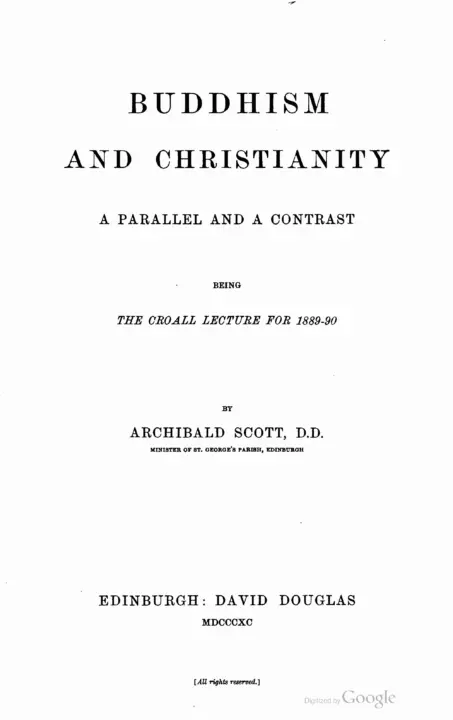
"Buddhism and Christianity: A Parallel and a Contrast" by Archibald Scott is a scholarly examination of the similarities and differences between Buddhism and Christianity, written in the late 19th century. This work presents a series of lectures, focusing on a comparative analysis of the two religions, to illuminate their unique features as well as their shared elements. Scott aims to foster a deeper understanding of both faiths, suggesting that studying these religions can enhance Christian appreciation for its own beliefs. The opening of the text provides a preface where Scott acknowledges the complexity of both religions and expresses a commitment to presenting Buddhism fairly, despite its historical misrepresentations. He highlights the significance of Buddhism as a major world religion that offers insights into human life and ethics. Scott also stresses the importance of comparative theology in strengthening Christianity rather than undermining it, encouraging an impartial study to discern universal truths that resonate within both traditions. He outlines the necessity to explore the distinct origins and developments of each faith while establishing a framework for a fruitful dialogue between the two.
Introduction adapted from the source catalogue; source summaries may be automatically generated.
Free to read · English · 95,734 words · No account needed
MAKE TIME FOR A GOOD BOOK
On by default. Untick to stop anonymous reading totals. Each page counts after 10 seconds in view. How this works.
Anonymous counting is on unless you have switched it off.
Never under the Papacy, even in the times when its pretensions were most extravagant, and its power was most unchecked, has Christianity deteriorated so fearfully as Buddhism has done in Nepāl and Tibet. Not even in the Abyssinian—the most degraded of all the Churches that have worn the name of Christ, in respect of its incorporation of old Jewish rites and Egyptian superstitions—can we find the contrivance of the prayer-wheel, or the poles with their silken flags blazoned with the six sacred syllables, “om mani padme hum,”[370] fluttering their supposed incantations to the heavens. Buddhism’s ages of worship have been only a long sad history of degradation, of perpetual falling from bad to worse.[371] The higher the worship of Buddhists for the founder of their system has risen, the more have they fallen from his virtue; but in Christianity the ages of strongest devotion to Christ have ever been the periods of progress. The more intense man’s reverence for Christ has been, the loftier has been the standard of virtue attained. Worship and pursuit of holiness have gone hand in hand, and we cannot conceive of a life truly offered up in adoration of Christ ever proving immoral or impure.
The story of Buddhism in India, where without much resistance it yielded to the seductions of Vishnaism and Sivaism, the record of its conquests in the surrounding countries, and especially in those just referred to, present few and slight analogies to the history of Christianity; but the story of Buddhism in China as related by those most competent to testify of the changing forms which it assumed from the fourth century onwards, is significantly akin to that of Christianity after it became the religion of the Empire. China, unlike India, had before the Christian era a very ancient history, marked by distinct epochs. Its annals, even of the eighth century B.C., seem to reflect a civilisation similar to that of Europe in the thirteenth century A.D. Two thousand years B.C. the Chinese are said to have attained to an idea of Deity somewhat equivalent to the El Elion of Melchizedek.[372] Shangti, the highest of all spirits to whom the people sacrificed, was the Creator, Preserver, and Governor of the world, unapproachable by the sinner, but merciful to all penitents; and in this idea of God, and in the morality which sprang from it, we have the secret of that social and political progress whose arrestment and decay Confucius lamented. Living in a degenerate age, he laboured earnestly as a reformer of personal morality and social order; but, departing himself from the ancestral faith in a Supreme Ruler of nature and man, “respecting, but keeping aloof, as he said, from all spiritual beings,” expressively silent as to the future, and refusing to present motives of conduct drawn from consideration of it, his vigorous ministry, conducted for many years in many of the States, could only have the effect of preparing the way for a real regeneration of society. He had great faith in man, as born good, with an innate moral faculty which only contact with the world and the delusion of the senses prevent from making him virtuous. Man was made for society, and the five relations of which society consists—that of ruler and subject, husband and wife, parent and child, elder brother and younger, and friend and friend—were Divine ordinances. His standard of personal righteousness and social purity, his strong faith in the power of example, his golden rule, “What you would not like to have done to yourself, do not to any other,”[373] his demand, as urgent as was that of Isaiah or Socrates,[374] that language should be used ever with scrupulous care to express only the thing that is, have gone far to form, with beneficial ethical results, the ordinary Chinese character. His ignoring of personal Deity, only referred to under the vague term Heaven, and of the future of man, could not long arrest the degeneracy of society or purge out the secret vices burrowing beneath its surface. If Buddha is to be regarded in his bold metaphysical speculations as the first of Gnostics, Confucius in his pure secularism may be designated the first Agnostic, and the monotonous and stagnant type of humanity which his teaching has produced may be a warning of the kind of civilisation which the world may expect should ever philanthropic secularism supplant or supersede the religion of Christ.[375]
Your reading position is saved on this browser. Take it to another device with a library code. Reading pages adapt to text, rather than matching a printed edition.
BEHIND THE BOOK
This eBook is for the use of anyone anywhere in the United States and most other parts of the world at no cost and with almost no restrictions whatsoever. You may copy it, give it away or re-use it under the terms of the Project Gutenberg License included with this eBook or online at www.gutenberg.org. If you are not located in the United States, you will have to check the laws of the country where you are located before using this eBook. Read the source licence.
The original source file, including credits and licence, is retained by this library. Request an original-format copy at no charge. Please include the book title and Project Gutenberg identifier #67171.
KEEP YOUR CURIOSITY GOING
David Patterson (Spirit) Hatch

David Patterson (Spirit) Hatch

David Patterson (Spirit) Hatch

Edwin Abbott Abbott

Richard Watson
T. G. (Theophilus Gould) Steward