
Last letters from the living dead man
David Patterson (Spirit) Hatch
THE CLASSIC COLLECTION · 1890
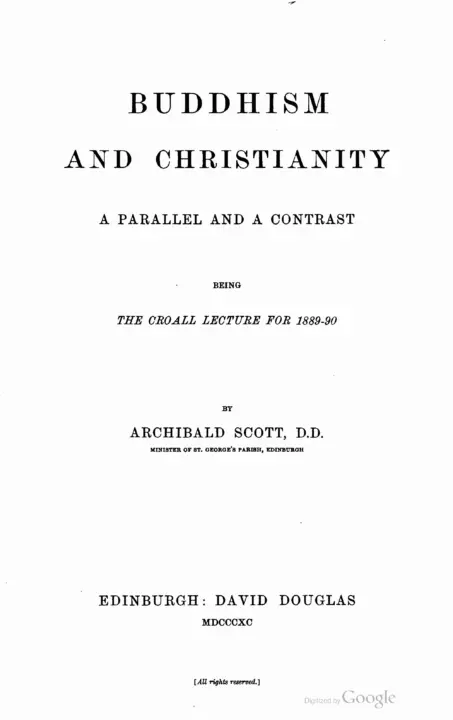
"Buddhism and Christianity: A Parallel and a Contrast" by Archibald Scott is a scholarly examination of the similarities and differences between Buddhism and Christianity, written in the late 19th century. This work presents a series of lectures, focusing on a comparative analysis of the two religions, to illuminate their unique features as well as their shared elements. Scott aims to foster a deeper understanding of both faiths, suggesting that studying these religions can enhance Christian appreciation for its own beliefs. The opening of the text provides a preface where Scott acknowledges the complexity of both religions and expresses a commitment to presenting Buddhism fairly, despite its historical misrepresentations. He highlights the significance of Buddhism as a major world religion that offers insights into human life and ethics. Scott also stresses the importance of comparative theology in strengthening Christianity rather than undermining it, encouraging an impartial study to discern universal truths that resonate within both traditions. He outlines the necessity to explore the distinct origins and developments of each faith while establishing a framework for a fruitful dialogue between the two.
Introduction adapted from the source catalogue; source summaries may be automatically generated.
Free to read · English · 95,734 words · No account needed
MAKE TIME FOR A GOOD BOOK
On by default. Untick to stop anonymous reading totals. Each page counts after 10 seconds in view. How this works.
Anonymous counting is on unless you have switched it off.
The conversion of the most of Eastern Asia was the work of the Northern or more corrupt Buddhism. Southern Buddhism, like the orthodox Eastern Church, which contented itself with its evangelistic achievements among the Goths, and its Nestorian missions, soon exhausted its propagative force. The introduction of the religion into Burma, Siam, and the adjacent kingdoms, may be said to sum up its triumphs. Northern Buddhism, on the other hand, ran from the beginning of our era a course of unchecked triumphs. In the close of the fourth century it spread from China to Corea, and in the sixth it reached Japan. Previous to this it entered the isolated regions of Tibet, more welcomed than resisted by the demonolatrous inhabitants on account of the adulterated form in which it presented itself. There, after a struggle for some two centuries, it succeeded, about the period when Islam was beginning its conquests elsewhere, in securing strong royal support. After experiencing for many generations the vicissitudes of popularity and persecution, the conquests of Genghiz, and the strong favour of Kublai, his greatest successor, established its hierarchy as supreme, and in spite of changes of dynasty, it has there dominated the whole relations of life in a manner like unto, but to an extent far beyond, the wildest dreams of Rome’s most ambitious Pope.[339]
It thus appears that Buddhism in the second period of its history, and after it had succeeded in winning the support of powerful kings, reached its furthest extension and achieved its grandest conquests. Christianity, on the other hand, was more rapidly diffused in the primitive than in the subsequent ages. Tested by its intensive hold upon the nations, it had only nominally converted the Roman Empire by the end of the fourth century. Gibbon’s estimate of the number of Christians within it, is acknowledged by friendly authorities,[340] like Bishop Lightfoot, to err if at all on the side of excess. During the reign of Constantine, probably not a twentieth of the whole population of the Empire were Christians, even by profession. After this period, no doubt, the proportion must have greatly increased, for the barbarous hordes that poured downwards in successive deluges over the South were converted so suddenly and so silently that “scarce a legend remains to tell the tale.” In regard, however, to the conversion of heathen Europe, it is a mistake to suppose that the missionaries had only to come, and see, and conquer. The conversion of England by the Roman monks, and of Ireland, Scotland, and Wales by Oriental and, it is said, Arian missionaries, cannot be said to have been accomplished before the close of the seventh century. Afterwards, the conversion of Central and Northern Germany occupied the Celtic and British missionaries for two centuries. The conversion of the Scandinavians, beginning in the ninth, could not be said to have been effected till the middle of the eleventh century, while that of Slavonia, undertaken in the tenth, did not terminate, if indeed even then, before the sixteenth century. The conquest of Europe was the result of a prolonged and often desultory warfare, in which, while the advance was slow, Christianity sometimes failed to hold the ground which it had gained. The powerful Churches in Asia, the seats of its great Councils and the capitals of its rule, either died or were swept away; Antioch and Constantinople, once its citadels, became the strongholds of an alien and hostile faith; the mighty Churches of Egypt and Abyssinia dwindled into a condition of immedicable disease, and the flourishing Church of Africa, with its more than six hundred bishoprics, was simply, because ripe for destruction, obliterated by the forces of Islam. Toward the latter half of the tenth century it seemed as if Christianity in Europe was surely following the fate of Buddhism before its disappearance from India. On all sides it was pressed in the deadly grip of Pagan and Moslem alike, while its bishops, and priests, and nobles, oblivious of the danger, were living in sinful self-indulgence. It seemed as if Christendom was being surely blotted out from the geography of the world; and yet as by a miracle it survived, or was preserved, till came the Renaissance, and that marvellous emergence of missionary zeal, which sent Christianity, Reformed and Unreformed, to the very ends of the earth, and which, increasing in every generation since then, was never more abundant nor more fervent than now.[341]
Your reading position is saved on this browser. Take it to another device with a library code. Reading pages adapt to text, rather than matching a printed edition.
BEHIND THE BOOK
This eBook is for the use of anyone anywhere in the United States and most other parts of the world at no cost and with almost no restrictions whatsoever. You may copy it, give it away or re-use it under the terms of the Project Gutenberg License included with this eBook or online at www.gutenberg.org. If you are not located in the United States, you will have to check the laws of the country where you are located before using this eBook. Read the source licence.
The original source file, including credits and licence, is retained by this library. Request an original-format copy at no charge. Please include the book title and Project Gutenberg identifier #67171.
KEEP YOUR CURIOSITY GOING
David Patterson (Spirit) Hatch

David Patterson (Spirit) Hatch

David Patterson (Spirit) Hatch

Edwin Abbott Abbott

Richard Watson
T. G. (Theophilus Gould) Steward