
Last letters from the living dead man
David Patterson (Spirit) Hatch
THE CLASSIC COLLECTION · 1890
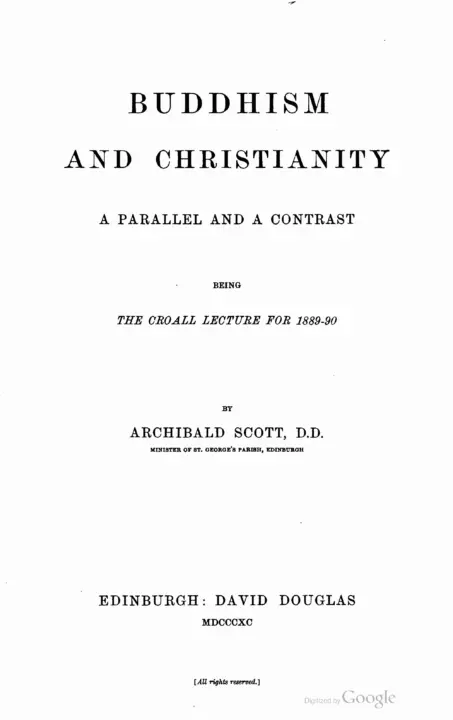
"Buddhism and Christianity: A Parallel and a Contrast" by Archibald Scott is a scholarly examination of the similarities and differences between Buddhism and Christianity, written in the late 19th century. This work presents a series of lectures, focusing on a comparative analysis of the two religions, to illuminate their unique features as well as their shared elements. Scott aims to foster a deeper understanding of both faiths, suggesting that studying these religions can enhance Christian appreciation for its own beliefs. The opening of the text provides a preface where Scott acknowledges the complexity of both religions and expresses a commitment to presenting Buddhism fairly, despite its historical misrepresentations. He highlights the significance of Buddhism as a major world religion that offers insights into human life and ethics. Scott also stresses the importance of comparative theology in strengthening Christianity rather than undermining it, encouraging an impartial study to discern universal truths that resonate within both traditions. He outlines the necessity to explore the distinct origins and developments of each faith while establishing a framework for a fruitful dialogue between the two.
Introduction adapted from the source catalogue; source summaries may be automatically generated.
Free to read · English · 95,734 words · No account needed
MAKE TIME FOR A GOOD BOOK
On by default. Untick to stop anonymous reading totals. Each page counts after 10 seconds in view. How this works.
Anonymous counting is on unless you have switched it off.
But it was not so in Buddhism. Its lay associates, however numerous, were but the fringes of religious communities essentially and wholly monastic. When, therefore, deterioration or degradation in the Order set in, reformation of it by the people was hopeless. In the Order this deterioration showed itself earlier that its dominant ideal was lower than the Christian. In early Christian Monachism, fortitude and devotion all sprang from the immolation of self for the universal good. In Buddha’s Sangha, however, though there was both devotion and fortitude displayed, the goal to be reached was simply self-rescue. Its course of beneficence therefore was not only shorter but shallower. Unintentionally it wrought out social reforms, and perhaps political revolution. It restrained luxury, and checked the unbounded sensuality to which Indians are prone; it rebuked the earthly-minded, and witnessed nobly of the higher interests of life to peoples that sorely needed the testimony. It not only propagated morality, but promoted learning, and a love of the beautiful in nature and art, but its force was eventually exhausted. Very early it sank into the stagnation in which it has existed for centuries, and any advance registered by the nations among whom the institution has existed has been due, for more than a thousand years, to the influx of Christian ideas and sentiments.
Its own methods hastened its decay. Like all Eastern religious growths, it represented the piety of inertion. Manual labour of all kinds was placed under the ban, and beyond attending to the cleanliness of his person and of his lodging the Buddhist monk was not allowed to do anything save itinerate for his maintenance and the preaching of the law. He was instructed that every moment abstracted from meditation was serious loss. This was in direct contradiction to the very first rule of Christian solitary life, which even in the stifling heat of the desert demanded manual tasks, which fasting might be said to have doubled, continued through the long day till vespers summoned the labourers to worship. The Buddhist monk knew neither the healthy life of physical exertion nor the spiritual refreshment of worship. He might vindicate his idleness against the reproaches of the industrious by the assertion that he too in his quiet life was also “ploughing and sowing” to much better purpose,[263] but then the effect of his ploughing and the fruit of his sowing were all confined to himself, who alone was freed by it from suffering. He could not answer, as the Nicæan monk and quondam courtier replied to Valens, when challenged as to whither he was going, “I go to pray for your empire.”[264] Augustine has indeed assured us that “the less a monk labours in anything but prayer the more serviceable he is to men”; but the prayer which he had in view was not selfish. On the contrary, the tears and penitential exercises of men who had become strangers to all personal desires “were mighty to drown sin and purify the world.”[265] As long as monks were truly prayerful, and nuns, like vestals, kept alive the sacred fire for every hearth, they represented that side of the Church’s mediation which is most important and effective; for no one can be really effective in the service of man who is not frequent in the service of waiting upon God. The heroes of the Christian Church, who have evangelised and civilised the wild waste places of the world, who, like the apostle, laid aside every encumbrance to run their race, were, like the apostle, men of much meditation and prayer. We have no such examples in Buddhism, for it lacked the provision which alone could nurture them. In the life of the Buddhist monk there was probably more, and more intense meditation than in that of the Christian, but there was a vast difference in their respective themes of meditation. The Christian could draw his inspiration from a source far higher and purer than himself, and in communion with the Father, Redeemer, Sanctifier of his spirit gather a strength which astonished the world; but what possible inspiration for endeavour could come to a poor Buddhist monk who was chiefly occupied in contemplating the impurity of his perishable body, and whose very highest theme of meditation was simply “nothing whatever”?[266]
Your reading position is saved on this browser. Take it to another device with a library code. Reading pages adapt to text, rather than matching a printed edition.
BEHIND THE BOOK
This eBook is for the use of anyone anywhere in the United States and most other parts of the world at no cost and with almost no restrictions whatsoever. You may copy it, give it away or re-use it under the terms of the Project Gutenberg License included with this eBook or online at www.gutenberg.org. If you are not located in the United States, you will have to check the laws of the country where you are located before using this eBook. Read the source licence.
The original source file, including credits and licence, is retained by this library. Request an original-format copy at no charge. Please include the book title and Project Gutenberg identifier #67171.
KEEP YOUR CURIOSITY GOING
David Patterson (Spirit) Hatch

David Patterson (Spirit) Hatch

David Patterson (Spirit) Hatch

Edwin Abbott Abbott

Richard Watson
T. G. (Theophilus Gould) Steward