
Last letters from the living dead man
David Patterson (Spirit) Hatch
THE CLASSIC COLLECTION · 1890
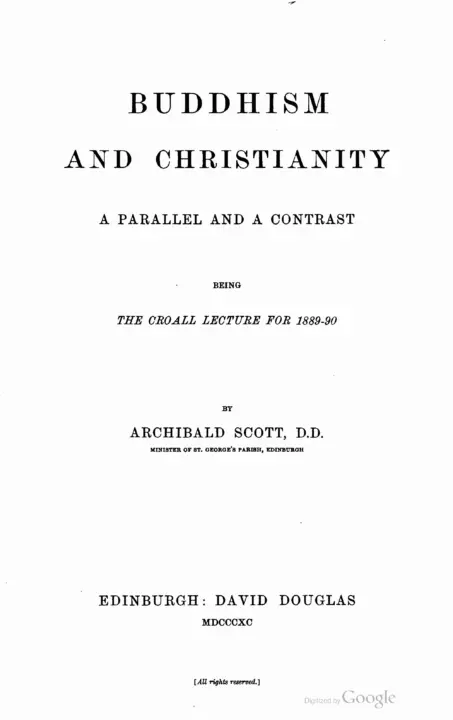
"Buddhism and Christianity: A Parallel and a Contrast" by Archibald Scott is a scholarly examination of the similarities and differences between Buddhism and Christianity, written in the late 19th century. This work presents a series of lectures, focusing on a comparative analysis of the two religions, to illuminate their unique features as well as their shared elements. Scott aims to foster a deeper understanding of both faiths, suggesting that studying these religions can enhance Christian appreciation for its own beliefs. The opening of the text provides a preface where Scott acknowledges the complexity of both religions and expresses a commitment to presenting Buddhism fairly, despite its historical misrepresentations. He highlights the significance of Buddhism as a major world religion that offers insights into human life and ethics. Scott also stresses the importance of comparative theology in strengthening Christianity rather than undermining it, encouraging an impartial study to discern universal truths that resonate within both traditions. He outlines the necessity to explore the distinct origins and developments of each faith while establishing a framework for a fruitful dialogue between the two.
Introduction adapted from the source catalogue; source summaries may be automatically generated.
Free to read · English · 95,734 words · No account needed
MAKE TIME FOR A GOOD BOOK
On by default. Untick to stop anonymous reading totals. Each page counts after 10 seconds in view. How this works.
Anonymous counting is on unless you have switched it off.
There is yet another characteristic of this religion which has commended it more to the unbelief than the belief of our age. Many agreements are alleged to subsist between the contents of the New Testament and those of the sacred books which profess to record the life and express the teaching of Buddha. Its ancient Pitakas are said to be filled with stories resembling the narratives of the Evangelists, with sayings which recall the parables, and miracles reflecting the signs and wonders which signalised the ministry of Jesus. It is averred that with the single exception of the Crucifixion—and how immense is the significance of that exception I shall endeavour in a subsequent lecture to show,—it would be easy to find in them a parallel to almost every incident related in the Gospel. Most startling of all are said to be the resemblances between the central figures in both sets of scriptures. For Buddhism, as truly as Christianity, has its ideal of a perfect human life, illustrated in one who, like unto the Son of Man, went about doing good, and enforcing by his example the pure morality which he preached, but who, most unlike the Son of Man, without any sustaining belief in deity, or hope of sympathy or help from any divine being, professed to have made good his own salvation, and to teach all whom he could reach the way to work out theirs.
When we come to examine its history, we find that it has followed a line of development strikingly parallel to that of Christianity, and the parallels thus furnished by its antecedents and progress, and by the external and foreign influences which encountered and modified it, are those which have the most interest and instruction for the student of Religion. In order, however, to ascertain their significance, we must examine these alleged correspondences of story and of doctrine; for these have powerfully influenced a certain class of thinkers, as supplying confirmation of a charge brought against our religion in almost the beginning of its history, that after all there was nothing original in Christ, and nothing new in His teaching. That resemblances do exist, not only between the forms in which Buddhism confronts us in some quarters of the world and the ritual and organisation of a large section of the Christian Church, but between the contents of the Buddhist scriptures as we have them now, and those of the New Testament, all must admit. As we cast a hasty and general glance over them we see how natural and how pardonable was the old rough and ready method of accounting for them by the supposition of direct transference of the various lineaments from the one to the other. The early Jesuit missionaries did not hesitate to assert that the Buddhists, by assimilating and incorporating the rites and doctrines of the primitive missionaries, had succeeded in producing a caricature of Christianity. In like manner, when in Central America—till then as independent of Europe as if it had been separated not by untraversed oceans, but by the immensities that divide the planets—the Spaniards found to their amazement a most complex religion, with priests, and monasteries, and temples adorned with the cross and statues of a goddess with an infant in her arms, they could only explain the mystery by averring that it was a gigantic mimetic ruse of the devil to lead the unhappy nations astray. The suppositions in both cases are not likely to be seriously supported now. Indeed, it is far more likely, as the author of Ancient Christianity and Dr. Prinsep and others have attempted to show, that in the East we have to seek for the origin of several institutions and rites once considered the peculiar growth of Greek or Latin Christianity. There can be little doubt that as these religions spread they would come in contact with and react upon each other.[23] It is difficult in the present state of our knowledge to indicate their first conjunction, or to trace their various intercommunications, but that they have been mutually indebted to each other is sufficiently attested by their histories. In later Hinduism and Buddhism and Lamaism there are plain indications of the action of the Western upon the Eastern religions. Romanism, on the other hand, has set its official seal upon the relationship, by incorporating a legend of Buddha among its “Lives of the Saints,” by canonising the founder of this most antichristian of all religions, and by consecrating the 27th November as a day on which he may be invoked for intercession.[24]
Your reading position is saved on this browser. Take it to another device with a library code. Reading pages adapt to text, rather than matching a printed edition.
BEHIND THE BOOK
This eBook is for the use of anyone anywhere in the United States and most other parts of the world at no cost and with almost no restrictions whatsoever. You may copy it, give it away or re-use it under the terms of the Project Gutenberg License included with this eBook or online at www.gutenberg.org. If you are not located in the United States, you will have to check the laws of the country where you are located before using this eBook. Read the source licence.
The original source file, including credits and licence, is retained by this library. Request an original-format copy at no charge. Please include the book title and Project Gutenberg identifier #67171.
KEEP YOUR CURIOSITY GOING
David Patterson (Spirit) Hatch

David Patterson (Spirit) Hatch

David Patterson (Spirit) Hatch

Edwin Abbott Abbott

Richard Watson
T. G. (Theophilus Gould) Steward