
Last letters from the living dead man
David Patterson (Spirit) Hatch
THE CLASSIC COLLECTION · 1890
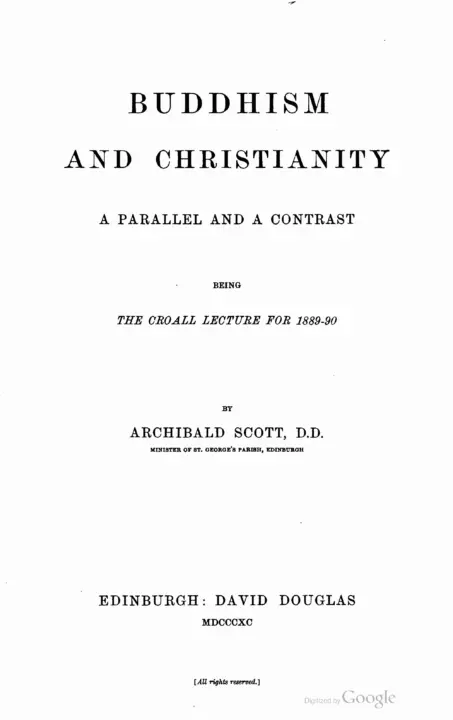
"Buddhism and Christianity: A Parallel and a Contrast" by Archibald Scott is a scholarly examination of the similarities and differences between Buddhism and Christianity, written in the late 19th century. This work presents a series of lectures, focusing on a comparative analysis of the two religions, to illuminate their unique features as well as their shared elements. Scott aims to foster a deeper understanding of both faiths, suggesting that studying these religions can enhance Christian appreciation for its own beliefs. The opening of the text provides a preface where Scott acknowledges the complexity of both religions and expresses a commitment to presenting Buddhism fairly, despite its historical misrepresentations. He highlights the significance of Buddhism as a major world religion that offers insights into human life and ethics. Scott also stresses the importance of comparative theology in strengthening Christianity rather than undermining it, encouraging an impartial study to discern universal truths that resonate within both traditions. He outlines the necessity to explore the distinct origins and developments of each faith while establishing a framework for a fruitful dialogue between the two.
Introduction adapted from the source catalogue; source summaries may be automatically generated.
Free to read · English · 95,734 words · No account needed
MAKE TIME FOR A GOOD BOOK
On by default. Untick to stop anonymous reading totals. Each page counts after 10 seconds in view. How this works.
Anonymous counting is on unless you have switched it off.
“that last large joy of all, Trust in the goodness and the love of Him Who, making so much well, will end all well.”
Footnote 180:
Dharma, an ancient Brahman term, meaning law or order; what holds things as they are, or ought to be. In later Sanskrit it also means duty and virtue, i.e. law performed.—Gifford Lectures, Natural Religion, pp. 94, 95. Buddha is also an ancient Brahman term applied to one who has attained a perfect knowledge of the Self.—Satapatha-brahmana, xiv. 7. 2. 17. In Buddhism Dharma means Buddha’s doctrines, “bodhi,” i.e. knowledge self-acquired, as distinguished from “Veda,” i.e. revelation obtainable only through the Brahmans.—Sir Monier Williams’ Buddhism, p. 97.
Footnote 181:
Oldenberg, Buddha, etc., pp. 205-208; Rhys Davids, Buddhism, p. 87; Spence Hardy, Manual of Buddhism, p. 375. His relation to the philosophical systems of his day is illustrated in several Suttas; see Sutta Nipâta, in vol. x. Part ii. of Sacred Books of the East, pp. 148-152. Evidently he regarded them with aversion, and even contempt.
Footnote 182:
Le Bouddha, etc., p. 79. The legends indicate that his use of the vernacular was matter of principle. Two Brahmans, “excelling in speech, excelling in pronunciation,” complained that the monks corrupted the word of the Buddhas by repeating it in their own dialect, and asked permission to put it into classical or polished verse. “How can you, O foolish ones, speak thus?... You are not, O monks, to put the words of the Buddhas into polished (Sanskrit) verse. Whosoever does so shall be guilty of a dukkata.”—Kullavagga, v. 33. 1; Sacred Books of the East, vol. xx.
Footnote 183:
Mahâparanibhâna Sutta, ii. 1. 2; Sacred Books of the East, vol. xi.; Mahavagga, i. 6. 18, 27; ibid. vol. xiii.
Footnote 184:
Not as the Nothing, as Wuttke tries to show in Geschichte des Heidenthums, ii. § 166. Oldenberg, Buddha, etc., p. 212.
Footnote 185:
Samyutta-ka-Nikâya, quoted by Oldenberg, Buddha, etc., p. 217.
Footnote 186:
Bouddha et sa Religion, p. iii, Introduction.
Footnote 187:
“The Modern Buddhist,” published in the volume called The Wheel of the Law: Buddhism illustrated from Siamese Sources, by H. Alabaster; London, 1876.
Footnote 188:
Dr. Westcott, Social Aspects of Christianity, p. 12; Aristotle,
Ethic., i. 1; iv. 3.
Footnote 189:
“The Modern Buddhist,” Alabaster, Wheel of the Law, p. 73; Spence Hardy, Eastern Monachism, pp. 5, 339; Gogerly’s translation of the Brahmajala Sutta in Digha Nikâya, Journal of Ceylon Asiatic Society, 1846.
Footnote 190:
Preface to Müller’s Dhammapada, p. xxx, old ed.
Footnote 191:
Note at pp. 31, 32 of Dhammapada in vol. x. of Sacred Books of the East. Frankfurter, App. Bamp. Lect. 1881, p. 349.
Footnote 192:
Your reading position is saved on this browser. Take it to another device with a library code. Reading pages adapt to text, rather than matching a printed edition.
BEHIND THE BOOK
This eBook is for the use of anyone anywhere in the United States and most other parts of the world at no cost and with almost no restrictions whatsoever. You may copy it, give it away or re-use it under the terms of the Project Gutenberg License included with this eBook or online at www.gutenberg.org. If you are not located in the United States, you will have to check the laws of the country where you are located before using this eBook. Read the source licence.
The original source file, including credits and licence, is retained by this library. Request an original-format copy at no charge. Please include the book title and Project Gutenberg identifier #67171.
KEEP YOUR CURIOSITY GOING
David Patterson (Spirit) Hatch

David Patterson (Spirit) Hatch

David Patterson (Spirit) Hatch

Edwin Abbott Abbott

Richard Watson
T. G. (Theophilus Gould) Steward