
Last letters from the living dead man
David Patterson (Spirit) Hatch
THE CLASSIC COLLECTION · 1890
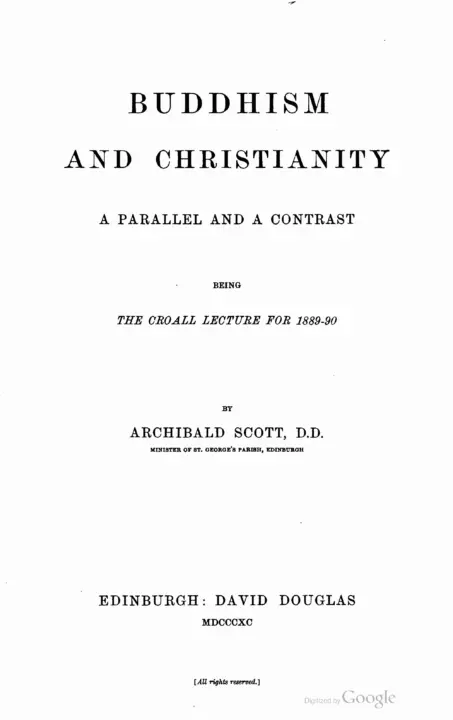
"Buddhism and Christianity: A Parallel and a Contrast" by Archibald Scott is a scholarly examination of the similarities and differences between Buddhism and Christianity, written in the late 19th century. This work presents a series of lectures, focusing on a comparative analysis of the two religions, to illuminate their unique features as well as their shared elements. Scott aims to foster a deeper understanding of both faiths, suggesting that studying these religions can enhance Christian appreciation for its own beliefs. The opening of the text provides a preface where Scott acknowledges the complexity of both religions and expresses a commitment to presenting Buddhism fairly, despite its historical misrepresentations. He highlights the significance of Buddhism as a major world religion that offers insights into human life and ethics. Scott also stresses the importance of comparative theology in strengthening Christianity rather than undermining it, encouraging an impartial study to discern universal truths that resonate within both traditions. He outlines the necessity to explore the distinct origins and developments of each faith while establishing a framework for a fruitful dialogue between the two.
Introduction adapted from the source catalogue; source summaries may be automatically generated.
Free to read · English · 95,734 words · No account needed
MAKE TIME FOR A GOOD BOOK
On by default. Untick to stop anonymous reading totals. Each page counts after 10 seconds in view. How this works.
Anonymous counting is on unless you have switched it off.
Moreover, in a universe where Moi-même is the only god, and a man’s own Nirvana his only goal, the primary motive of action can rise no higher than fear or self-interest. Apparently strong, it is really essentially weak in regard to the maintenance of proper relations to others demanded by the second table of the Moral Law. The suffering caused to others through his failure to fulfil the law, or by conscious transgression of it, makes no impression on the Buddhist, except in as far as it interferes with his pursuit of perfection. Others are regarded only as occasions of acquiring merit. Instead of serving them as Christ enjoins us to do, the Buddhist serves himself of them. It is a religion of every man for himself. It has been likened to Positivism, but it falls far short of it, as lacking the altruism which Positivism has borrowed from Christianity.[222] Positivism refuses to do anything for the glory of God, but it lays great stress upon the duty of living for humanity. It makes the great mistake of supposing that the claims of God must be distinct from or antagonistic to the interests of humanity. It does not recognise that they are identical—that the more the life is reserved for God, the more of it is communicated to our fellow-men, and that we must love the Lord our God with all our hearts, before we can love our neighbour as ourselves. The Positivist scheme of morals, however, is vastly superior to that of Buddhism, for in it the goal is Nirvana, without any reference to the good of any other, and the decided advantage of any action consists wholly and solely in the consequences to the actor himself.
Dr. Oldenberg has pointed out to us that the much-vaunted charity of Buddhism, illustrated in the legends by the self-immolation of Buddha to satisfy the hunger of a wild beast, though it “sways toward does not even touch the law of Christian charity.”[223] Buddha’s Rule, though benevolent to the extent that it would harm no one, and beneficent in respect of doing good, knew nothing of Christianity’s enthusiastic passionate desire to help and work for others.[224] It was the interest of the true Buddhist to forgive his enemies and not to hate them,[225] but he never considered himself bound to love them. It was good policy for one pressing on to Arhatship to do good works, and he would go far out of his way to do them; but he never went about doing good as one who found his reward in the opportunity and power to do it. He was among men not as one who ministers and gives his life to ransom others. His very self-abnegation had egoism at its core. Between the Christian surrender of self to God for the sake of others, and the Buddhist surrender to others for the sake of self, there is a great gulf fixed. The first springs from a sense of indebtedness, a consciousness of mercy unmerited, but freely bestowed; but the other, having no sense of forgiveness received, has no real mercy to show. The mercy of God is the spring of all true human compassion, for he who truly receives it finds it impossible to withhold it. It is, alas! bestowed upon many who are too full of themselves to take it in, and in all such cases it is lost, but in every heart that is conscious of it, it becomes a disposition to show kindness that cannot be counted by acts, and that never will ask, “How oft shall my brother offend me and I forgive him?” Buddhism was friendly in its benevolence, but it never was actively charitable, in taking upon it the infirmities and bearing the sicknesses of others. It has no passionate desire to gather the wrecked and blighted of humanity and to bind up their bleeding wounds and sores. On the contrary, in its pursuit of Nirvana it passed by all such in the path of life, precisely as the priest and Levite passed the wounded man on their way to Jericho. It not only was selfish, but even cruel in this pursuit, for a woman in difficulty or in distress was not to be helped by a passing monk. The poor and the diseased and the lost were not to be considered, for they were simply suffering the due reward of their deeds; but the yellow-robed monks, healthy and shining-faced, were to be the recipients of the bounty of the charitable and the proper objects of their attention. One of its beatitudes runs thus: “Not to serve the foolish, but to serve the wise; to honour those worthy of honour. This is the greatest blessing.”[226] Almsgiving was indeed encouraged; but alms were only to be bestowed upon the worthy—on the monk and Arhat—not on the outcast and the leper, whose miserable condition indicated their unworthiness. If the animal creation profited by their charity, which they refused to their suffering fellow-men, it was from a selfish motive: for the parent, or wife, or child, whom by Buddha’s rule they were obliged to help, might be looking at them, for all they knew, out of the eyes of the beast, and not to fulfil the precept would bring to themselves both harm and loss.[227] Tested even socially, therefore, the Rule of Buddha is defective, and this because it is not founded on religion. The cause of God is eternally the cause of man. In the Fatherhood of God is essentially involved the universal brotherhood of man. Christ is before us as the representative of humanity, because He is the representative of Deity. Refusal to acknowledge His supremacy will disturb all human relationships and throw them into disorder. We learn to do to others as Christ hath done to us; the sense of our indebtedness will be the measure of our charity. For this end He has chosen the poorest and the most wretched as His memorials, and He has said, “Inasmuch as ye have done it unto the least of these my brethren, ye have done it unto Me.”
Your reading position is saved on this browser. Take it to another device with a library code. Reading pages adapt to text, rather than matching a printed edition.
BEHIND THE BOOK
This eBook is for the use of anyone anywhere in the United States and most other parts of the world at no cost and with almost no restrictions whatsoever. You may copy it, give it away or re-use it under the terms of the Project Gutenberg License included with this eBook or online at www.gutenberg.org. If you are not located in the United States, you will have to check the laws of the country where you are located before using this eBook. Read the source licence.
The original source file, including credits and licence, is retained by this library. Request an original-format copy at no charge. Please include the book title and Project Gutenberg identifier #67171.
KEEP YOUR CURIOSITY GOING
David Patterson (Spirit) Hatch

David Patterson (Spirit) Hatch

David Patterson (Spirit) Hatch

Edwin Abbott Abbott

Richard Watson
T. G. (Theophilus Gould) Steward