
Last letters from the living dead man
David Patterson (Spirit) Hatch
THE CLASSIC COLLECTION · 1890
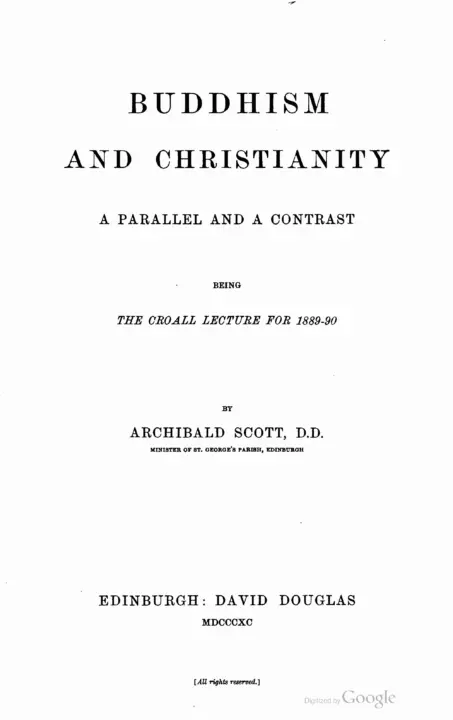
"Buddhism and Christianity: A Parallel and a Contrast" by Archibald Scott is a scholarly examination of the similarities and differences between Buddhism and Christianity, written in the late 19th century. This work presents a series of lectures, focusing on a comparative analysis of the two religions, to illuminate their unique features as well as their shared elements. Scott aims to foster a deeper understanding of both faiths, suggesting that studying these religions can enhance Christian appreciation for its own beliefs. The opening of the text provides a preface where Scott acknowledges the complexity of both religions and expresses a commitment to presenting Buddhism fairly, despite its historical misrepresentations. He highlights the significance of Buddhism as a major world religion that offers insights into human life and ethics. Scott also stresses the importance of comparative theology in strengthening Christianity rather than undermining it, encouraging an impartial study to discern universal truths that resonate within both traditions. He outlines the necessity to explore the distinct origins and developments of each faith while establishing a framework for a fruitful dialogue between the two.
Introduction adapted from the source catalogue; source summaries may be automatically generated.
Free to read · English · 95,734 words · No account needed
MAKE TIME FOR A GOOD BOOK
On by default. Untick to stop anonymous reading totals. Each page counts after 10 seconds in view. How this works.
Anonymous counting is on unless you have switched it off.
In like manner his creed was as essentially materialistic. Man was no spiritual being, but a bundle of Sankharas—a term, it is said, very difficult to translate, but implying that person meant a mass of “forms” or material qualities so changing as to be never the same for two consecutive moments. Belief in a soul he regarded as a heresy, which he distinctly classed with sensuality and belief in the efficacy of sacrificial rites.[192] To the heart as the sixth sense he ascribed the power of conceiving ideas without form, as the eye had the power of perceiving objects; but this disappeared in dissolution as completely as did the others, and what was re-born was not the soul but the quality, the merit or demerit acquired. This startling assertion of Bishop Bigandet’s[193] has been confirmed and amplified by others, specially by Rhys Davids, and so the question at once suggests itself, now that the governing ideas of Deity and the separate existence of the soul were expelled from the human mind,—What was there left to give vitality and coherence to his system as a religion? A kind of religion is conceivable when something eternal and self-dependent is recognised, if not without and above a man, at least within him; but here is a religion vast and comprehensive springing from the determination to annihilate all religion, asserting not simply that man is independent of all superior beings, but that as the sum-total of groups of sensations, abstract ideas, tendencies, and potentialities, nothing of his personality can survive dissolution, and how are we to account for it?[194]
The answer is to be sought for in the working of that great moral instinct which is at the root of the belief in transmigration. Though there was no person, no soul to emigrate from the body, though the man perished, there was something which he called the Karma—a word coined by old Brahman sages long before him, though used by them in a different sense—that survived.[195] The aggregate of the good and evil in the life that had come to an end formed the seed of another existence, so that each new individual and generation became the exact and inevitable results of those that had preceded them. It was evidently a theory of continuity as unscientific as it was unphilosophic. It could not be called an evolution in any sense of the word, seeing it meant the appearance in a new individual of the mental and physical acts of another who had ceased to be. The assertion, again, that though there was no “continuing consciousness,” no transience of soul in any sense from one person to the other, the two persons are one, has been very properly stigmatised as a “psychological absurdity.”[196] From the first, though one of their stablest dogmas, this one was a difficulty to the Buddhists themselves. Their learned men never professed to justify it to reason, but accepted it as a mystery, in open contradiction to their principle that everything was to be rejected which could not be comprehended or explained. The common people again simply ignored it, and adhered to the belief of their fathers in continuity of life and personal identity for man in the future. The sages might refine, but the moral sense of the masses could not escape from the conviction that the evil which they had done must follow them, and the good which they would do could not be interred with their bones. Even the speculation of the sages was a telling confirmation of the truth that man cannot get rid of himself. He may make a mock at God, may demand, If a man die can he live again? or how differs the life of a man from the life of a beast? but he cannot refine away his moral sense and the instinct of retribution which is inwoven in his inmost being. Buddha acknowledged no moral government of Deity, discarded the old belief that the same soul must receive the reward of the deeds done in the body; he denied even to the soul a separate existence from the perishable body; but he was haunted by the ghost of personal identity. He felt absolutely certain that there was a real connection of cause and effect between past and present and future, and that each act of the soul must work out its full effect to the bitter end.[197] So it was only by profession that God was mocked; men were witnesses to themselves of a Sovereign Power forcing Himself upon them, even when they tried to forsake Him, compelling them to receive His thoughts when they would not think for themselves. So in primitive Buddhism we have the strange paradox that out of Atheism there arose a religion, with a demand upon conscience almost Christian, and asserting as Christianity does the eternal necessity of righteousness and truth.[198]
Your reading position is saved on this browser. Take it to another device with a library code. Reading pages adapt to text, rather than matching a printed edition.
BEHIND THE BOOK
This eBook is for the use of anyone anywhere in the United States and most other parts of the world at no cost and with almost no restrictions whatsoever. You may copy it, give it away or re-use it under the terms of the Project Gutenberg License included with this eBook or online at www.gutenberg.org. If you are not located in the United States, you will have to check the laws of the country where you are located before using this eBook. Read the source licence.
The original source file, including credits and licence, is retained by this library. Request an original-format copy at no charge. Please include the book title and Project Gutenberg identifier #67171.
KEEP YOUR CURIOSITY GOING
David Patterson (Spirit) Hatch

David Patterson (Spirit) Hatch

David Patterson (Spirit) Hatch

Edwin Abbott Abbott

Richard Watson
T. G. (Theophilus Gould) Steward