
Last letters from the living dead man
David Patterson (Spirit) Hatch
THE CLASSIC COLLECTION · 1890
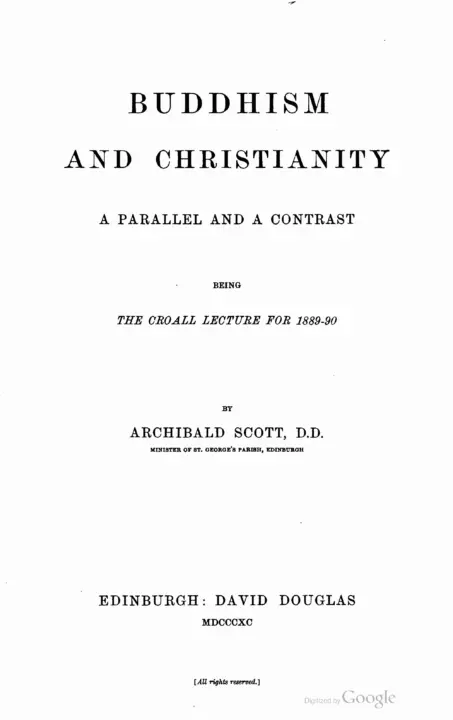
"Buddhism and Christianity: A Parallel and a Contrast" by Archibald Scott is a scholarly examination of the similarities and differences between Buddhism and Christianity, written in the late 19th century. This work presents a series of lectures, focusing on a comparative analysis of the two religions, to illuminate their unique features as well as their shared elements. Scott aims to foster a deeper understanding of both faiths, suggesting that studying these religions can enhance Christian appreciation for its own beliefs. The opening of the text provides a preface where Scott acknowledges the complexity of both religions and expresses a commitment to presenting Buddhism fairly, despite its historical misrepresentations. He highlights the significance of Buddhism as a major world religion that offers insights into human life and ethics. Scott also stresses the importance of comparative theology in strengthening Christianity rather than undermining it, encouraging an impartial study to discern universal truths that resonate within both traditions. He outlines the necessity to explore the distinct origins and developments of each faith while establishing a framework for a fruitful dialogue between the two.
Introduction adapted from the source catalogue; source summaries may be automatically generated.
Free to read · English · 95,734 words · No account needed
MAKE TIME FOR A GOOD BOOK
On by default. Untick to stop anonymous reading totals. Each page counts after 10 seconds in view. How this works.
Anonymous counting is on unless you have switched it off.
The blessed Buddha rebuked Pindola Bhâradvâga (for having won a bowl of sandalwood by performing a miracle), saying, “This is improper, not according to rule, unsuitable, unworthy of a Samana, unbecoming, and ought not to be done. How can you for the sake of a miserable wooden pot display before the laity the superhuman quality of your miraculous power of Iddhi?... This will not conduce either to the conversion of the unconverted or to the increase of the converted” (Kullavagga, v. 8. 2). The danger of performing a miracle by power of Iddhi, for self-glorification, is exemplified in the story of Devadatta in Kullavagga, vii. 1. 2, 3. In the Mahavagga, Kullavagga, Sutta Nipâta, and similar books, however, miracles are ascribed to Buddha, and conversions attributed to their performance.
Footnote 162:
Luke i. 1.
Footnote 163:
T. W. Rhys Davids, Hibbert Lectures, p. 128.
Footnote 164:
Oldenberg, Buddha, etc., p. 190.
Footnote 165:
Matthew xi. 27; xxviii. 16-20.
Footnote 166:
Mark i. 7-11; ii. 10-28; viii. 38; xii. 35-37.
Footnote 167:
Pressensé, Vie de Jésus, p. 373.
Footnote 168:
Cox, Commentary on Job, p. 19.
Footnote 169:
See Mahavagga, i. pp. 15-20, for specimens of the “three thousand five hundred” wonders of Buddha. “The marvellous in the Gospels is but sober good sense compared with what we find in ... the Hindu European mythologies” (Renan, Études d’histoire Relig. pp. 177, 203).
Footnote 170:
Godet, Lectures in Defence of the Christian Faith, pp. 118-161.
Footnote 171:
Dr. Dods, Mohammed, Buddha, and Christ, p. 201; Dr. Fairbairn, Studies in Religion as a Philosophy, p. 36.
Footnote 172:
p. 58, one-vol. edition.
Footnote 173:
Trench, Hulsean Lectures, p. 150.
Footnote 174:
Sutta Nipâta, translated by Fausböll in vol. x. p. 102; parallel suggested to John xviii. 37.
Footnote 175:
Hibbert Lectures, pp. 144-147.
Footnote 176:
Dorner, Doctrine of the Person of Christ, Introd. pp. 56-60, 64-70; Liddon, Bampton Lectures, 1866, pp. 364-380; Lange, Life of Christ, vol. i. pp. 121-124.
Footnote 177:
E.g. the Targums.
Footnote 178:
E.g. De Opific. Mund. i. 4; De Mundi incor. § 16, 17.
Footnote 179:
Sears, Fourth Gospel, pp. 220 seq.; Westcott, Introduction to St. John, pp. xvi, xvii; Dorner, op. cit. vol. i. pp. 327-332.
Your reading position is saved on this browser. Take it to another device with a library code. Reading pages adapt to text, rather than matching a printed edition.
BEHIND THE BOOK
This eBook is for the use of anyone anywhere in the United States and most other parts of the world at no cost and with almost no restrictions whatsoever. You may copy it, give it away or re-use it under the terms of the Project Gutenberg License included with this eBook or online at www.gutenberg.org. If you are not located in the United States, you will have to check the laws of the country where you are located before using this eBook. Read the source licence.
The original source file, including credits and licence, is retained by this library. Request an original-format copy at no charge. Please include the book title and Project Gutenberg identifier #67171.
KEEP YOUR CURIOSITY GOING
David Patterson (Spirit) Hatch

David Patterson (Spirit) Hatch

David Patterson (Spirit) Hatch

Edwin Abbott Abbott

Richard Watson
T. G. (Theophilus Gould) Steward