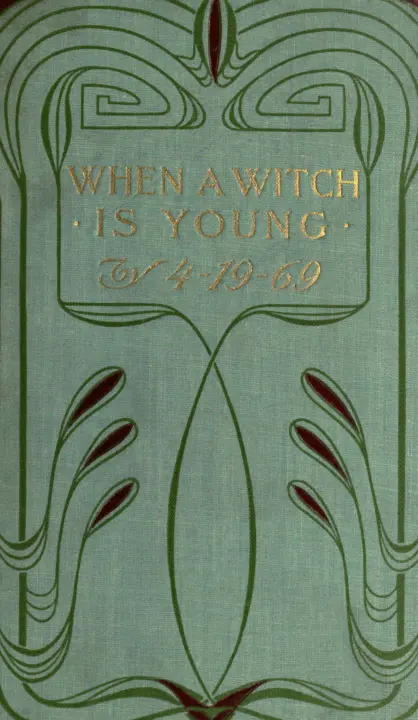
When a witch is young: a historical novel
Philip Verrill Mighels
THE CLASSIC COLLECTION · 1904
"Bruvver Jim's Baby" by Philip Verrill Mighels is a novel written in the early 20th century. The story revolves around a young child who is unexpectedly found amidst an Indian rabbit drive in the wilderness of Nevada by a rugged miner named Jim. The narrative explores themes of compassion, family, and community as Jim takes the child, who appears to be lost and abandoned, under his wing, prominently highlighting their bond and the miner's transformation as a paternal figure. The opening of the book sets the stage during a vivid description of a rabbit hunt by the Piute tribe. Here, we are introduced to a young boy, timidly riding on a pony, who finds himself separated from the Indian tribe and subsequently falls off, left behind amid the wilderness. This sets the scene for Jim's entrance, a lanky miner who discovers the boy sitting among scattered rabbits. Despite his rough exterior, Jim's heart opens to the lost child, whom he names "Skeezucks" or "Aborigineezer." The subsequent chapters follow their developing relationship, Jim's attempts at caring for the boy, and the unforeseen challenges they face in the rugged landscape of Borealis, ultimately showcasing the creation of a makeshift family against the backdrop of a close-knit community.
Introduction adapted from the source catalogue; source summaries may be automatically generated.
Free to read · English · 43,390 words · No account needed
MAKE TIME FOR A GOOD BOOK
On by default. Untick to stop anonymous reading totals. Each page counts after 10 seconds in view. How this works.
Anonymous counting is on unless you have switched it off.
"Howdy, stranger?" said the blacksmith, as he came from his forge, bareheaded, his leathern apron tied about his waist, his sleeves rolled up, and his big, hairy arms akimbo. "Pleasant day. You're needin' somethin' fixed, I see," and he nodded quietly towards a road-side job of mending at the doubletree, which was roughly wrapped about with rope.
"Yes. Good-morning," said the driver of the rig, a clear-eyed, wholesome-looking man of clerical appearance. "We had a little accident. We've come from Bullionville. How long do you think it will take you to put us in shape?"
The smith was looking at the children.
Such a trio of blue-eyed, rosy-cheeked, unalarmed little girls had never before been seen in Borealis; and they all looked back at him and the others with the most engaging frankness.
"Well, about how far you goin'?" said the smith, by way of answer.
"To Fremont," replied the stranger. "I'm a preacher, but they thought they couldn't support a church at Bullionville," he added, with a look, half mirth, half worry, in his eyes. "However, a man from Fremont loaned us the horses and carriage, so we thought we'd move before the snow fell any deeper. I'd like to go on without great delay, if the mending can be hastened."
"Your off horse needs shoein'," said Webber, quickly scanning every detail of the animals and vehicle with his practised eye. "It's a long pull to Fremont. I reckon you can't git started before the day after tomorrow."
To a preacher who had found himself superfluous, the thought of the bill of expenses that would heap up so swiftly here in Borealis was distressing. He was poor; he was worried. Like many of the miners, he had worked at a claim that proved to be worthless in the end.
"I--hoped it wouldn't take so long," he answered, slowly, "but then I suppose we shall be obliged to make the best of the situation. There are stables where I can put up the horses, of course?"
"You kin use two stalls of mine," said the teamster, who liked the looks of the three little girls as well as those of the somewhat shy little mother and the preacher himself. "Boys, unhitch his stock."
Field, Bone, and the carpenter, recently made tender over all of youngster-kind, proceeded at once to unfasten the harness.
"But--where are we likely to find accommodations?" faltered the preacher, doubtfully. "Is there any hotel or boarding-house in camp?"
"Well, not exactly--is there, Webber?" replied the teamster. "The boardin'-house is over to the mill--the quartz-mill, ten miles down the canon."
Your reading position is saved on this browser. Take it to another device with a library code. Reading pages adapt to text, rather than matching a printed edition.
Philip Verrill Mighels
Philip Verrill Mighels
Philip Verrill Mighels
BEHIND THE BOOK
This eBook is for the use of anyone anywhere in the United States and most other parts of the world at no cost and with almost no restrictions whatsoever. You may copy it, give it away or re-use it under the terms of the Project Gutenberg License included with this eBook or online at www.gutenberg.org. If you are not located in the United States, you will have to check the laws of the country where you are located before using this eBook. Read the source licence.
The original source file, including credits and licence, is retained by this library. Request an original-format copy at no charge. Please include the book title and Project Gutenberg identifier #16608.
KEEP YOUR CURIOSITY GOING
Coulson Kernahan

Maurice Baring
Frances Wright
Cécile Tormay

Frederic Jesup Stimson

W. H. P. (William Henry Pope) Jarvis