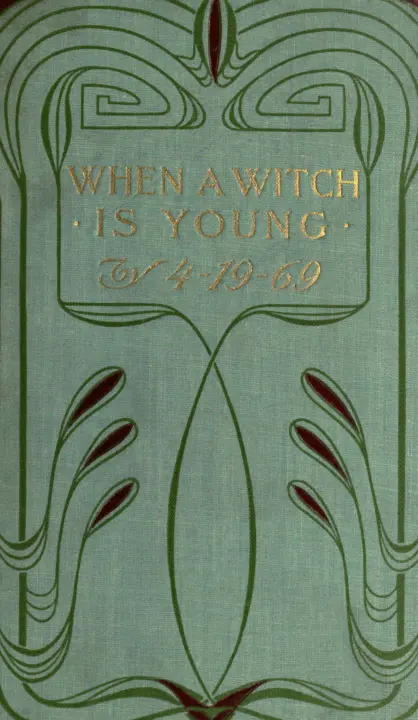
When a witch is young: a historical novel
Philip Verrill Mighels
THE CLASSIC COLLECTION · 1904
"Bruvver Jim's Baby" by Philip Verrill Mighels is a novel written in the early 20th century. The story revolves around a young child who is unexpectedly found amidst an Indian rabbit drive in the wilderness of Nevada by a rugged miner named Jim. The narrative explores themes of compassion, family, and community as Jim takes the child, who appears to be lost and abandoned, under his wing, prominently highlighting their bond and the miner's transformation as a paternal figure. The opening of the book sets the stage during a vivid description of a rabbit hunt by the Piute tribe. Here, we are introduced to a young boy, timidly riding on a pony, who finds himself separated from the Indian tribe and subsequently falls off, left behind amid the wilderness. This sets the scene for Jim's entrance, a lanky miner who discovers the boy sitting among scattered rabbits. Despite his rough exterior, Jim's heart opens to the lost child, whom he names "Skeezucks" or "Aborigineezer." The subsequent chapters follow their developing relationship, Jim's attempts at caring for the boy, and the unforeseen challenges they face in the rugged landscape of Borealis, ultimately showcasing the creation of a makeshift family against the backdrop of a close-knit community.
Introduction adapted from the source catalogue; source summaries may be automatically generated.
Free to read · English · 43,390 words · No account needed
MAKE TIME FOR A GOOD BOOK
On by default. Untick to stop anonymous reading totals. Each page counts after 10 seconds in view. How this works.
Anonymous counting is on unless you have switched it off.
He sat with him throughout that day, however, as he had so many of these fleeting days. The larder was neglected; the money contributed at "church" had gone at once, to score against a bill at the store, as large as the cabin itself, and only the labors of Keno, chopping brush for fuel, kept the home supplied even with a fire. Jim had been born beneath the weight of some star too slow to move along.
When Keno came back to the cabin from his work in the brush it was well along in the afternoon. Jim decided to go below and stock up the pantry with food. On arriving at the store, however, he met a new manner of reception.
The gambler, Parky, was in charge, as a recent purchaser of the whole
concern.
"You can't git no more grub-stake here without the cash," he said to Jim. "And now you've come, you can pony up on the bill you 'ain't yet squared."
"So?" said Jim.
"You bet your boots it's so, and you can't begin to pungle up a minute too soon!" was the answer.
"I reckon you'd ask a chicken to pungle up the gravel in his gizzard if you thought he'd picked up a sliver of gold," Jim drawled, in his lazy utterance. "And an ordinary chicken, with the pip thrown in, could pungle twice to my once."
"Ain't got the stuff, hey?" said Parky. "Broke, I s'pose? Then maybe you'll git to work, you old galoot, and stop playin' parson and goody-goody games. You don't git nothing here without the chink. So perhaps you'll git to work at last."
A red-nosed henchman of the gambler's put in a word.
"I don't see why you 'ain't gone to work," he said.
"Don't you?" drawled Jim, leaning on the counter to survey the speaker. "Well, it looks to me as if you found out, long ago, that all work and no play makes a man a Yankee."
"I ain't no Yankee, you kin bet on that!" said the man.
"That's pretty near incredible," drawled Jim.
"And I ain't neither," declared the gambler, who boasted of being Canadian. "Don't you forget that, old boy."
"No," Jim slowly replied, "I've often noticed that all that glitters
ain't American."
"Well, you can clear out of here and notice how things look outside,"
retorted Parky.
Jim was slowly straightening up when the blacksmith and the teamster entered the place. They had heard the gambler's order and were thoroughly astounded. No man, howsoever poor and unprepared to pay a wretched bill, had ever been treated thus in Borealis before.
"What's the matter?" said Webber.
Your reading position is saved on this browser. Take it to another device with a library code. Reading pages adapt to text, rather than matching a printed edition.
Philip Verrill Mighels
Philip Verrill Mighels
Philip Verrill Mighels
BEHIND THE BOOK
This eBook is for the use of anyone anywhere in the United States and most other parts of the world at no cost and with almost no restrictions whatsoever. You may copy it, give it away or re-use it under the terms of the Project Gutenberg License included with this eBook or online at www.gutenberg.org. If you are not located in the United States, you will have to check the laws of the country where you are located before using this eBook. Read the source licence.
The original source file, including credits and licence, is retained by this library. Request an original-format copy at no charge. Please include the book title and Project Gutenberg identifier #16608.
KEEP YOUR CURIOSITY GOING
Coulson Kernahan

Maurice Baring
Frances Wright
Cécile Tormay

Frederic Jesup Stimson

W. H. P. (William Henry Pope) Jarvis