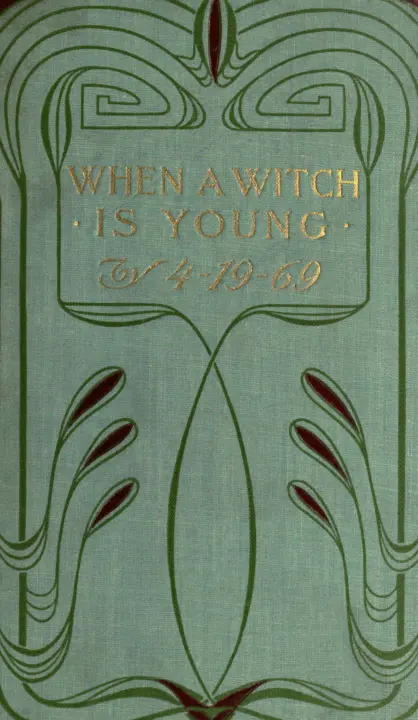
When a witch is young: a historical novel
Philip Verrill Mighels
THE CLASSIC COLLECTION · 1904
"Bruvver Jim's Baby" by Philip Verrill Mighels is a novel written in the early 20th century. The story revolves around a young child who is unexpectedly found amidst an Indian rabbit drive in the wilderness of Nevada by a rugged miner named Jim. The narrative explores themes of compassion, family, and community as Jim takes the child, who appears to be lost and abandoned, under his wing, prominently highlighting their bond and the miner's transformation as a paternal figure. The opening of the book sets the stage during a vivid description of a rabbit hunt by the Piute tribe. Here, we are introduced to a young boy, timidly riding on a pony, who finds himself separated from the Indian tribe and subsequently falls off, left behind amid the wilderness. This sets the scene for Jim's entrance, a lanky miner who discovers the boy sitting among scattered rabbits. Despite his rough exterior, Jim's heart opens to the lost child, whom he names "Skeezucks" or "Aborigineezer." The subsequent chapters follow their developing relationship, Jim's attempts at caring for the boy, and the unforeseen challenges they face in the rugged landscape of Borealis, ultimately showcasing the creation of a makeshift family against the backdrop of a close-knit community.
Introduction adapted from the source catalogue; source summaries may be automatically generated.
Free to read · English · 43,390 words · No account needed
MAKE TIME FOR A GOOD BOOK
On by default. Untick to stop anonymous reading totals. Each page counts after 10 seconds in view. How this works.
Anonymous counting is on unless you have switched it off.
Out of saloons and houses men came sauntering, or running, according to the tension of their nerves. Many thought some house must be afire. At least thirty men were presently gathered at the place of summons. With five or six informers to tell the news of Jim's bereavement, all were soon aware of what was making the trouble. But none had seen the tiny foundling since they bade him good-bye in the charge of Jim himself.
"Are you plum dead sure he's went?" said Webber, the smith. "Did you
look all over the cabin?"
"Everywhere," said Jim. "He's gone!"
"Wal, maybe some mystery got him," suggested Bone. "Jim, you don't suppose his father, or some one who lost him, come and nabbed him while you was gone?"
They saw old Jim turn pale in the light that came from across the
street.
Keno broke in with an answer.
"By jinks! Jim was his mother! Jim had more good rights to the little feller than anybody, livin' or dead!"
"You bet!" agreed a voice.
Jim spoke with difficulty.
"If any one did that"--he faltered--"why, boys, he never should have let me find him in the brush."
"Are you plum dead sure he's went?" insisted the blacksmith, whom the
news had somewhat stunned.
"I thought perhaps you fellows might have played a joke--taken him off to see me run around," said Jim, with a faint attempt at a smile. "'Ain't you got him, boys--all the time?"
"Aw, no, he'd be too scared," said Bone. "We know he'd be scared of
any one of us."
"It ain't so much that," said Field, "but I shouldn't wonder if his father, or some other feller just as good, came and took him off."
"Of course his father would have the right," said Jim, haltingly, "but--I wish he hadn't let me find him first. You fellows are sure you ain't a-foolin'?"
"We couldn't have done it--not on Sunday--after church," said Lufkins. "No, Jim, we wouldn't fool that way."
"You don't s'pose that Parky might have took him, out of spite?" said Jim, eager for hope in any direction whatsoever.
"No! He hates kids worse than pizen," said the barkeep, decisively. "He's been a-gamblin' since four this afternoon, dealin' faro-bank."
"We could go and search every shack in camp," suggested a listener.
"What would be the good of that?" inquired Field. "If the father came and took the little shaver, do you think he'd hide him 'round here in somebody's cabin?"
The blacksmith said: "It don't seem as if you could have looked all over the house. He's such a little bit of a skeezucks."
Your reading position is saved on this browser. Take it to another device with a library code. Reading pages adapt to text, rather than matching a printed edition.
Philip Verrill Mighels
Philip Verrill Mighels
Philip Verrill Mighels
BEHIND THE BOOK
This eBook is for the use of anyone anywhere in the United States and most other parts of the world at no cost and with almost no restrictions whatsoever. You may copy it, give it away or re-use it under the terms of the Project Gutenberg License included with this eBook or online at www.gutenberg.org. If you are not located in the United States, you will have to check the laws of the country where you are located before using this eBook. Read the source licence.
The original source file, including credits and licence, is retained by this library. Request an original-format copy at no charge. Please include the book title and Project Gutenberg identifier #16608.
KEEP YOUR CURIOSITY GOING
Coulson Kernahan

Maurice Baring
Frances Wright
Cécile Tormay

Frederic Jesup Stimson

W. H. P. (William Henry Pope) Jarvis