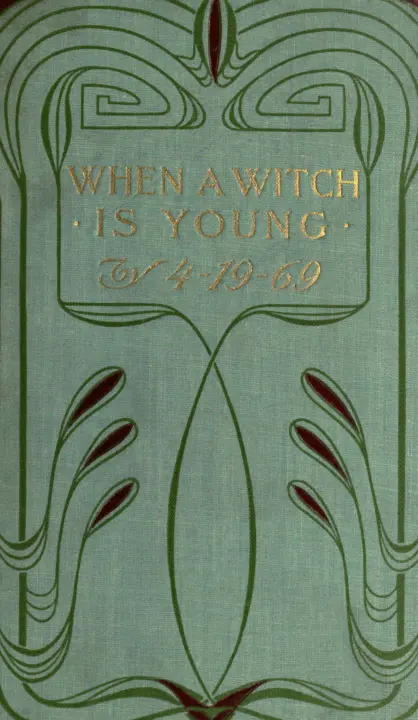
When a witch is young: a historical novel
Philip Verrill Mighels
THE CLASSIC COLLECTION · 1904
"Bruvver Jim's Baby" by Philip Verrill Mighels is a novel written in the early 20th century. The story revolves around a young child who is unexpectedly found amidst an Indian rabbit drive in the wilderness of Nevada by a rugged miner named Jim. The narrative explores themes of compassion, family, and community as Jim takes the child, who appears to be lost and abandoned, under his wing, prominently highlighting their bond and the miner's transformation as a paternal figure. The opening of the book sets the stage during a vivid description of a rabbit hunt by the Piute tribe. Here, we are introduced to a young boy, timidly riding on a pony, who finds himself separated from the Indian tribe and subsequently falls off, left behind amid the wilderness. This sets the scene for Jim's entrance, a lanky miner who discovers the boy sitting among scattered rabbits. Despite his rough exterior, Jim's heart opens to the lost child, whom he names "Skeezucks" or "Aborigineezer." The subsequent chapters follow their developing relationship, Jim's attempts at caring for the boy, and the unforeseen challenges they face in the rugged landscape of Borealis, ultimately showcasing the creation of a makeshift family against the backdrop of a close-knit community.
Introduction adapted from the source catalogue; source summaries may be automatically generated.
Free to read · English · 43,390 words · No account needed
MAKE TIME FOR A GOOD BOOK
On by default. Untick to stop anonymous reading totals. Each page counts after 10 seconds in view. How this works.
Anonymous counting is on unless you have switched it off.
This was sung no less than seven times, when Jim at length lifted his
hand for the end.
"We'll follow this up with the Lord's Prayer," he said.
Laying his big, freckled hand on the shoulder of the wondering little pilgrim, seated so quietly upon the anvil, he closed his eyes and bowed his head. How thin, but kindly, was his rugged face as the lines were softened by his attitude!
He began with hesitation. The prayer, indeed, was a stumbling towards the long-forgotten--the wellnigh unattainable.
"'Our Father which art in heaven . . .
Our Father which art in heaven--'
"Now, hold on, just a minute," and he paused to think before resuming and wiped his suddenly sweating brow.
"'Our Father which art in heaven--
If I should die before I wake . . .
Give us our daily bread. Amen.'"
The men all sat in silence. Then Keno whispered, so loudly that every
one could hear;
"By jinks! I didn't think he could do it!"
"We'll now have another hymn," announced the leader, "There used to be one that went on something about, 'I'm lost and far away from the shack, and it's dark, and lead me--somewhere--kindly light.' Any one remember the words all straight?"
"I don't," replied the blacksmith, "but I might come in on the chorus."
"Seems to me," said Bone, "a candle or just a plain, unvarnished light, would 'a' went out. It must have bin a lantern."
"Objection well taken," responded Jim, gravely. "I reckon I got it turned 'round a minute ago. It was more like:
"'Lead me on, kindly lantern,
For I am far from home,
And the night is dark.'"
"It don't sound like a song--not exactly," ventured Lufkins. "Why not give 'em 'Down on the Swanee River'?"
"All right," agreed the "parson," and therefore they were all presently singing at the one perennial "hymn" of the heart, universal in its application, sweetly religious in its humanism. They sang it with a woful lack of its own original lines; they put in string on string of "dum te dums," but it came from their better natures and it sanctified the dingy shop.
When it was ended, which was not until it had gone through persistent repetitions, old Jim was prepared for almost anything.
"I s'pose you boys want a regular sermon," said he, "and if only I'd 'a' had the time--wal, I won't say what a torch-light procession of a sermon you'd have got, but I'll do the best I can."
He cleared his throat, struck an attitude inseparable from American
elocution, and began:
Your reading position is saved on this browser. Take it to another device with a library code. Reading pages adapt to text, rather than matching a printed edition.
Philip Verrill Mighels
Philip Verrill Mighels
Philip Verrill Mighels
BEHIND THE BOOK
This eBook is for the use of anyone anywhere in the United States and most other parts of the world at no cost and with almost no restrictions whatsoever. You may copy it, give it away or re-use it under the terms of the Project Gutenberg License included with this eBook or online at www.gutenberg.org. If you are not located in the United States, you will have to check the laws of the country where you are located before using this eBook. Read the source licence.
The original source file, including credits and licence, is retained by this library. Request an original-format copy at no charge. Please include the book title and Project Gutenberg identifier #16608.
KEEP YOUR CURIOSITY GOING
Coulson Kernahan

Maurice Baring
Frances Wright
Cécile Tormay

Frederic Jesup Stimson

W. H. P. (William Henry Pope) Jarvis