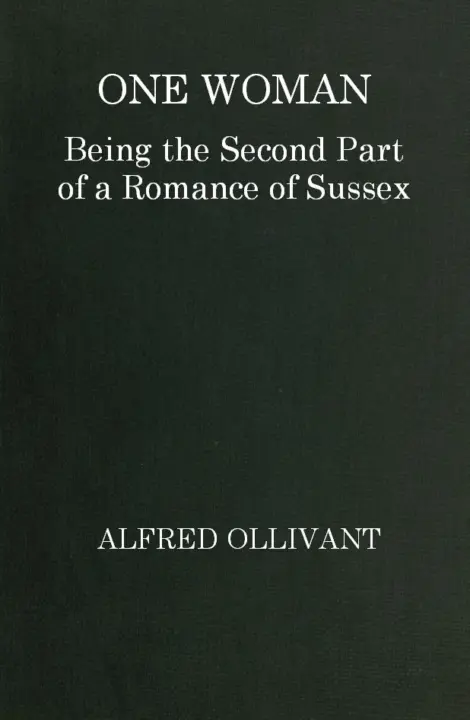
One Woman: Being the Second Part of a Romance of Sussex
Alfred Ollivant
THE CLASSIC COLLECTION · 1918
"Boy Woodburn: A Story of the Sussex Downs" by Alfred Ollivant is a novel written in the early 20th century. The story is centered around Boy Woodburn, the spirited daughter of a horse trainer named Old Mat, as she navigates life in the Sussex Downs, which blends themes of passion, adventure, and the world of horse racing. The novel paints a vivid picture of the rural environment and introduces readers to a cast of colorful characters connected to the horse training profession. At the start of the book, we are introduced to Old Mat, a well-respected horse trainer known for his unconventional methods and charming personality. As he prepares for the Spring Meeting at Polefax, we see glimpses of his daughter Boy, who is portrayed as a strong-willed and determined young girl, engaged in the world of racing and its accompanying challenges. The opening chapters establish a lively setting filled with local sportsmen and cheerful chaos, while subtly hinting at Boy's dreams and ambitions, which are influenced by her upbringing and her father's legacy. We also meet a variety of characters that contribute to both the excitement of the races and personal narratives that intertwine with Boy's journey.
Introduction adapted from the source catalogue; source summaries may be automatically generated.
Free to read · English · 84,937 words · No account needed
MAKE TIME FOR A GOOD BOOK
On by default. Untick to stop anonymous reading totals. Each page counts after 10 seconds in view. How this works.
Anonymous counting is on unless you have switched it off.
Her Daughter
Boy Woodburn had been born to the apparently incongruous couple some
years after their marriage.
From the very beginning she had always been Boy. Mrs. Haggard, who didn't quite approve of the name--and there were many things Mrs. Haggard didn't quite approve of--once inquired the origin of it.
"I think it came," answered Mrs. Woodburn.
And certainly nobody but the vicar's wife ever thought or spoke of the girl as Joyce. She grew up in Mrs. Haggard's judgment quite uneducated. That lady, a good but somewhat officious creature, was genuinely distressed and made many protests.
The protests were invariably met by Mrs. Woodburn imperturbably as
always.
"It's how my father was bred," she replied in that plain manner of hers, so plain indeed that conventional people sometimes complained of it as rude. "That's good enough for me."
Mrs. Haggard carried her complaint to her husband, the vicar.
"There was once a man called Wordsworth, I believe," was all the answer of that enigmatic creature.
"You're much of a pair, you and Mrs. Woodburn," snapped his wife as she
left the room.
"My dear, you flatter me," replied the quiet vicar.
On the face of it, indeed, Mrs. Haggard had some ground for her anxiety
about the girl.
Boy from the beginning was bred in the stables, lived in them, loved
them.
At four she began to ride astride and had never known a side-saddle or worn a habit all her life. She took to the pigskin as a duck to water; and at seven, Monkey Brand, then in his riding prime, gave her up.
"She knows more'n me," he said, half in sorrow, half in pride, as his erstwhile pupil popped her pony over a Sussex heave-gate.
"Got wings, she have."
"Look-a-there!"
But the girl did not desert her first master. She would sit on a table in the saddle-room, swinging her legs, and shaking her fair locks as she listened bright-eyed while Monkey, busy on leather with soap and sponge, told again the familiar story of Cannibal's National.
It was on her ninth birthday that, at the conclusion of the oft-told tale, she put a solemn question:
"Monkey Brand!"
"Yes, Minie."
"Do-you-think-I-could-win-with-the National?"
"No sayin' but you might, Min."
The child's eyes became steel. She set her lips, and nodded her flaxen head with fierce determination.
She never recurred to the matter, or mentioned it to others. But from that time forth to ride the National winner became her secret ambition, dwelt upon by day, dreamed over by night, her constant companion in the saddle, nursed secretly in the heart of her heart, and growing always as she grew.
Your reading position is saved on this browser. Take it to another device with a library code. Reading pages adapt to text, rather than matching a printed edition.
Alfred Ollivant
Alfred Ollivant
Alfred Ollivant
Alfred Ollivant
BEHIND THE BOOK
This eBook is for the use of anyone anywhere in the United States and most other parts of the world at no cost and with almost no restrictions whatsoever. You may copy it, give it away or re-use it under the terms of the Project Gutenberg License included with this eBook or online at www.gutenberg.org. If you are not located in the United States, you will have to check the laws of the country where you are located before using this eBook. Read the source licence.
The original source file, including credits and licence, is retained by this library. Request an original-format copy at no charge. Please include the book title and Project Gutenberg identifier #17965.
KEEP YOUR CURIOSITY GOING
Coulson Kernahan

Maurice Baring
Frances Wright
Cécile Tormay

Frederic Jesup Stimson

W. H. P. (William Henry Pope) Jarvis