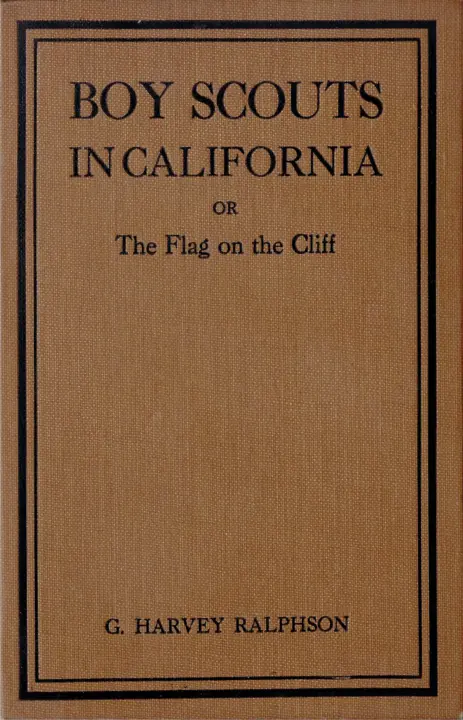
Boy Scouts in California; or, The Flag on the Cliff
G. Harvey (George Harvey) Ralphson
THE CLASSIC COLLECTION · 1913
"Boy Scouts on the Great Divide; Or, The Ending of the Trail" by Archibald Lee Fletcher is a fictional work written in the early 20th century. The story follows a group of Boy Scouts, including characters such as Will Smith, George Benton, Charley (Sandy) Green, and Tommy Gregory, as they embark on a vacation trip to the Great Divide that quickly turns into an investigation filled with adventure and intrigue. Tasked with finding a missing witness related to a criminal case, the boys encounter a range of challenges, including a daunting confrontation with robbers, the mysterious presence of a stranger, and unexpected twists that put their scouting skills to the test. At the start of the novel, the boys are setting up their camp in Wyoming's picturesque yet potentially perilous landscape, eagerly awaiting a messenger from their attorney. As they prepare supper, they meet a suspicious stranger named Katz, who claims to be lost and in need of their hospitality. Their lighthearted camping trip soon escalates as they hear distant gunshots and notice unsettling events, hinting at the presence of train robbers in the vicinity. The opening chapters set a thrilling tone, introducing themes of camaraderie, adventure, and the moral dilemmas of trust and deception among friends and strangers alike, captivating readers with a blend of youthful bravado and suspense.
Introduction adapted from the source catalogue; source summaries may be automatically generated.
Free to read · English · 36,588 words · No account needed
MAKE TIME FOR A GOOD BOOK
On by default. Untick to stop anonymous reading totals. Each page counts after 10 seconds in view. How this works.
Anonymous counting is on unless you have switched it off.
"You never have!" declared Tommy.
"Honest!" replied Sandy. "I filled myself up with provisions and crawled under the blanket and went to sleep just after you went away to get some bear steak for breakfast. Did you get the steak?" the boy added with a grin.
"You bet I did," answered Tommy, "and I brought it back with me," he added, stroking the waistband of his trousers. "How's your shoulder?"
"Fine as a fiddle," was the reply. "I'm not going to have any trouble with it after this! Did you find Chester's fond parent," he added, glancing in the direction of the escaped convict.
"Sure we did," replied Tommy. "And, do you know," the boy went on, "that we needn't have bothered about finding him at all. Chester knows everything about the Fremont case that the father does."
"Is that right, Chester?" asked Sandy.
"Now you come on over here to father," Chester said, "and we'll ask him what took place in the private room of Fremont's bank that night, and we'll see if his memory of the things which occurred there is the same as mine."
The boys now all trooped to the tent where Mr. Wagner had been placed
and Chester asked:
"Do you know why these boys are here, father?"
"To take me back to prison, I suppose," was the almost sullen reply.
"They are here to establish your innocence," the son went on. "Do you
know why?"
The father glanced keenly from his son to the others and finally asked, his voice trembling with excitement:
"Why should they take an interest in me?"
"Because," Will broke in, "you can help us, and we want to help you. We have information that you are innocent of the crime of which you were convicted, and we believe that you have information which will prevent the conviction of an innocent man."
"Do you refer to the Fremont case?" asked Wagner.
"Exactly," replied Will. "And I'd like to ask you now," the boy went on, "before anything more is said, why you never communicated with young Fremont's attorney. He advertised for you extensively, and you might have held conference with him without subjecting yourself to arrest."
"I saw the advertisement," was the reply, "but I thought it was only a trap set by the police. I was determined not to go back to the penitentiary. If I had been captured by the police, I would have killed myself. I had no money, no influence, and it would have been impossible for me to establish my innocence, so I decided to let young Fremont look out for himself. I know now that I was wrong."
Your reading position is saved on this browser. Take it to another device with a library code. Reading pages adapt to text, rather than matching a printed edition.
G. Harvey (George Harvey) Ralphson
G. Harvey (George Harvey) Ralphson
G. Harvey (George Harvey) Ralphson
G. Harvey (George Harvey) Ralphson
BEHIND THE BOOK
This eBook is for the use of anyone anywhere in the United States and most other parts of the world at no cost and with almost no restrictions whatsoever. You may copy it, give it away or re-use it under the terms of the Project Gutenberg License included with this eBook or online at www.gutenberg.org. If you are not located in the United States, you will have to check the laws of the country where you are located before using this eBook. Read the source licence.
The original source file, including credits and licence, is retained by this library. Request an original-format copy at no charge. Please include the book title and Project Gutenberg identifier #31487.
KEEP YOUR CURIOSITY GOING
Coulson Kernahan

Maurice Baring
Frances Wright
Cécile Tormay

Frederic Jesup Stimson

W. H. P. (William Henry Pope) Jarvis