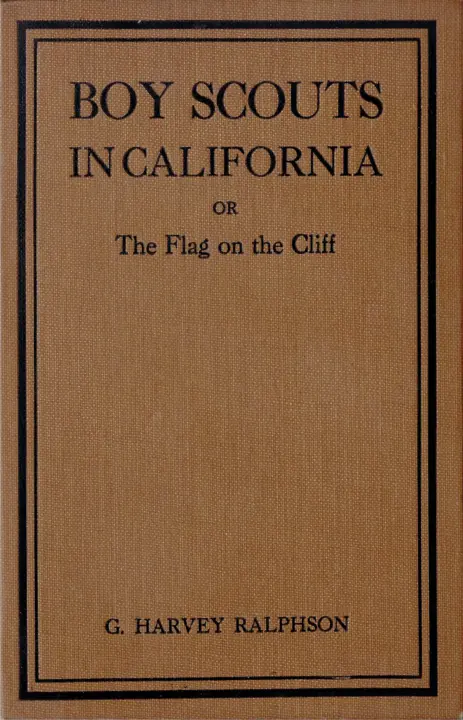
Boy Scouts in California; or, The Flag on the Cliff
G. Harvey (George Harvey) Ralphson
THE CLASSIC COLLECTION · 1914
"Boy Scouts on Hudson Bay; Or, The Disappearing Fleet" by G. Harvey Ralphson is a novel written in the early 20th century. This adventure story follows a group of five young Boy Scouts—Ned, Jimmy, Jack, Frank, and Teddy—who venture far into the wilderness of Northern Canada with the goal of exploring the mysterious Hudson Bay region while investigating claims of a potentially rich copper mine. As they navigate through rugged terrains and face various challenges, including encounters with wildlife and mysterious figures, the boys demonstrate camaraderie, ingenuity, and the spirit of adventure. The opening of the story introduces the five protagonists as they set up camp after a long day's journey through the wilderness. They are characterized by their distinct personalities and backgrounds, with Ned serving as the leader, supported by his spirited friends. Each boy contributes to the group's dynamic, and their camaraderie is evident through their playful banter. As they settle in for the night, they are unexpectedly charged by a bull moose, leading to a comical but intense moment. The narrative context not only establishes their journey's challenges but also hints at a greater mystery surrounding the region, particularly with the mention of a "disappearing fleet," setting the stage for an engaging adventure.
Introduction adapted from the source catalogue; source summaries may be automatically generated.
Free to read · English · 57,364 words · No account needed
MAKE TIME FOR A GOOD BOOK
On by default. Untick to stop anonymous reading totals. Each page counts after 10 seconds in view. How this works.
Anonymous counting is on unless you have switched it off.
"Well, I declare if they don't use the same sort of signals the scouts do down our way!" exclaimed Jimmy, looking rather disgusted, as though he had caught some one stealing his thunder.
Ned had to laugh at the blank expression of his assistant's face.
"Why, Jimmy," he said, "you forget that the scout movement is only half a dozen years old. It began after the Boer war, when General Baden-Powell saw what a great thing it would be for the whole British Nation, if every boy learned a thousand things about all creation, useful things at that. And, Jimmy, don't forget that smoke was used to signal with for hundreds of years before ever the white man landed on the shores of America."
"Say, that's right, Ned, they always made fires with their flints, didn't they? And these men up here, hunters, trappers, or whatever they may be, inherited the Injun way of sending messages. Sure, I knew it all along. The only trouble with me is I go and forget things. But what d'ye think they are doin' sending out that old smoke signal?"
"They've got friends within seeing distance, because smoke can be sighted many miles away, especially when it rises as straight as it's doing now," Jack ventured to interpose.
"The crowd over on the Harricanaw River, you mean?" demanded Jimmy.
"Yes."
"Then they'll be apt to know we gave 'em the slip, won't they?" the freckled faced scout continued.
"I suppose they will, because you notice that every now and then the smoke seems to stop," Ned answered. "As a scout in good standing, Jimmy, you ought to know how that's done."
"Two fellers swing a blanket over the smoking wood and smother it for a bit, to send up another big puff. Yes, that's what they call talking. Letters are formed by the puffs of smoke, just as we do the same with the wigwag flags, or the piece of looking-glass in the sun, when we heliograph."
"And right now, somewhere or other, one or more of those men must be reading out the message, letter by letter," said the patrol leader seriously, while they continued to walk on.
"It won't take long to tell how we happened to show up at the mine, and took a nice little saunter through the same, seeing how fine it was being cured--I mean salted," Teddy interrupted, thinking that Jimmy had done more than his full share of the cross questioning, and ought to give place to some one else.
"I shouldn't think it would," agreed Ned.
Your reading position is saved on this browser. Take it to another device with a library code. Reading pages adapt to text, rather than matching a printed edition.
G. Harvey (George Harvey) Ralphson
G. Harvey (George Harvey) Ralphson
G. Harvey (George Harvey) Ralphson
G. Harvey (George Harvey) Ralphson
BEHIND THE BOOK
This eBook is for the use of anyone anywhere in the United States and most other parts of the world at no cost and with almost no restrictions whatsoever. You may copy it, give it away or re-use it under the terms of the Project Gutenberg License included with this eBook or online at www.gutenberg.org. If you are not located in the United States, you will have to check the laws of the country where you are located before using this eBook. Read the source licence.
The original source file, including credits and licence, is retained by this library. Request an original-format copy at no charge. Please include the book title and Project Gutenberg identifier #22674.
KEEP YOUR CURIOSITY GOING
Coulson Kernahan

Maurice Baring
Frances Wright
Cécile Tormay

Frederic Jesup Stimson

W. H. P. (William Henry Pope) Jarvis