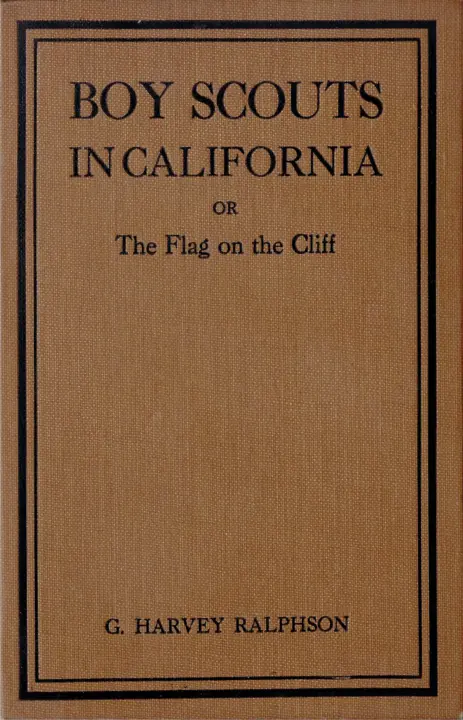
Boy Scouts in California; or, The Flag on the Cliff
G. Harvey (George Harvey) Ralphson
THE CLASSIC COLLECTION · 1911
"Boy Scouts in the Philippines; Or, The Key to the Treaty Box" by G. Harvey Ralphson is a fictional adventure tale written in the early 20th century. The story follows a group of Boy Scouts, particularly Ned Nestor and his friends Frank Shaw, Jimmie McGraw, and Jack Bosworth, as they embark on a secret mission in the Philippines under Major John Ross of the U.S. Secret Service. Their objective involves uncovering a treasonous plot against American interests in the region, setting the stage for excitement and intrigue. The opening of the book introduces us to the boys aboard the United States army transport "Union", nearing their destination in the Philippines. As they anticipate their arrival, they engage in playful banter, establishing their camaraderie and excitement about the upcoming adventures. However, the tone shifts as they learn that their trip is not just recreational; they are tasked with aiding in a covert investigation surrounding an alleged conspiracy. As they disembark, the boys encounter a sense of foreboding when they discover that Lieutenant Rowe, who is supposed to provide them with further instructions, has gone missing under suspicious circumstances, suggesting darker forces at play as they navigate both the tropical landscape and the political tension in the islands. The stakes are high, and the stage is set for a thrilling adventure filled with mystery and danger.
Introduction adapted from the source catalogue; source summaries may be automatically generated.
Free to read · English · 49,510 words · No account needed
MAKE TIME FOR A GOOD BOOK
On by default. Untick to stop anonymous reading totals. Each page counts after 10 seconds in view. How this works.
Anonymous counting is on unless you have switched it off.
The boys hastened down to the campfire and quickly extinguished it, much to the disgust of Jimmie, who had begun the preparation of an elaborate meal--at least as elaborate as could be gotten together out of tin cans.
This precaution taken, the Manhattan was towed into the mouth of the little creek and climbers and creepers drawn over her until no one would have suspected her presence there. The engine was not set in motion in making this change because of the danger from the explosions.
All this accomplished, Ned and Pat climbed back to the shelf of rock and again looked out over the mysterious China Sea. There were the two lights, one to the west and one to the north. They were closer to the island than before, however, and the light up toward Formosa was drawing to the south rapidly.
"They are going to meet here, all right," Pat said, "and I'll go apples to snowballs that they've got arms for the insurrectos. The manager of this enterprise never let all those chiefs get away from that other island without signing the treaty, and now he's sneaking in guns to help them out."
The boys discussed the situation for some moments, the lights coming nearer with astonishing rapidity. At length another light showed away to the south and west, but not such a light as the others.
It was not high up in the air, like the others, and directly it seemed to divide itself into half a dozen points. Its progress toward the island seemed to be even faster than that of the others.
"That's a steamer," Ned said, after a long look through his glass.
"The other lights are on steamers, too," Pat replied. "No wind-jammer could make the time, in this calm, that those boats are making."
While the boys looked the lights went out, or appeared to, and there was only the glimmer of the unfamiliar constellations of the heavens over the China Sea.
"That's strange!"
Pat turned to Ned and grasped him by the arm.
"What do you make of it?" he continued.
"That may be a signal," was the reply.
"If it is, the glims will show again directly."
"They may," was the reply.
But the lights did not show again, and, after waiting for an hour or more, the boys started back to the camp. Half way down, the dull, reverberating boom of a cannon came to their ears, over the water.
"What does that mean?" asked Pat.
"It may be the gunboat Jimmie insisted would be sent for me," smiled
Ned.
"You don't really think that?"
"Hardly," was the reply, "but I don't know what to make of it."
Your reading position is saved on this browser. Take it to another device with a library code. Reading pages adapt to text, rather than matching a printed edition.
G. Harvey (George Harvey) Ralphson
G. Harvey (George Harvey) Ralphson
G. Harvey (George Harvey) Ralphson
G. Harvey (George Harvey) Ralphson
BEHIND THE BOOK
This eBook is for the use of anyone anywhere in the United States and most other parts of the world at no cost and with almost no restrictions whatsoever. You may copy it, give it away or re-use it under the terms of the Project Gutenberg License included with this eBook or online at www.gutenberg.org. If you are not located in the United States, you will have to check the laws of the country where you are located before using this eBook. Read the source licence.
The original source file, including credits and licence, is retained by this library. Request an original-format copy at no charge. Please include the book title and Project Gutenberg identifier #20208.
KEEP YOUR CURIOSITY GOING
Coulson Kernahan

Maurice Baring
Frances Wright
Cécile Tormay

Frederic Jesup Stimson

W. H. P. (William Henry Pope) Jarvis