
Last letters from the living dead man
David Patterson (Spirit) Hatch
THE CLASSIC COLLECTION · 1912
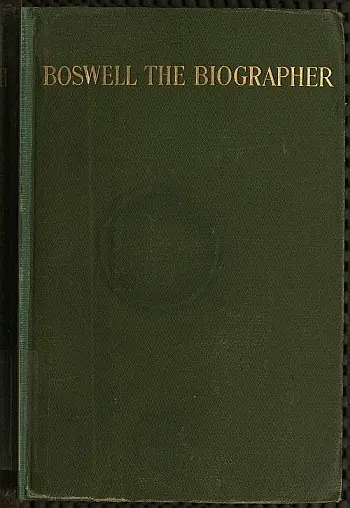
"Boswell the Biographer" by George Mallory is a biographical examination written in the early 20th century. This work delves into the character and psychological profile of James Boswell, particularly in relation to his renowned biography of Samuel Johnson, rather than providing a complete life account of Boswell himself. The book likely appeals to readers interested in literary history and the complexities of human relationships as it unpacks the nuances of Boswell's life and his enduring legacy as a biographer. The opening of the text discusses Boswell's unique standing in biographical literature, specifically highlighting the unmatched nature of his "Life of Johnson." Mallory states that the enduring appeal of Boswell's biography stems not only from its rich portrayal of Johnson but also from the vividness of Boswell's own character, which draws readers from various backgrounds. Through detailed references to Boswell's upbringing, early literary ambitions, and complex relationships, particularly with his father and peers, it sets the stage for a deeper exploration of how these elements shaped his eventual legacy as a biographer and a notable literary figure. The text establishes a foundation for analyzing Boswell's genius, his profound awareness of his own persona, and how these aspects contributed to his artistic output.
Introduction adapted from the source catalogue; source summaries may be automatically generated.
Free to read · English · 84,304 words · No account needed
MAKE TIME FOR A GOOD BOOK
On by default. Untick to stop anonymous reading totals. Each page counts after 10 seconds in view. How this works.
Anonymous counting is on unless you have switched it off.
That Boswell was always fond of his wife is clear enough. 'Eleven years have elapsed and I have never yet wanted to take advantage of my stipulated privilege.' He never speaks of her without affection, and was deeply distressed by her death in 1789. But for how long he continued to love her fervently it is difficult to tell; not, one would suppose, for a great length of time, or he could hardly have written in the London Magazine: 'Whatever respect I may have for the institution of marriage, and however much I am convinced that it upon the whole produces rational happiness, I cannot but be of the opinion that the passion of love has been improperly feigned as continuing long after the conjugal knot has been tied.' Nor, if Boswell had continued to love his wife passionately, would he have found it disagreeable to return to Edinburgh, after visits to London.
But Boswell no doubt wanted to be a faithful husband: 'I can unite little fondnesses with perfect conjugal love.'[15] His idea of fidelity would seem to involve no kind of restriction upon his natural inclinations except in so far as that he should appear to be a good husband in the eyes of the world and particularly of his wife. However sensible this view may have been, it was not such as commonly finds favour among the female sex. But he was undoubtedly in his own view a faithful husband and he had really at heart the welfare of his wife. 'Upon the whole I do believe,' he says, 'I make her very happy.'[16]
[Footnote 1: Tour to the Hebrides, September 17.]
[Footnote 2: Autobiography, Letters, &c., of Mrs. Piozzi,
ii, 124.]
[Footnote 3: Perhaps the best evidence of all for this quality is Boswell's habit of attending executions (mentioned several times in the Life and also in the Life of Reynolds, by Leslie and Taylor), and his acquaintance with Mrs. Rudd, a notorious criminal.]
[Footnote 4: Life of Johnson, ii, 59. This letter is an
admirable instance of Boswell's affected manner of expressing
real feelings.]
[Footnote 5: Life of Johnson, ii, 3, note 1.]
[Footnote 6: Letters to Temple, p. 126.]
[Footnote 7: Boswelliana, p. 186.]
[Footnote 8: Life of Johnson, ii, 20.]
[Footnote 9: Fitzgerald's Life of Boswell, i, 111.]
[Footnote 10: Boswell's authorship proved by Letters to
Temple, p. 89.]
[Footnote 11: Fitzgerald's Life of Boswell, i, 113.]
[Footnote 12: Fitzgerald's Life of Boswell, i, 116.]
[Footnote 13: London Magazine, 1, 40.]
[Footnote 14: Temple, it appears, was promised payment for his services: 'You shall have consultation guineas, as an ambassador has his appointments.' This seems to imply more than the mere travelling expenses which Dr. Rogers suggests as an explanation.]
[Footnote 15: Letters to Temple, p. 159.]
[Footnote 16: Ib. p. 137.]
Your reading position is saved on this browser. Take it to another device with a library code. Reading pages adapt to text, rather than matching a printed edition.
BEHIND THE BOOK
This eBook is for the use of anyone anywhere in the United States and most other parts of the world at no cost and with almost no restrictions whatsoever. You may copy it, give it away or re-use it under the terms of the Project Gutenberg License included with this eBook or online at www.gutenberg.org. If you are not located in the United States, you will have to check the laws of the country where you are located before using this eBook. Read the source licence.
The original source file, including credits and licence, is retained by this library. Request an original-format copy at no charge. Please include the book title and Project Gutenberg identifier #52246.
KEEP YOUR CURIOSITY GOING
David Patterson (Spirit) Hatch

David Patterson (Spirit) Hatch

David Patterson (Spirit) Hatch
John L. Ransom

Ralph Waldo Emerson

Maurice Baring