
Last letters from the living dead man
David Patterson (Spirit) Hatch
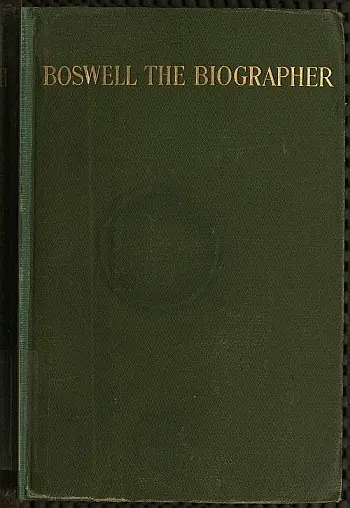
THE CLASSIC COLLECTION · 1912
"Boswell the Biographer" by George Mallory is a biographical examination written in the early 20th century. This work delves into the character and psychological profile of James Boswell, particularly in relation to his renowned biography of Samuel Johnson, rather than providing a complete life account of Boswell himself. The book likely appeals to readers interested in literary history and the complexities of human relationships as it unpacks the nuances of Boswell's life and his enduring legacy as a biographer. The opening of the text discusses Boswell's unique standing in biographical literature, specifically highlighting the unmatched nature of his "Life of Johnson." Mallory states that the enduring appeal of Boswell's biography stems not only from its rich portrayal of Johnson but also from the vividness of Boswell's own character, which draws readers from various backgrounds. Through detailed references to Boswell's upbringing, early literary ambitions, and complex relationships, particularly with his father and peers, it sets the stage for a deeper exploration of how these elements shaped his eventual legacy as a biographer and a notable literary figure. The text establishes a foundation for analyzing Boswell's genius, his profound awareness of his own persona, and how these aspects contributed to his artistic output.
Introduction adapted from the source catalogue; source summaries may be automatically generated.
Free to read · English · 84,304 words · No account needed
MAKE TIME FOR A GOOD BOOK
On by default. Untick to stop anonymous reading totals. Each page counts after 10 seconds in view. How this works.
Anonymous counting is on unless you have switched it off.
Inner Temple, 137, 167
Ireland, 22
Ireland, Mr., 193-4
James, King, 8
Jockey Club, 26
Johnson, Lionel, 189
Johnson, Samuel:
better known to us than other literary men, 1-2;
interest in, 3-4;
argument with Lord Auchinleck, 7;
retort to Mr. Dunn, 9;
Temple contrasted with, 13;
condemnation of Dempster, 19;
commends Boswell's accent, 21;
opinion of Derrick, 25;
great writer, 36;
becomes friends with Boswell, 40-50;
conversation, 45-7;
liked admiration, 45;
strength of personality, 49;
Frederick the Great and Voltaire, 54;
compared with Paoli, 56-8;
approves Boswell's adventures in Corsica, 58;
opinion of Boswell's account of Corsica, &c., 59;
opinion of Gibbon and condemnation of 'infidelity,' 68 seq.;
talks of going to Sweden, 71;
dines with Boswell, 74;
writes on behalf of Mr. Dodd, 79;
legal help to Boswell, 83-4;
on Scotchmen, 85-7, on Mrs. Boswell, 100-1;
Mrs. Boswell's opinion of, 102;
the Johnsonian circle, 106 seq.;
meeting with Wilkes arranged, 110-12;
friendship with Boswell, 112-34;
lack of sympathy and blunt advice, 114;
irritated by Boswell, 115;
quarrels, 116-24;
no venom in his wounds, 120;
very angry, 121;
in the Hebrides, 125 seq.;
at Streatham, 128;
at Lochbuy, 129;
use of images, 144;
influence on Boswell, 150-61;
conventional prejudices, 153 seq.;
talks for victory, 121, 153-4;
truth, honesty, 155, 201;
dislikes affectation, 157-8;
a moralist, 159-60;
Lord Auchinleck's opinion of, 165;
on Lord Auchinleck as Boswell's father, 166;
knows nothing of Scotch law, 171;
view of Boswell's attendance at executions, 173;
discourages Boswell's political ambitions, 175;
Boswell's imitation of, 191-2;
'just frown,' 155, 201;
mot about Boswell's boasting, 204;
fear of death, 206;
Gargantua, 207;
records of the tour in the Hebrides, 209-14;
little taste for rural beauties, 210;
interest in human nature, 211;
remarks on his host's avarice, 212-13;
introduced to Temple, 215;
moral support, 222;
melancholy, 225;
faults of the great moralist, 233-4;
love of truth applied to biography, 235-7;
Hawkins' Life, and Mrs. Thrale's Memoirs, 237-8;
Boswell's conception of, 238-40;
description of, 242;
physical characteristics, 244;
his cat, 244-5;
Latin quotations, 245;
presents a Highland lass with 'Cocker's Arithmetic,' 245;
letter to Lord Chesterfield, 248;
his pension, 248-9;
gay Sam, 254, 295;
a great talker, 256;
not expansive, 257;
baited by Boswell, 259;
the subject of Boswell's experiments, 260 seq.;
questioned by Boswell, 261 seq.;
helps Boswell in his biographical work, 272;
the Johnsonian æther, 286-7;
the dictator, 288-93;
dancing lessons, 288;
the element of humour, 289;
his humanity and tenderness, 291;
Tom Davies put down, 292;
his 'awfulness,' 293-8;
Miss Burney's account, 294 seq.;
his gallantry, 294-5;
his rebuke to Hannah More, 295;
his kindness, 295;
the dogmatist, 296;
pompousness and playfulness, 297;
his 'formality,' 298;
public interest in, 302;
his share in Boswell's great work, 315-6;
talked about, 317;
fertility and readiness of his wit, 323;
See also under Boswell.
Your reading position is saved on this browser. Take it to another device with a library code. Reading pages adapt to text, rather than matching a printed edition.
BEHIND THE BOOK
This eBook is for the use of anyone anywhere in the United States and most other parts of the world at no cost and with almost no restrictions whatsoever. You may copy it, give it away or re-use it under the terms of the Project Gutenberg License included with this eBook or online at www.gutenberg.org. If you are not located in the United States, you will have to check the laws of the country where you are located before using this eBook. Read the source licence.
The original source file, including credits and licence, is retained by this library. Request an original-format copy at no charge. Please include the book title and Project Gutenberg identifier #52246.
KEEP YOUR CURIOSITY GOING
David Patterson (Spirit) Hatch

David Patterson (Spirit) Hatch

David Patterson (Spirit) Hatch
John L. Ransom

Ralph Waldo Emerson

Maurice Baring