
Last letters from the living dead man
David Patterson (Spirit) Hatch
THE CLASSIC COLLECTION · 1912
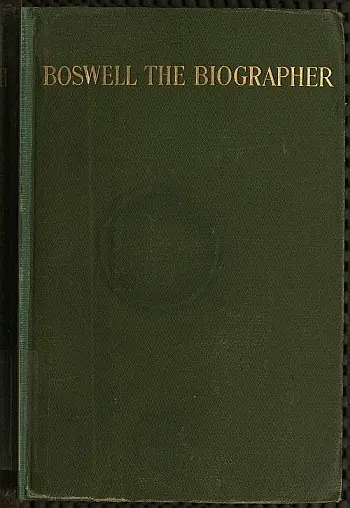
"Boswell the Biographer" by George Mallory is a biographical examination written in the early 20th century. This work delves into the character and psychological profile of James Boswell, particularly in relation to his renowned biography of Samuel Johnson, rather than providing a complete life account of Boswell himself. The book likely appeals to readers interested in literary history and the complexities of human relationships as it unpacks the nuances of Boswell's life and his enduring legacy as a biographer. The opening of the text discusses Boswell's unique standing in biographical literature, specifically highlighting the unmatched nature of his "Life of Johnson." Mallory states that the enduring appeal of Boswell's biography stems not only from its rich portrayal of Johnson but also from the vividness of Boswell's own character, which draws readers from various backgrounds. Through detailed references to Boswell's upbringing, early literary ambitions, and complex relationships, particularly with his father and peers, it sets the stage for a deeper exploration of how these elements shaped his eventual legacy as a biographer and a notable literary figure. The text establishes a foundation for analyzing Boswell's genius, his profound awareness of his own persona, and how these aspects contributed to his artistic output.
Introduction adapted from the source catalogue; source summaries may be automatically generated.
Free to read · English · 84,304 words · No account needed
MAKE TIME FOR A GOOD BOOK
On by default. Untick to stop anonymous reading totals. Each page counts after 10 seconds in view. How this works.
Anonymous counting is on unless you have switched it off.
Boswell, in the preface to the second edition of the 'Life,' tells us that the book had been received with favour, that he had obtained a great deal of spontaneous praise, and that Sir Joshua Reynolds lived to give the strongest testimony to its fidelity. These are expressions which he could not use, had they been untrue, in that place; for they would invite a damaging attack from the reviewers. But a book which upset the popular conception of a figure like Johnson, or even one which merely overdrew the 'shades' in his character, would hardly have been received like that. And Boswell in fact was never attacked in print for these faults, which, considering what a number of enemies he had, and the disputes in which he was engaged after the publication of the 'Life,' is almost conclusive evidence that his accounts of Johnson's 'awfulness' corresponded with the observations of other people. Courtenay was a good judge when he wrote the following lines about the 'Tour to the Hebrides':
"With Reynolds' pencil, vivid, bold, and true,
So fervent Boswell gives him to our view:
In every trait we see his mind expand;
The master rises by the pupil's hand.
We love the writer, praise his happy vein,
Grac'd with the naïveté of the sage Montaigne.
Hence not alone are brighter parts display'd,
But e'en the specks of character pourtray'd:
We see the Rambler with fastidious smile...."[15]
[Footnote 1: Autobiography, Letters, &c., of Mrs. Piozzi,
ii, 403.]
[Footnote 2: Nichols' Illustrations, vii, 313.]
[Footnote 3: Henley, in Views and Reviews, speaks of Boswell
as an artist.]
[Footnote 4: Fitzgerald and Birkbeck Hill both say something
of this.]
[Footnote 5: I use this term not in a particular technical sense (as applied to a school of French painters) but in a general sense, of all art that neglects details for the sake of general effect.]
[Footnote 6: The italics are mine.]
[Footnote 7: Life of Johnson, ii. 262, n. 2.]
[Footnote 8: Miss Burney's Diary, iv, 478.]
[Footnote 9: Ib., i, 100.]
[Footnote 10: Life of Johnson, iii, 80-1.]
[Footnote 11: Life of Johnson, iv, 340 et seq.]
[Footnote 12: Miss Burney's Diary, i, 211.]
[Footnote 13: Ib., i, 231.]
[Footnote 14: Ib., i, 102.]
[Footnote 15: Life of Johnson, ii, 268.]
Your reading position is saved on this browser. Take it to another device with a library code. Reading pages adapt to text, rather than matching a printed edition.
BEHIND THE BOOK
This eBook is for the use of anyone anywhere in the United States and most other parts of the world at no cost and with almost no restrictions whatsoever. You may copy it, give it away or re-use it under the terms of the Project Gutenberg License included with this eBook or online at www.gutenberg.org. If you are not located in the United States, you will have to check the laws of the country where you are located before using this eBook. Read the source licence.
The original source file, including credits and licence, is retained by this library. Request an original-format copy at no charge. Please include the book title and Project Gutenberg identifier #52246.
KEEP YOUR CURIOSITY GOING
David Patterson (Spirit) Hatch

David Patterson (Spirit) Hatch

David Patterson (Spirit) Hatch
John L. Ransom

Ralph Waldo Emerson

Maurice Baring