THE CLASSIC COLLECTION✦Lost DiariesCLASSIC FREE BOOKS
Lost Diaries
Maurice Baring
THE CLASSIC COLLECTION · 1927
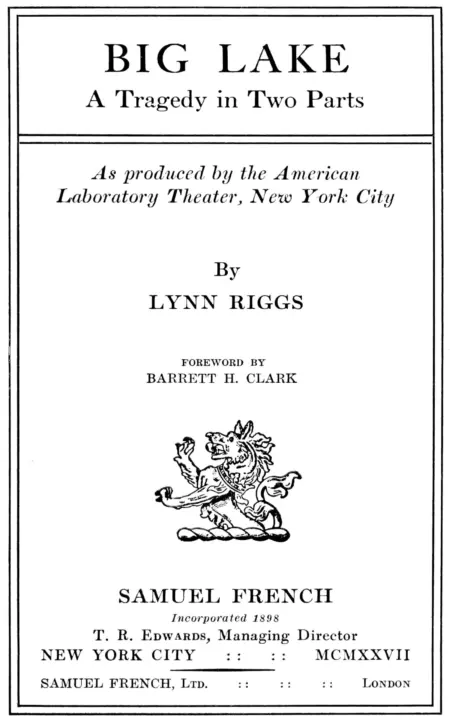
"Big Lake: A Tragedy in Two Parts" by Lynn Riggs is a dramatic play that captures the emotional turmoil of young love set against the backdrop of the woods and a lake in Indian Territory, now Oklahoma, in the year 1906. Written in the late 1920s, this two-part tragedy explores themes of innocence, fear, the wilderness, and the loss of youth. The likely topic revolves around the struggles of two young characters, Lloyd and Betty, against both external threats and their own internal fears as they navigate their complex feelings in a harsh environment. The storyline primarily focuses on Lloyd and Betty, two young individuals who venture into the woods near Big Lake for a picnic. Their innocent outing becomes entangled with darker events as they encounter Butch, a disturbed man hiding from the law after committing murder. As the picnic unfolds, tensions rise, leading to a tragic conclusion that sees innocent lives lost, culminating in a confrontation between youthful aspiration and the harsh realities of life, underscored by the dangers lurking in both the woods and the depths of human nature. The play ultimately presents a poignant commentary on the clash between the idealism of youth and the stark truths of existence.
Introduction adapted from the source catalogue; source summaries may be automatically generated.
Free to read · English · 13,280 words · No account needed
MAKE TIME FOR A GOOD BOOK
On by default. Untick to stop anonymous reading totals. Each page counts after 10 seconds in view. How this works.
Anonymous counting is on unless you have switched it off.
(A cleared place on the bank of the lake. At the back, beyond a slight mound, the lake begins. Willow trees droop into the water. Gold sunshine touches the lake, plays over an old boat tied under a tree. Voices—excited, boisterous, rough—shatter the quiet. From the left the picnic party enters, singly, in groups of three, in pairs—a dozen or more people. Tall farm boys, red-handed, red-faced, dressed in battered overalls, clumping shoes, ragged shirts; short, round farm girls, in unbecoming calicos and ginghams, with bows in their hair. Some of the boys carry boxes of food.)
I cain’t carry this no fu’ther.
Whur’s the f’ar go?
Fu’ther down, I reckon.
Over thar’s a good place.
She’s a-gettin’ her sewin’ done now, the crazy fool, an’ the Fair six
months off!
Aw, she cain’t sew a-tall.
Guess she aims t’ git married.
Married? Huh! Wouldn’t no one have her!
Would too have me! Lem Sickles ud have me.
He’d have you, all right, ’f you’d give him a chanst!
BUD BICKEL (loudly)
Le’s play, le’s stop a minute!
Hey, Miss Meredith!
Shet up yer yellin’! Miss Meredith’ll take yer head off.
Whut if I call her Jessie?
You better hadn’t! Arclo went ’n’ called her Jessie, ’n’ you orter seen her! She slapped him—!
BOYS AND GIRLS (protesting)
I’m hungry!
Aw, c’m’on ’n’ do whut Bud says!
Miss Meredith won’t let us, I bet.
Fraidy cat! Shootin’ on it, Clem, quit steppin’ on my feet, you crazy!
Le’s play! Keep yer feet in yer pocket!
Le’s play “Little Brown Jug.”
I’m hungry!
Well, who keers if you air? Be hungry! So’re we.
Who’s gonna cook the meat? Who’s got the meat? Whur is the meat anyhow? It’s bacon, ain’t it?
Shore, it’s bacon. (Singing.) “Sow belly bacon ’n’ bean soup!”
Le’s play “Happy is the Miller Boy.” I’ll be it.
Aw, le’s play “Ole Joe Clark.” C’m’on! Irey! Git her! Git Hildie fer a pardner. Well, you’re it, then. Irey’s it! Everbody got a pardner?
Wait a minute!
Go ahead. You start it, Bud. “Ole Joe Clark”—
(They begin to play, singing the song as they “do si do,”
promenade, etc.)
“Ole Joe Clark’s dead an’ gone,
I hope he’s doin’ well.
He made me wear the ball and chain
Till my ankles swelled.
Your reading position is saved on this browser. Take it to another device with a library code. Reading pages adapt to text, rather than matching a printed edition.
BEHIND THE BOOK
This eBook is for the use of anyone anywhere in the United States and most other parts of the world at no cost and with almost no restrictions whatsoever. You may copy it, give it away or re-use it under the terms of the Project Gutenberg License included with this eBook or online at www.gutenberg.org. If you are not located in the United States, you will have to check the laws of the country where you are located before using this eBook. Read the source licence.
The original source file, including credits and licence, is retained by this library. Request an original-format copy at no charge. Please include the book title and Project Gutenberg identifier #70780.
KEEP YOUR CURIOSITY GOING
Maurice Baring
W. B. (William Butler) Yeats
Edward Martyn

John Brougham & Charlotte Brontë
Marguerite Merington
Leonid Andreyev