THE CLASSIC COLLECTION✦An outlaw’s diary: the CommuneCLASSIC FREE BOOKS
An outlaw’s diary: the Commune
Cécile Tormay
THE CLASSIC COLLECTION · 1864
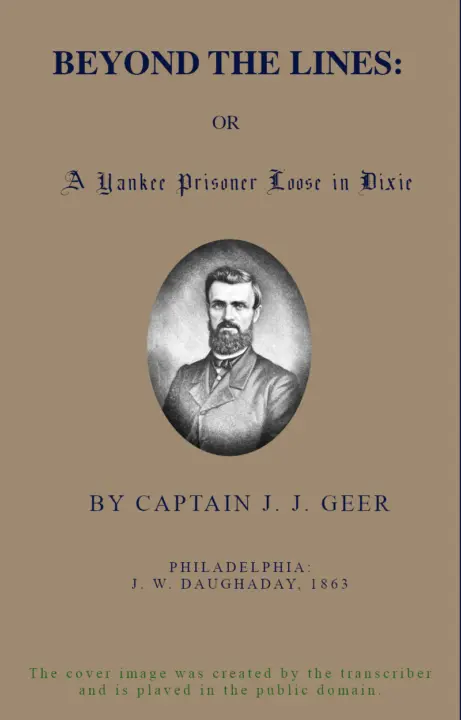
"Beyond the Lines; Or, A Yankee Prisoner Loose in Dixie" by John James Geer is a historical account written in the mid-19th century. The narrative details the experiences of Geer, a Union officer captured during the Civil War, as he recounts his struggles, sufferings, and eventual escape from Confederate captivity. The book offers a vivid insight into the realities faced by Union soldiers in the South, highlighting themes of bravery, survival, and the horrors of war. The opening of the narrative introduces us to Captain John J. Geer, who has recently left Camp Dennison with his regiment and is quickly thrust into battle at Shiloh, where he is captured. The tension of the battlefield is palpable as Geer describes witnessing the conflict and the suffering of civilians caught in the crossfire. Captured by rebel forces, he details the initial reactions of both the rebels, who are astonished to encounter a Union officer, and his own set of hardships as he faces threats from his captors. The early chapters set a dark tone, hinting at further trials ahead while establishing a framework for Geer's resilience and determination to escape.
Introduction adapted from the source catalogue; source summaries may be automatically generated.
Free to read · English · 57,584 words · No account needed
MAKE TIME FOR A GOOD BOOK
On by default. Untick to stop anonymous reading totals. Each page counts after 10 seconds in view. How this works.
Anonymous counting is on unless you have switched it off.
“Oh, sah,” she replied, amidst tears and sobs, “I darsen’t tell you, sah, for it’ll break my poor old heart.”
“Oh, yes, come now, Susie, tell me. If I cannot help you, I can at least feel sorry for you.”
“Oh, sah, but you are kind to feel sorry for a poor old slave like me. Dey’re sold my two dear little children, and dey’ll take ’em away to-morrow, and I knows I’ll neber see ’em no more ’till I sees ’em up dar, sah—up dar, sah, whar none of us’ll be sold any more.”
As Aunt Susie made this reply, she turned her face heavenward, and pointed up with her finger. In her agonized countenance, wet as it was with her sorrowful tears, I read an appeal for the freedom of the slave, stronger and more touching than all the volumes and speeches that have ever been written or made upon the subject.
I could not stand it any longer, and bidding the poor old slave good-bye, I turned away without my bread, for my heart was full. I no longer wondered at the strength of the language used by Ireland’s great orator, Daniel O’Connell, when he said:
“The Americans, in their conduct towards the slaves, are traitors to the cause of human liberty, foul detractors of the democratic principles which I have cherished throughout my political life. They are blasphemers of that great and sacred name which they pretend to honor. For in their solemn league and covenant, the Declaration of Independence, they declare that all men have certain ‘inalienable rights.’ These they defined to be life, liberty, and the pursuit of happiness. To maintain these, they pledged themselves with all the solemnity of an oath in the presence of Almighty God. The aid which they invoked from heaven was awarded to them; but they have violated their awfully solemn compact with the Deity, and set at naught every principle which they profess to hold sacred, by keeping two and a half millions of their fellow-men in bondage. In reprobation of that disgraceful conduct, my humble voice is heard across the waves of the wide Atlantic. Like the thunderstorm in its strength, it careers against the breeze armed with the lightning of Christian truth. And let them seek to repress it as they may; let them murder and assassinate in the true spirit of Lynch law; the storm will rave louder and louder around them till the claims of justice become too strong to be withstood, and the black man will stand up too big for his chains. I hope what I am about to say is not a profanation, but it seems as if the curse of the Almighty has already overtaken them. For the first time in their political history, disgraceful tumults and anarchy have been witnessed in their cities. Blood has been shed without the sanction of the law, and even Sir Robert Peel has been enabled to taunt Americans with gross inconsistency and lawless proceedings. I differ with Sir Robert Peel on many points. On one point, however, I fully agree with him. Let the proud Americans learn that all parties in this country unite in condemnation of their present conduct, and let them also learn that the worst of all aristocracies is that which prevails in America, an aristocracy which has been aptly denominated that of the human skin. The most insufferable pride is that shown by such an aristocracy. I will continue to hurl these taunts across the Atlantic. They will ascend the Mississippi, they will descend the Missouri, and be heard along the banks of the Ohio and Monongahela, till the black man leaps delightedly to express his gratitude to those who have effected his emancipation. And oh! but perhaps it is my pride that dictates this hope, that some black O’Connell may rise among his fellow-slaves, who will cry ‘agitate! agitate! agitate!’ till the two millions and a half of his fellow-sufferers learn their strength, learn that they are two millions and a half! If there is one thing more than another which can excite my hatred, it is the laws which the Americans have framed to prevent the instruction of their slaves. To teach a slave to read is made a capital offence! Shame! To be seen in the company of a slave who can write, is visited with imprisonment! Shame! And to teach the slave the principles of freedom is punishable with death! It may be asked, Are these human laws? Are they not made by the wolves of the forest? No, but they are made by a congregation of two-legged wolves, American wolves, monsters in human shape, who boast of their liberty and of their humanity, while they carry the hearts of tigers within them. With regard to the attacks that have been made upon my countrymen by such men, I rejoice at them. They prove to me that the sufferings to which they have been subjected in the land of their birth have not been lost upon them; but that their kindly affections have been nurtured into strength, and that they have ranged themselves on the side of the oppressed slave.”
Your reading position is saved on this browser. Take it to another device with a library code. Reading pages adapt to text, rather than matching a printed edition.
BEHIND THE BOOK
This eBook is for the use of anyone anywhere in the United States and most other parts of the world at no cost and with almost no restrictions whatsoever. You may copy it, give it away or re-use it under the terms of the Project Gutenberg License included with this eBook or online at www.gutenberg.org. If you are not located in the United States, you will have to check the laws of the country where you are located before using this eBook. Read the source licence.
The original source file, including credits and licence, is retained by this library. Request an original-format copy at no charge. Please include the book title and Project Gutenberg identifier #63120.
KEEP YOUR CURIOSITY GOING
Cécile Tormay

Moritz Busch
John L. Ransom
Frances Wright
Cécile Tormay

Mabel Potter Daggett