THE CLASSIC COLLECTION✦An outlaw’s diary: the CommuneCLASSIC FREE BOOKS
An outlaw’s diary: the Commune
Cécile Tormay
THE CLASSIC COLLECTION · 1864
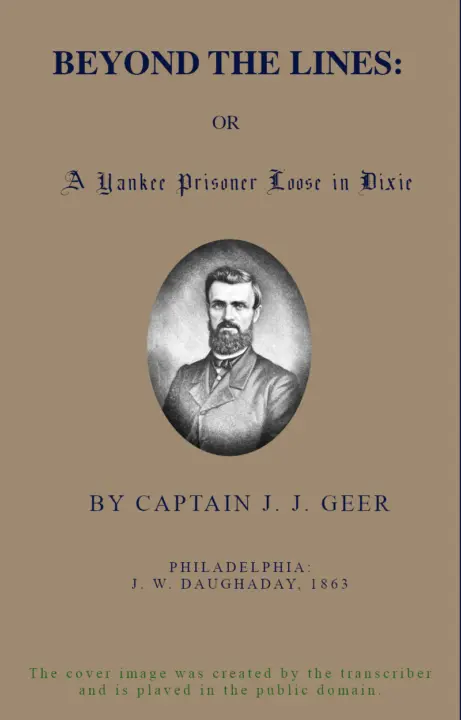
"Beyond the Lines; Or, A Yankee Prisoner Loose in Dixie" by John James Geer is a historical account written in the mid-19th century. The narrative details the experiences of Geer, a Union officer captured during the Civil War, as he recounts his struggles, sufferings, and eventual escape from Confederate captivity. The book offers a vivid insight into the realities faced by Union soldiers in the South, highlighting themes of bravery, survival, and the horrors of war. The opening of the narrative introduces us to Captain John J. Geer, who has recently left Camp Dennison with his regiment and is quickly thrust into battle at Shiloh, where he is captured. The tension of the battlefield is palpable as Geer describes witnessing the conflict and the suffering of civilians caught in the crossfire. Captured by rebel forces, he details the initial reactions of both the rebels, who are astonished to encounter a Union officer, and his own set of hardships as he faces threats from his captors. The early chapters set a dark tone, hinting at further trials ahead while establishing a framework for Geer's resilience and determination to escape.
Introduction adapted from the source catalogue; source summaries may be automatically generated.
Free to read · English · 57,584 words · No account needed
MAKE TIME FOR A GOOD BOOK
On by default. Untick to stop anonymous reading totals. Each page counts after 10 seconds in view. How this works.
Anonymous counting is on unless you have switched it off.
General Prentiss remained in close confinement until October 6th, and during the time he had been absent from our party. I had been taken with a severe illness, which obtained for me admission to a rear room of the prison, which was dignified by the name of a hospital. Here I enjoyed the privilege of drawing my allowance of corn-meal from the commissary, and taking it, or sending it, under guard, out to some one in the town, to have it cooked. I got a slave, called Aunt Susie, belonging to a widow, to attend to mine, and she did it well. I was forbidden to speak to her, however.
One day, Lieutenant Welsh came in with the report that Aunt Susie was having great trouble. I suspected the reason, but kept silent. The next day, feeling well enough, I obtained permission to take my own meal out to get it cooked. As it happened, two black boys were on guard, and one of these only accompanied me. He knew all about Aunt Susie’s sorrow, and, as he walked along, he said:
“Don’t b’lieve Aunt Susie ’ill be able to do your cookin’, sah.”
“Why?” asked I.
“Kase she’s in heaps o’ trouble, sah. You see, de sheriff sold her little boy an’ gal t’oder day, an’ she’s bin cryin’ eber since, as though her heart ’ud break.”
“Do you think that sale was right?” said I.
“Well, now, I guess I doesn’t, sah!” was the quick reply.
“Well, then, why are you in the army that supports such doings?”
“Ah, sah, dey makes me shoulder my gun, an’ dey makes me fire, sah; but dey can’t make me shoot low, so as to hit anybody. When I fire, sah, I shoots ober, d’ye understand, sah? I fires, but nobody gits hurt wid my ball, sah!”
“Well, why is it,” continued I, “that your masters mix you up with white soldiers? Why don’t they put all you blacks into regiments by yourselves?”
“Yah! yah! sah,” said the slave, “dey knows ’nuff better dan dat. Dey knows we’d fight t’odder way, if we got togedder. Yes, sah!”
By this time we reached Aunt Susie’s cabin, where I found the poor creature sitting an a stool, weeping bitterly. On her lap lay a little boy two years old, while by her knee stood another of four years.
When I entered the cabin, she sprang to her feet in an excited manner; but when she saw myself and guard, she became calmer.
“What is the matter, Aunt Susie?” I asked.
Your reading position is saved on this browser. Take it to another device with a library code. Reading pages adapt to text, rather than matching a printed edition.
BEHIND THE BOOK
This eBook is for the use of anyone anywhere in the United States and most other parts of the world at no cost and with almost no restrictions whatsoever. You may copy it, give it away or re-use it under the terms of the Project Gutenberg License included with this eBook or online at www.gutenberg.org. If you are not located in the United States, you will have to check the laws of the country where you are located before using this eBook. Read the source licence.
The original source file, including credits and licence, is retained by this library. Request an original-format copy at no charge. Please include the book title and Project Gutenberg identifier #63120.
KEEP YOUR CURIOSITY GOING
Cécile Tormay

Moritz Busch
John L. Ransom
Frances Wright
Cécile Tormay

Mabel Potter Daggett