
The story of Betty
Carolyn Wells
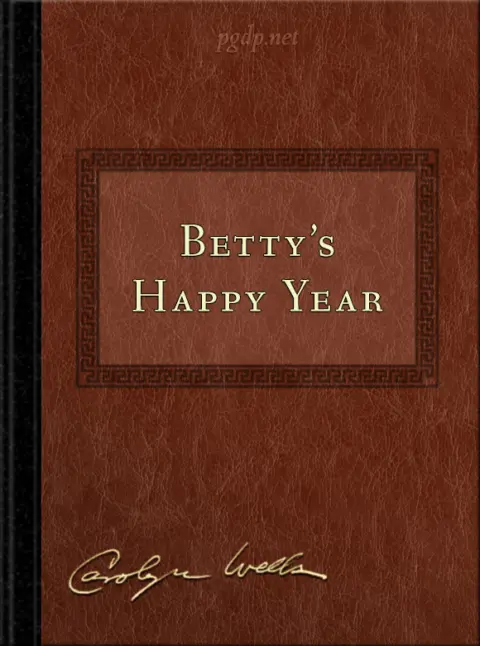
THE CLASSIC COLLECTION · 1909
"Betty's Happy Year" by Carolyn Wells is a novel written in the early 20th century. The story follows Betty McGuire, a joyful and spirited fifteen-year-old girl who recently inherited a fortune from her grandfather. Set against the backdrop of her new life at the beautiful summer home of Denniston, the narrative delves into her adventures with friends, family, and the various celebrations that punctuate her happy year, capturing the essence of youthful exuberance and the importance of relationships. The opening of the novel introduces the reader to Betty's excitement about her new sleigh and her joy of life in winter. As she prepares for a Thanksgiving party with her friends, the themes of friendship, social gatherings, and the happiness that comes from planning events begin to unfold. Betty's character is portrayed as lively and carefree, eager to involve her friends and family in her plans. The narrative sets the stage for not only the Thanksgiving celebration but also the dynamics of her relationships with her mother, her adopted brother Jack, and her friends, indicating the warmth and love that fill her life, alongside the adventures that are to come.
Introduction adapted from the source catalogue; source summaries may be automatically generated.
Free to read · English · 55,773 words · No account needed
MAKE TIME FOR A GOOD BOOK
On by default. Untick to stop anonymous reading totals. Each page counts after 10 seconds in view. How this works.
Anonymous counting is on unless you have switched it off.
As soon as June had fairly dawned upon the calendar, the girls of Miss Whittier’s school began to prepare for closing day.
It was customary to give an evening entertainment, in which all the
pupils took part.
“This year,” Miss Whittier announced to the class, “I have a very delightful plan, of which I will now tell you. It is not exactly a play, but a little staged allegory which I am sure you will all think very attractive.”
Betty listened eagerly, for “staged allegory” sounded rather dry and poky, and yet it might turn out to be fun after all.
“Sounds like ‘Pilgrim’s Progress,’” whispered Dorothy, who sat next her, and Betty’s imagination immediately saw all the girls with packs on their backs, climbing the Hill of Difficulty. But Miss Whittier went on to reveal her plan.
“It is called ‘Honor Chaplet,’” she said, “and it represents all the women who have done praiseworthy deeds presenting their claims for the Chaplet of Honor, which is to be awarded to the one who best merits it. Of course the characters represent women of all time who have become famous for great deeds or noble efforts.”
Betty’s head gave a nod of satisfaction. The whole plan appealed to her, for it meant “dressing up,” and she dearly loved to wear fancy costumes.
“We will have a pretty stage,” said Miss Whittier, who on occasions like this talked sociably with her pupils, “and I’m sure you will all be willing to help with the work of decorating it.”
“Yes, indeed,” and “We will,” said the girls, and then Constance Harper
asked:
“Who are the characters, Miss Whittier? Will you tell us now?”
Reading from some papers she held, Miss Whittier named about thirty celebrated women, including Cleopatra, Queen Elizabeth, Pocahontas, Grace Darling, Florence Nightingale, Isabella of Spain, Joan of Arc, Queen Victoria, Barbara Frietchie, Rosa Bonheur, and many others well known to history or tradition.
“I think,” she went on, “you may each select the character you prefer. If, by chance, two choose the same one, we can easily adjust matters afterward. I will distribute papers, and you may each write your own name, followed by the character you choose.”
“While we’re doing that, won’t you tell us a little more about the play, Miss Whittier?” said Dorothy Bates.
Your reading position is saved on this browser. Take it to another device with a library code. Reading pages adapt to text, rather than matching a printed edition.
Carolyn Wells

Carolyn Wells & Harry Persons Taber

Carolyn Wells

Carolyn Wells
BEHIND THE BOOK
This eBook is for the use of anyone anywhere in the United States and most other parts of the world at no cost and with almost no restrictions whatsoever. You may copy it, give it away or re-use it under the terms of the Project Gutenberg License included with this eBook or online at www.gutenberg.org. If you are not located in the United States, you will have to check the laws of the country where you are located before using this eBook. Read the source licence.
The original source file, including credits and licence, is retained by this library. Request an original-format copy at no charge. Please include the book title and Project Gutenberg identifier #45577.
KEEP YOUR CURIOSITY GOING
Coulson Kernahan

Maurice Baring
Frances Wright
Cécile Tormay

Frederic Jesup Stimson

W. H. P. (William Henry Pope) Jarvis