
The story of Betty
Carolyn Wells
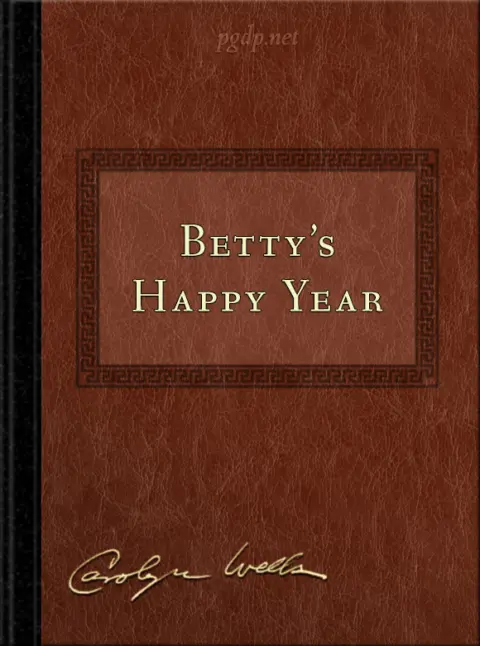
THE CLASSIC COLLECTION · 1909
"Betty's Happy Year" by Carolyn Wells is a novel written in the early 20th century. The story follows Betty McGuire, a joyful and spirited fifteen-year-old girl who recently inherited a fortune from her grandfather. Set against the backdrop of her new life at the beautiful summer home of Denniston, the narrative delves into her adventures with friends, family, and the various celebrations that punctuate her happy year, capturing the essence of youthful exuberance and the importance of relationships. The opening of the novel introduces the reader to Betty's excitement about her new sleigh and her joy of life in winter. As she prepares for a Thanksgiving party with her friends, the themes of friendship, social gatherings, and the happiness that comes from planning events begin to unfold. Betty's character is portrayed as lively and carefree, eager to involve her friends and family in her plans. The narrative sets the stage for not only the Thanksgiving celebration but also the dynamics of her relationships with her mother, her adopted brother Jack, and her friends, indicating the warmth and love that fill her life, alongside the adventures that are to come.
Introduction adapted from the source catalogue; source summaries may be automatically generated.
Free to read · English · 55,773 words · No account needed
MAKE TIME FOR A GOOD BOOK
On by default. Untick to stop anonymous reading totals. Each page counts after 10 seconds in view. How this works.
Anonymous counting is on unless you have switched it off.
“I don’t know, really,” said Ada, not unkindly, but entirely uninterested. “What classes are you in?”
“I don’t know,” said Betty, smiling at the absurdity of the conversation.
But Ada didn’t seem to think it humorous, and merely stared at Betty, as she said, “How queer!”
Betty colored. She felt awkward and tongue-tied, and yet, the more she realized her inability to impress these girls pleasantly, the more she determined to do so.
Then Betty bethought herself of a box of fine candies in her satchel, and taking it out, she passed it around to the other girls.
Murmuring conventional thanks, each accepted one bonbon, but declined a second one, and then Betty found herself with her box in her lap, gazing out of the window, as much alone as if there had been no one in the car.
But at last the three hours’ ride was over, and Betty’s hopeful nature looked forward to finding some among the pupils who would be more friendly than her traveling associates.
Omnibuses from the school met them at the station, and by chance Betty was put in with a dozen girls none of whom had been with her in the car.
But conditions were no better than before. They nodded diffidently to Betty, and then began to chatter to each other with the gay freedom of old acquaintances.
One girl, however, who sat opposite Betty, was also a new pupil. She had coal-black hair and bright black eyes, that darted quickly about, seeming to take in everything.
“You’re new, too, aren’t you?” she said at last, leaning over to seize
Betty’s hand.
“Yes,” replied Betty, grateful for the word spoken voluntarily to her.
“So am I. I think the other girls are hateful to ignore us so. But don’t you mind; we’ll show them!”
Though this was independence of spirit, Betty couldn’t quite approve of the way it was expressed, nor of the belligerent wag of the head with which it was emphasized.
But the girl’s attitude was friendly toward her, if rather hostile toward the others, and lonely little Betty yearned for friendliness.
“Well, you see, they all know each other,” she said, smiling at the black-eyed one; “that makes such a difference, and they’ve so much to tell.”
“All right; let us know each other, then. My name’s Madeleine Gorman;
what’s yours?”
“Betty McGuire,” said Betty, smiling into the friendly eyes.
“Betty! My, you are new! You must call yourself Elizabeth up here.
Nicknames don’t go.”
“Well, I’d just as lief be called Elizabeth; I don’t mind. But I’m Betty
at home.”
Your reading position is saved on this browser. Take it to another device with a library code. Reading pages adapt to text, rather than matching a printed edition.
Carolyn Wells

Carolyn Wells & Harry Persons Taber

Carolyn Wells

Carolyn Wells
BEHIND THE BOOK
This eBook is for the use of anyone anywhere in the United States and most other parts of the world at no cost and with almost no restrictions whatsoever. You may copy it, give it away or re-use it under the terms of the Project Gutenberg License included with this eBook or online at www.gutenberg.org. If you are not located in the United States, you will have to check the laws of the country where you are located before using this eBook. Read the source licence.
The original source file, including credits and licence, is retained by this library. Request an original-format copy at no charge. Please include the book title and Project Gutenberg identifier #45577.
KEEP YOUR CURIOSITY GOING
Coulson Kernahan

Maurice Baring
Frances Wright
Cécile Tormay

Frederic Jesup Stimson

W. H. P. (William Henry Pope) Jarvis