
The story of Betty
Carolyn Wells
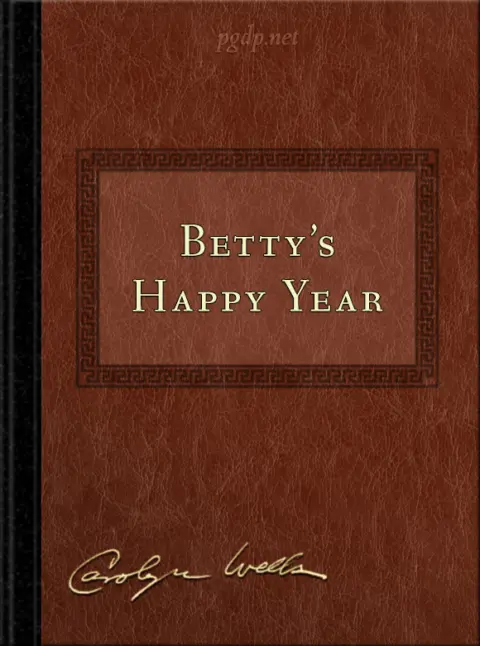
THE CLASSIC COLLECTION · 1909
"Betty's Happy Year" by Carolyn Wells is a novel written in the early 20th century. The story follows Betty McGuire, a joyful and spirited fifteen-year-old girl who recently inherited a fortune from her grandfather. Set against the backdrop of her new life at the beautiful summer home of Denniston, the narrative delves into her adventures with friends, family, and the various celebrations that punctuate her happy year, capturing the essence of youthful exuberance and the importance of relationships. The opening of the novel introduces the reader to Betty's excitement about her new sleigh and her joy of life in winter. As she prepares for a Thanksgiving party with her friends, the themes of friendship, social gatherings, and the happiness that comes from planning events begin to unfold. Betty's character is portrayed as lively and carefree, eager to involve her friends and family in her plans. The narrative sets the stage for not only the Thanksgiving celebration but also the dynamics of her relationships with her mother, her adopted brother Jack, and her friends, indicating the warmth and love that fill her life, alongside the adventures that are to come.
Introduction adapted from the source catalogue; source summaries may be automatically generated.
Free to read · English · 55,773 words · No account needed
MAKE TIME FOR A GOOD BOOK
On by default. Untick to stop anonymous reading totals. Each page counts after 10 seconds in view. How this works.
Anonymous counting is on unless you have switched it off.
“We seem to be irrevocably fated, don’t we?”
“I’m satisfied to have it so,” he replied gallantly, making a gesture like a real stage suitor; and Betty returned saucily:
“So am I—during supper-time!”
After supper they assembled in the “black room” for a fagot party.
The screen was removed from the blazing wood fire, and all sat on the floor, or on cushions or ottomans clustered round the big fireplace.
Each was given a “fagot,” a bundle of tiny sticks tied together with red and black ribbons, and each, in turn, threw the fagot into the fire. While the fagot burned, the thrower was to tell a ghost story, which must stop as soon as the sticks were entirely consumed.
This was a most exasperating performance, for in nearly every instance, just as the thrilling climax of the story was nearly reached, the sticks burned out, and the narrator was not allowed to proceed.
Hal Pennington’s was one of the most interesting.
“Mine is a fearful tale,” he said, as he threw his fagot on the fire, “and I will tell it rapidly that you may all hear the marvelous and almost incredible dénouement.”
The others crowded closer to hear, for Hal spoke in low, mysterious
tones.
“It was a house up on Cape Cod,” he began, “an old-fashioned, rambling sort of house, that was said to be haunted. It had long borne this reputation, and one room in particular, a small room at the end of a long ball-room, was said to be the room where the ghost appeared. The people who told about it always shuddered, and refused to tell what horrible shapes the ghost assumed when it made itself visible.”
Harry Harper gave a scared sort of gasping groan, and then the other boys groaned dismally, while the girls shivered and giggled both at once.
“A lot of us fellows,” went on Hal, “didn’t believe in this ghost, and we decided to spend a night in the old house and test it.”
“Did no one live in the house?” asked Betty.
“Oh, no; it hadn’t been occupied for years, because of the ghost. Well, eight of us went there one evening, and one, Phil Hardy, said he would go into the haunted room and lock himself in, and we others must keep watch in the ball-room.”
“Why did he lock himself in?” asked Lena.
Your reading position is saved on this browser. Take it to another device with a library code. Reading pages adapt to text, rather than matching a printed edition.
Carolyn Wells

Carolyn Wells & Harry Persons Taber

Carolyn Wells

Carolyn Wells
BEHIND THE BOOK
This eBook is for the use of anyone anywhere in the United States and most other parts of the world at no cost and with almost no restrictions whatsoever. You may copy it, give it away or re-use it under the terms of the Project Gutenberg License included with this eBook or online at www.gutenberg.org. If you are not located in the United States, you will have to check the laws of the country where you are located before using this eBook. Read the source licence.
The original source file, including credits and licence, is retained by this library. Request an original-format copy at no charge. Please include the book title and Project Gutenberg identifier #45577.
KEEP YOUR CURIOSITY GOING
Coulson Kernahan

Maurice Baring
Frances Wright
Cécile Tormay

Frederic Jesup Stimson

W. H. P. (William Henry Pope) Jarvis