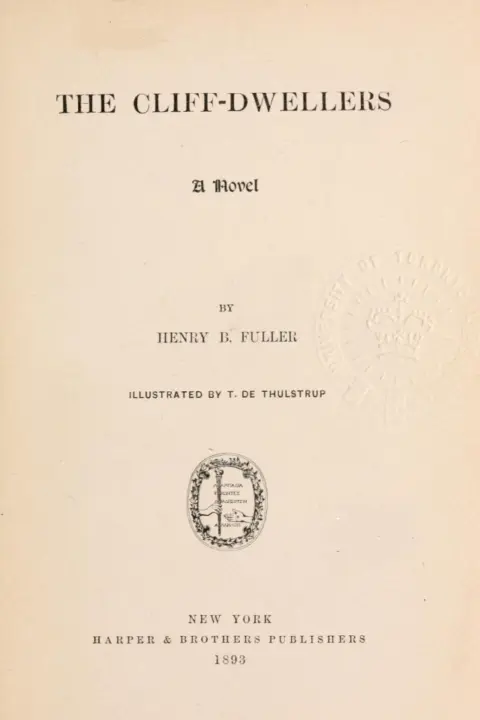
The Cliff-Dwellers: A Novel
Henry Blake Fuller
THE CLASSIC COLLECTION · 1919
"Bertram Cope's Year" by Henry Blake Fuller is a novel published in 1919, sometimes called the first American homosexual novel. Set at a Midwestern university, it follows an attractive young English instructor navigating the attentions of wealthy patrons—both male and female—while completing his thesis. Fuller's understated, ironic approach depicts what one critic called "normative homosexuality" with delicate restraint, allowing his characters to move through their world with surprising ease. The novel's subtle treatment of taboo themes initially baffled reviewers and readers, leaving its deeper meanings hidden to those without the key.
Introduction adapted from the source catalogue; source summaries may be automatically generated.
Free to read · English · 71,715 words · No account needed
MAKE TIME FOR A GOOD BOOK
On by default. Untick to stop anonymous reading totals. Each page counts after 10 seconds in view. How this works.
Anonymous counting is on unless you have switched it off.
"It was an afternoon in Lesbos--with Sappho and her band of appreciative maidens. Phaon, a poor lad of nineteen, swept some pamphlets and paper-cutters off the center-table, and we all plunged into the ocean of Oolong--the best thing we do on this island...."
He was lingering in a smiling abstractedness on his fancy, when--
"Bertram Cope!" a voice suddenly said, "do you do nothing--nothing?"
He suddenly came to. Perhaps he had really deserved his hostess' rebuke. He had not offered to help with the tea-service; he had proferred no appropriate remark, of an individual nature, to any of the three ancillae....
"I mean," proceeded Mrs. Phillips, "can you do nothing whatever to
entertain?"
Cope gained another stage on the way to self-consciousness and
self-control. Entertainment was doubtless the basic curse of this
household.
"I sing," he said, with naïf suddenness and simplicity.
"Then, sing--do. There's the open piano. Can you play your own
accompaniments?"
"Some of the simpler ones."
"Some of the simpler ones! Do you hear that, girls? He is quite prepared to wipe us all out. Shall we let him?"
"That's unfair," Cope protested. "Is it my fault if composers will write hard accompaniments to easy airs?"
"Will you sing before your tea, or after it?"
"I'm ready to sing this instant,--during it, or before it."
"Very well."
The room was now in dusk, save for the bulbs which made the portrait shine forth like a wayside shrine. Roddy, the possible sophomore, helped a maid find places for the cups and saucers; and the three girls, still formed in a careful group about the sofa, silently waited.
"Of course you realize that this is not such a very large room," said
Mrs. Phillips.
"Meaning....?"
"Well, your speaking voice is resonant, you know."
"Meaning, then, that I am not to raise the roof nor jar the china. I'll
try not to."
Nor did he. He sang with care rather than with volume, with discretion rather than with abandon. The "simple accompaniments" went off with but a slight hitch or two, yet the "resonant voice" was somehow, somewhere lost. Possibly Cope gave too great heed to his hostess' caution; but it seemed as if a voice essentially promising had slipped through some teacher's none too competent hands, or--what was quite as serious--as if some temperamental brake were operating to prevent the complete expression of the singer's nature. Lassen, Grieg, Rubinstein--all these were carried through rather cautiously, perhaps a little mechanically; and there was a silence. Hortense broke it.
"Parnassus, yes. And finally comes Apollo." She reached over and murmured to Mrs. Phillips: "None too skillful on the lyre, and none too strong in the lungs...."
Your reading position is saved on this browser. Take it to another device with a library code. Reading pages adapt to text, rather than matching a printed edition.
Henry Blake Fuller
Henry Blake Fuller
Henry Blake Fuller
Henry Blake Fuller
BEHIND THE BOOK
This eBook is for the use of anyone anywhere in the United States and most other parts of the world at no cost and with almost no restrictions whatsoever. You may copy it, give it away or re-use it under the terms of the Project Gutenberg License included with this eBook or online at www.gutenberg.org. If you are not located in the United States, you will have to check the laws of the country where you are located before using this eBook. Read the source licence.
The original source file, including credits and licence, is retained by this library. Request an original-format copy at no charge. Please include the book title and Project Gutenberg identifier #8101.
KEEP YOUR CURIOSITY GOING
Coulson Kernahan

Maurice Baring
Frances Wright
Cécile Tormay

Frederic Jesup Stimson

W. H. P. (William Henry Pope) Jarvis