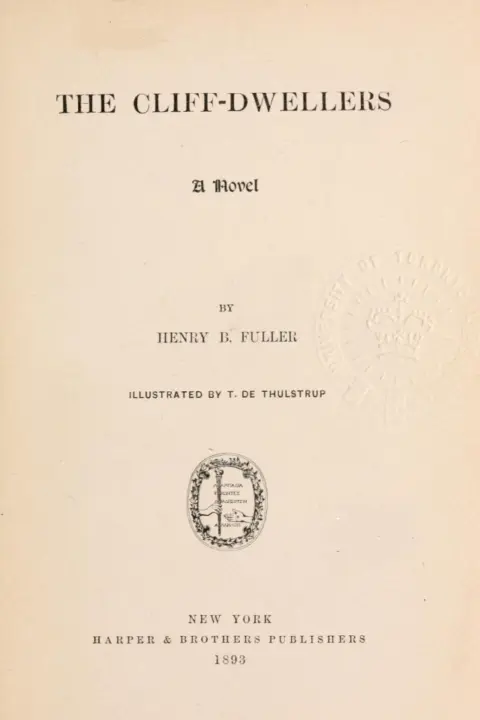
The Cliff-Dwellers: A Novel
Henry Blake Fuller
THE CLASSIC COLLECTION · 1919
"Bertram Cope's Year" by Henry Blake Fuller is a novel published in 1919, sometimes called the first American homosexual novel. Set at a Midwestern university, it follows an attractive young English instructor navigating the attentions of wealthy patrons—both male and female—while completing his thesis. Fuller's understated, ironic approach depicts what one critic called "normative homosexuality" with delicate restraint, allowing his characters to move through their world with surprising ease. The novel's subtle treatment of taboo themes initially baffled reviewers and readers, leaving its deeper meanings hidden to those without the key.
Introduction adapted from the source catalogue; source summaries may be automatically generated.
Free to read · English · 71,715 words · No account needed
MAKE TIME FOR A GOOD BOOK
On by default. Untick to stop anonymous reading totals. Each page counts after 10 seconds in view. How this works.
Anonymous counting is on unless you have switched it off.
"There!" said Mrs. Phillips, at its close. "Isn't it too sweet? And it inspired Carolyn too. She wrote a poem after hearing it."
"A copy of verses," corrected Carolyn, with a modest catch in her breath. She was a quiet, sedate girl, with brown eyes and hair. Her eyes were shy, and her hair was plainly dressed.
"Oh, you're so sweet, so old-fashioned!" protested Mrs. Phillips, slightly rolling her eyes. "It's a poem,--of course it's a poem. I leave it to Mr. Cope, if it isn't!"
"Oh, I beg--" began Cope, in trepidation.
"Well, listen, anyway," said Medora.
The poem consisted of some six or seven brief stanzas. Its title was read, formally, by the writer; and, quite as formally, the dedication which intervened between title and first stanza,--a dedication to "Medora Townsend Phillips."
"Of course," said Cope to himself. And as the reading went on, he ran his eyes over the dusky, darkening walls. He knew what he expected to find.
Just as he found it the sophomore standing between the big padded chair and the book-case spatted his hands three times. The poem was over, the patroness duly celebrated. Cope spatted a little too, but kept his eye on one of the walls.
"You're looking at my portrait!" declared Mrs. Phillips, as the poetess sank deeper into the big chair. "Hortense did it."
"Of course she did," said Cope under his breath. He transferred an obligatory glance from the canvas to the expectant artist. But--
"It's getting almost too dark to see it," said his hostess, and suddenly pressed a button. This brought into play a row of electric bulbs near the top edge of the frame and into full prominence the dark plumpness of the subject. He looked back again from the painter (who also had black hair and eyes) to her work.
"I am on Parnassus!" Cope declared, in one general sweeping compliment, as he looked toward the sofa where Medora Phillips sat with the three girls now grouped behind her. But he made it a boreal Parnassus--one set in relief by the cold flare and flicker of northern lights.
"Isn't he the dear, comical chap!" exclaimed Mrs. Phillips, with unction, glancing upward and backward at the girls. They smiled discreetly, as if indulging in a silent evaluation of the sincerity of the compliment. Yet one of them--Hortense--formed her black brows into a frown, and might have spoken resentfully, save for a look from their general patroness.
"Meanwhile, how about a drop of tea?" asked Mrs. Phillips suddenly. "Roddy"--to the sophomore--"if you will help clear that table...."
The youth hastened to get into action. Cope went on with his letter to
"Arthur":
Your reading position is saved on this browser. Take it to another device with a library code. Reading pages adapt to text, rather than matching a printed edition.
Henry Blake Fuller
Henry Blake Fuller
Henry Blake Fuller
Henry Blake Fuller
BEHIND THE BOOK
This eBook is for the use of anyone anywhere in the United States and most other parts of the world at no cost and with almost no restrictions whatsoever. You may copy it, give it away or re-use it under the terms of the Project Gutenberg License included with this eBook or online at www.gutenberg.org. If you are not located in the United States, you will have to check the laws of the country where you are located before using this eBook. Read the source licence.
The original source file, including credits and licence, is retained by this library. Request an original-format copy at no charge. Please include the book title and Project Gutenberg identifier #8101.
KEEP YOUR CURIOSITY GOING
Coulson Kernahan

Maurice Baring
Frances Wright
Cécile Tormay

Frederic Jesup Stimson

W. H. P. (William Henry Pope) Jarvis