THE CLASSIC COLLECTION✦A journey to Central AfricaCLASSIC FREE BOOKS
A journey to Central Africa
Bayard Taylor
THE CLASSIC COLLECTION · 1872
"Beauty and the Beast" by Bayard Taylor is a novel that intertwines fact and fancy, presenting a narrative set in mid-19th century Russia. The story engages with themes of love, power dynamics, and societal customs, focused on the characters of Prince Alexis, his wife Princess Martha, and their son Prince Boris. It explores the complexities of their lives within the context of Russian nobility and serfdom, revealing the interpersonal struggles and emotions that shape their world. The opening portion introduces us to Kinesma, a town on the Volga, where Prince Alexis finds himself in turmoil over a postponed dinner. His comedic insistence on avoiding a festival for his son leads to a series of events involving a drunken bear and a harried court-poet, setting the stage for the whimsical yet dark environment of the castle. As the narrative unfolds, we witness the egocentric behaviors of Alexis, the meekness of Princess Martha, and the cowardly nature of Boris, all richly painted against the backdrop of Russian culture and humor. The tone oscillates between severe brutality and lighthearted farce, foreshadowing the transformations that will occur as their lives progress.
Introduction adapted from the source catalogue; source summaries may be automatically generated.
Free to read · English · 85,672 words · No account needed
MAKE TIME FOR A GOOD BOOK
On by default. Untick to stop anonymous reading totals. Each page counts after 10 seconds in view. How this works.
Anonymous counting is on unless you have switched it off.
“I will go on with my mowing,” said she, when they reached the horses, “and you can rake and load with my father. What name shall I call you by?”
“Everybody calls me Jake.”
“'Jake!' Jacob is better. Well, Jacob, I hope you'll give us all the
help you can.”
With a nod and a light laugh she sprang upon the machine. There was a sweet throb in Jacob's heart, which, if he could have expressed it, would have been a triumphant shout of “I'm not afraid of her! I'm not afraid of her!”
The farmer was a kindly, depressed man, with whose quiet ways Jacob instantly felt himself at home. They worked steadily until sunset, when the girl, detaching her horses from the machine, mounted one of them and led the other to the barn. At the supper-table, the farmer's wife said: “Susan, you must be very tired.”
“Not now, mother!” she cheerily answered. “I was, I think, but after I picked up Jacob I felt sure we should get our hay in.”
“It was a good thing,” said the farmer; “Jacob don't need to be told how
to work.”
Poor Jacob! He was so happy he could have cried. He sat and listened, and blushed a little, with a smile on his face which it was a pleasure to see. The honest people did not seem to regard him in the least as a stranger; they discussed their family interests and troubles and hopes before him, and in a little while it seemed as if he had known them always.
How faithfully he worked! How glad and tired he felt when night came, and the hay-mow was filled, and the great stacks grew beside the barn! But ah! the haying came to an end, and on the last evening, at supper, everybody was constrained and silent. Even Susan looked grave and thoughtful.
“Jacob,” said the farmer, finally, “I wish we could keep you until wheat harvest; but you know we are poor, and can't afford it. Perhaps you could--”
He hesitated; but Jacob, catching at the chance and obeying his own unselfish impulse, cried: “Oh, yes, I can; I'll be satisfied with my board, till the wheat's ripe.”
Susan looked at him quickly, with a bright, speaking face. “It's hardly fair to you,” said the farmer.
“But I like to be here so much!” Jacob cried. “I like--all of you!”
“We DO seem to suit,” said the farmer, “like as one family. And that reminds me, we've not heard your family name yet.”
“Flint.”
“Jacob FLINT!” exclaimed the farmer's wife, with sudden agitation.
Your reading position is saved on this browser. Take it to another device with a library code. Reading pages adapt to text, rather than matching a printed edition.
Bayard Taylor
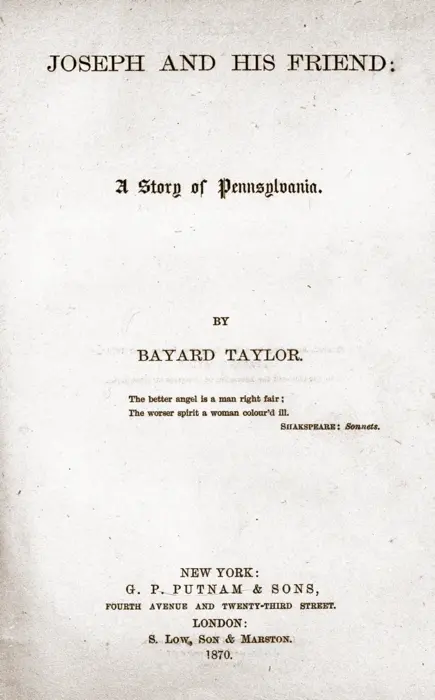
Bayard Taylor
Bayard Taylor
Bayard Taylor
BEHIND THE BOOK
This eBook is for the use of anyone anywhere in the United States and most other parts of the world at no cost and with almost no restrictions whatsoever. You may copy it, give it away or re-use it under the terms of the Project Gutenberg License included with this eBook or online at www.gutenberg.org. If you are not located in the United States, you will have to check the laws of the country where you are located before using this eBook. Read the source licence.
The original source file, including credits and licence, is retained by this library. Request an original-format copy at no charge. Please include the book title and Project Gutenberg identifier #292.
KEEP YOUR CURIOSITY GOING
Coulson Kernahan

Maurice Baring
Frances Wright
Cécile Tormay

Frederic Jesup Stimson

W. H. P. (William Henry Pope) Jarvis