
Letters to a Friend, Written to Mrs. Ezra S. Carr, 1866-1879
John Muir
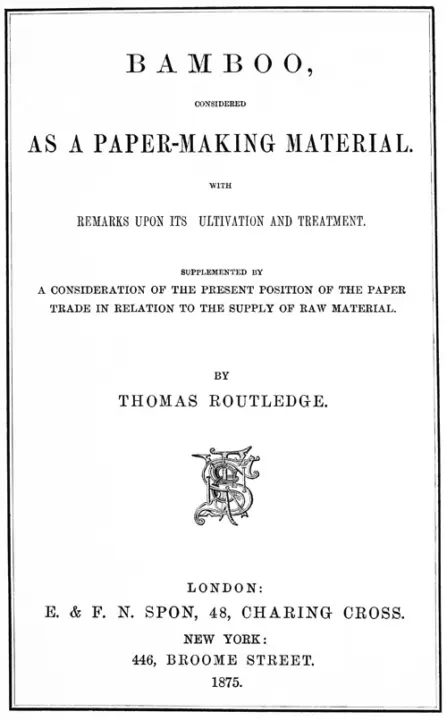
THE CLASSIC COLLECTION · 1875
"Bamboo, Considered as a Paper-making Material" by Thomas Routledge is a scientific publication written in the late 19th century. The book examines the potential of bamboo as a sustainable and economically viable raw material for the paper-making industry, emphasizing its cultivation and processing methods. Routledge argues that bamboo can meet the growing demands for paper due to its rapid growth, high yield, and low cost compared to traditional fibers. In this detailed treatise, Routledge discusses the characteristics of bamboo, including its growth patterns and the chemistry involved in converting it into paper stock. He stresses the importance of harvesting bamboo at an early stage to utilize its fibrous properties before it becomes too woody. Additionally, the book outlines a systematic approach to processing bamboo into paper stock, advocating for a production model that leverages its abundant availability in suitable climates. By juxtaposing bamboo with other fibrous plants like esparto, the author presents a compelling case for its adoption in the paper industry, predicting a significant shift toward this environmentally friendly and efficient source of material.
Introduction adapted from the source catalogue; source summaries may be automatically generated.
Free to read · English · 8,832 words · No account needed
MAKE TIME FOR A GOOD BOOK
On by default. Untick to stop anonymous reading totals. Each page counts after 10 seconds in view. How this works.
Anonymous counting is on unless you have switched it off.
I have confined myself to recapitulating a few only of the fibres in either class, best known to commerce; this list, indeed, might be extended almost indefinitely, as may be seen by reference to the work before alluded to, 'The Fibrous Plants of India,' by Dr. Forbes Royle, as also to the elaborate Paper on the same subject, read at the meeting of the Society of Arts, May 9, 1860, by Dr. J. Forbes Watson, Reporter on the Products of India, Dr. Royle's able successor.
With some few exceptions (notably "Esparto" and some of the Cereal straws and grasses), the resulting or ultimate fibres from vegetable fibrous plants, before they can be utilized either for Textile purposes, or for the manufacture of Paper, must be freed from the extraneous substances with which during their growth they are more or less combined.
In the case of Endogens, the fibres are imbedded or enveloped in succulent, fleshy, or pulpy stems, or leaves; and in the case of Exogens, the fibre is combined with, and attaching to, wood, or woody matter, such extraneous substances or matters constituting, more or less, a considerable portion both of the weight and bulk of the plant even when matured.
From all, or nearly all, Endogenous plants the fibres are extracted by hand labour, no machinery having been hitherto invented by which this operation can be performed in an economical and satisfactory manner.
The fleshy stems, or leaves, of this class of plants are crushed and beaten, macerated in water, scraped and roughly combed, to separate the fibrous from the vascular, or pulpy portion of the plant; sometimes the plants are buried in wet sand, or mud, leaving them to soak, or rot, for many days, then beaten on a stone, scraped, and combed; but by this system the fibres generally lose colour and strength. The yield of fibre from this class of Endogens ranges from 6 to 12 per cent., and it is only where native labour is exceedingly cheap and abundant that such a laborious and tedious process could be carried on.
The majority of the fibres from Exogenous plants are also, in somewhat a similar manner obtained solely by manual labour; the herbaceous, or woody stems of such plants, being first steeped, or retted, to induce partial fermentation, and facilitate the separation of the corticular fibres, from the woody stem.
When produced in Europe, Flax and Hemp form an exception, being generally dried before steeping, which process is also more systematically and regularly conducted, and the subsequent separation of the ultimate fibres effected by breaking, scutching, and heckling; these operations being as far as possible carried out mechanically.
Your reading position is saved on this browser. Take it to another device with a library code. Reading pages adapt to text, rather than matching a printed edition.
BEHIND THE BOOK
This eBook is for the use of anyone anywhere in the United States and most other parts of the world at no cost and with almost no restrictions whatsoever. You may copy it, give it away or re-use it under the terms of the Project Gutenberg License included with this eBook or online at www.gutenberg.org. If you are not located in the United States, you will have to check the laws of the country where you are located before using this eBook. Read the source licence.
The original source file, including credits and licence, is retained by this library. Request an original-format copy at no charge. Please include the book title and Project Gutenberg identifier #54090.
KEEP YOUR CURIOSITY GOING
John Muir

Asa Gray
Asa Gray

Florence Nightingale
Elizabeth Robins Pennell
Denison Olmsted